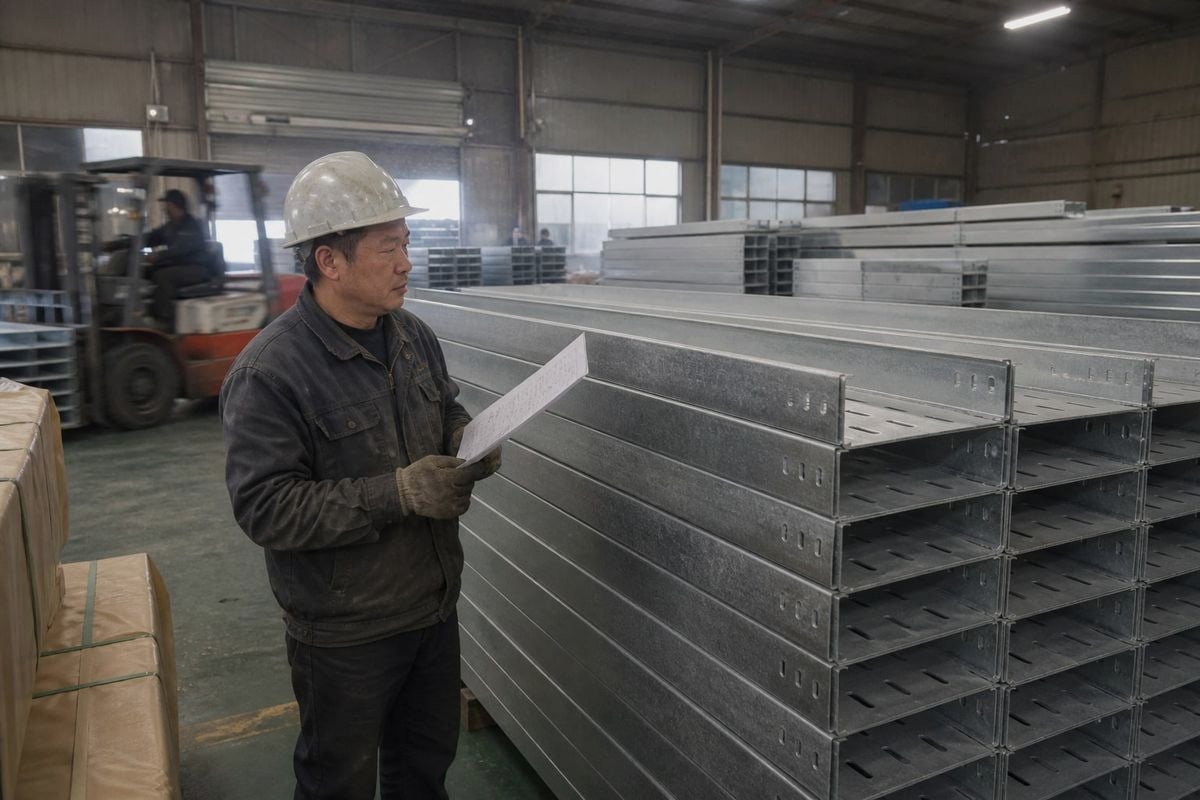
Buyers often ask me why their cable trays rust within two years. On our production line in Tai’an, hot dipped galvanized perforated cable tray solves exactly that problem.
Hot dipped galvanized perforated cable tray, also called GI cable tray, is a U-shaped steel tray with a slotted base and side rails, dipped in molten zinc after fabrication. The zinc coating, typically over 65μm thick, delivers long-term corrosion resistance, heat dissipation, and easy cable fixing.
That is the short answer. But the details matter when you specify one for a real project. Let me walk you through the coating, the perforation patterns, the fit, and the quality checks.
How Does Hot Dip Galvanizing Improve My Cable Tray’s Corrosion Resistance?
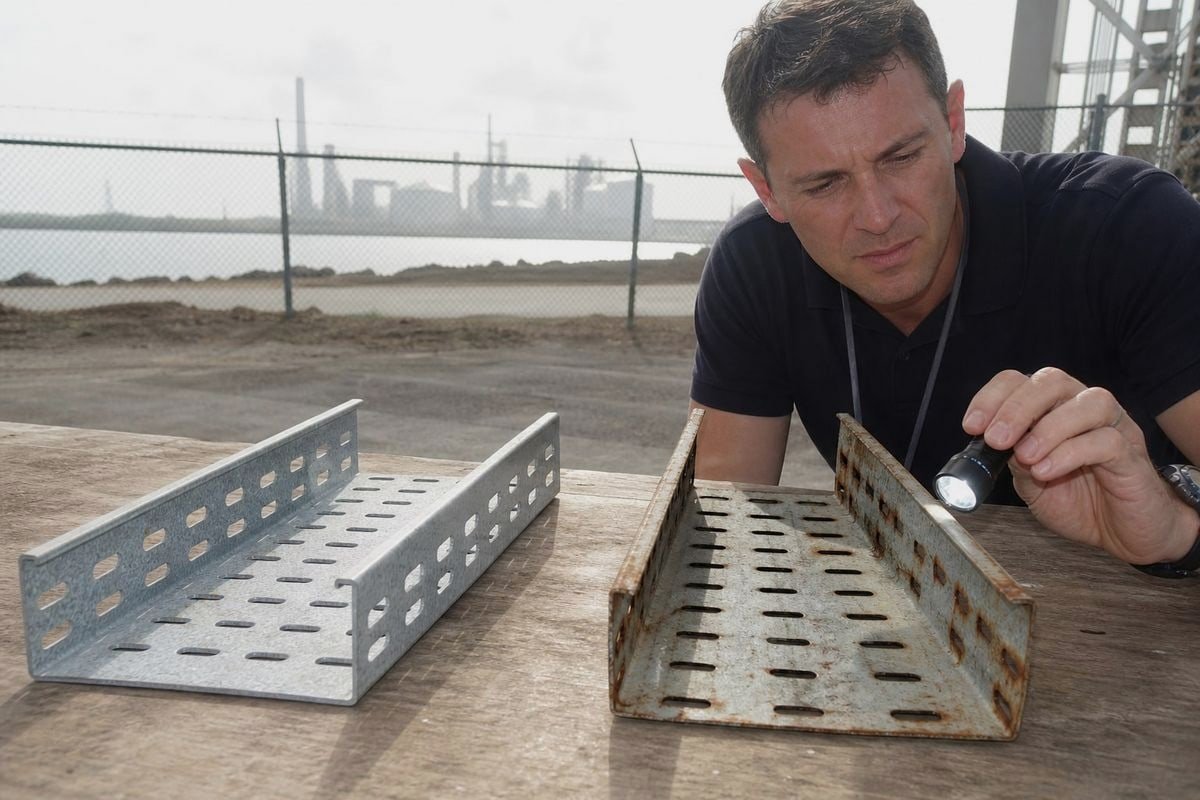
Last year, a water treatment contractor sent me photos of pre-galvanized trays with rusty cut edges after eighteen months. That single image explains why our export orders keep specifying hot dip galvanizing.
Hot dip galvanizing immerses the finished tray in a molten zinc bath, coating every surface, hole edge, and weld point with a zinc-iron alloy layer over 65μm thick. The zinc corrodes sacrificially before the steel, so even scratched trays stay protected for decades.
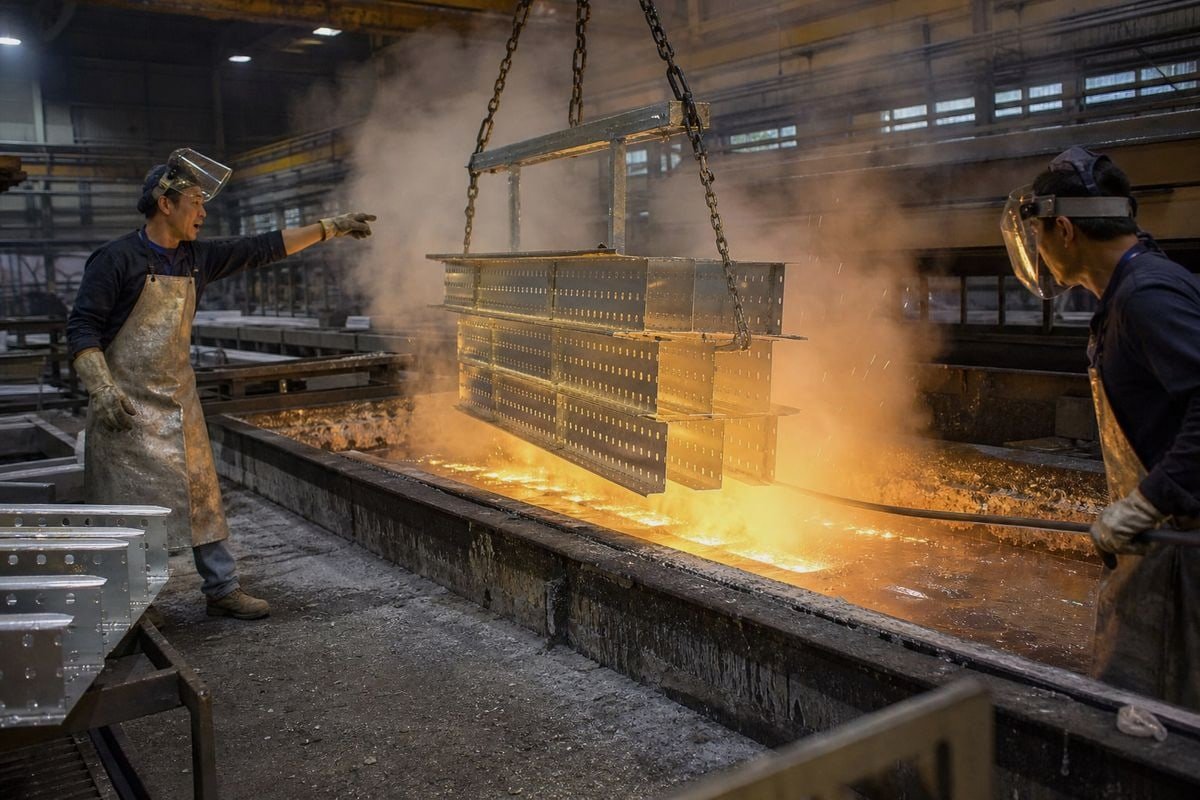
The sequence of the process is what makes the difference. With hot dip galvanizing, we cut, punch, and weld the tray first. Only then does the whole assembly go into the molten zinc bath. So every exposed steel point — including the inside edges of hundreds of perforations — gets covered. Pre-galvanized steel works the other way around. The sheet is coated first, then cut and punched. Every cut leaves bare steel behind, and that is where “edge-creep” corrosion starts.
Why the Zinc Layer Works Two Ways
The zinc coating protects your tray through two mechanisms:
- Barrier protection. The zinc-iron alloy layer physically seals the steel from moisture, salt, and chemicals.
- Sacrificial protection. Zinc is more reactive than steel. If the coating gets deeply scratched during installation, the surrounding zinc corrodes first and keeps the exposed steel safe.
There is a third benefit that buyers rarely mention until they hit thermal cycling problems. The metallurgical bond 1 between zinc and steel means the coating expands and contracts at nearly the same rate as the substrate. The layer does not flake or delaminate under outdoor temperature swings or seismic stress.
Pre-Galvanized Comparison at a Glance
| Feature | Hot Dipped Galvanized | Pre-Galvanized |
|---|---|---|
| Coating applied | After fabrication | Before cutting and punching |
| Typical zinc coating thickness 2 | 65–120μm | 15–25μm |
| Hole and cut-edge protection | Fully coated | Bare steel exposed |
| Best environments | Outdoor, coastal, chemical, industrial environments | Dry indoor use |
| Surface finish | Slightly rougher, matte gray | Smoother, more uniform |
One honest trade-off: electro-galvanized and pre-galvanized finishes look smoother and more uniform. If your project is a dry, air-conditioned indoor space and aesthetics matter, they can be acceptable. But for humid, coastal, or industrial environments, the thicker zinc coating of hot dip galvanizing is the standard choice, and it usually costs far less than jumping to stainless steel.
What Perforation Patterns Should I Choose for Better Ventilation and Cable Support?
When we punch tray bases at our workshop, the most common pattern by far is the elongated slot hole. There is a practical reason for that, and it goes beyond airflow.
Choose elongated slot perforations in staggered parallel rows for most projects. Slots allow air convection for heat dissipation, accept standard cable ties for direct fixing, drain water in wet areas, and keep enough solid metal for load bearing capacity and EMI shielding.
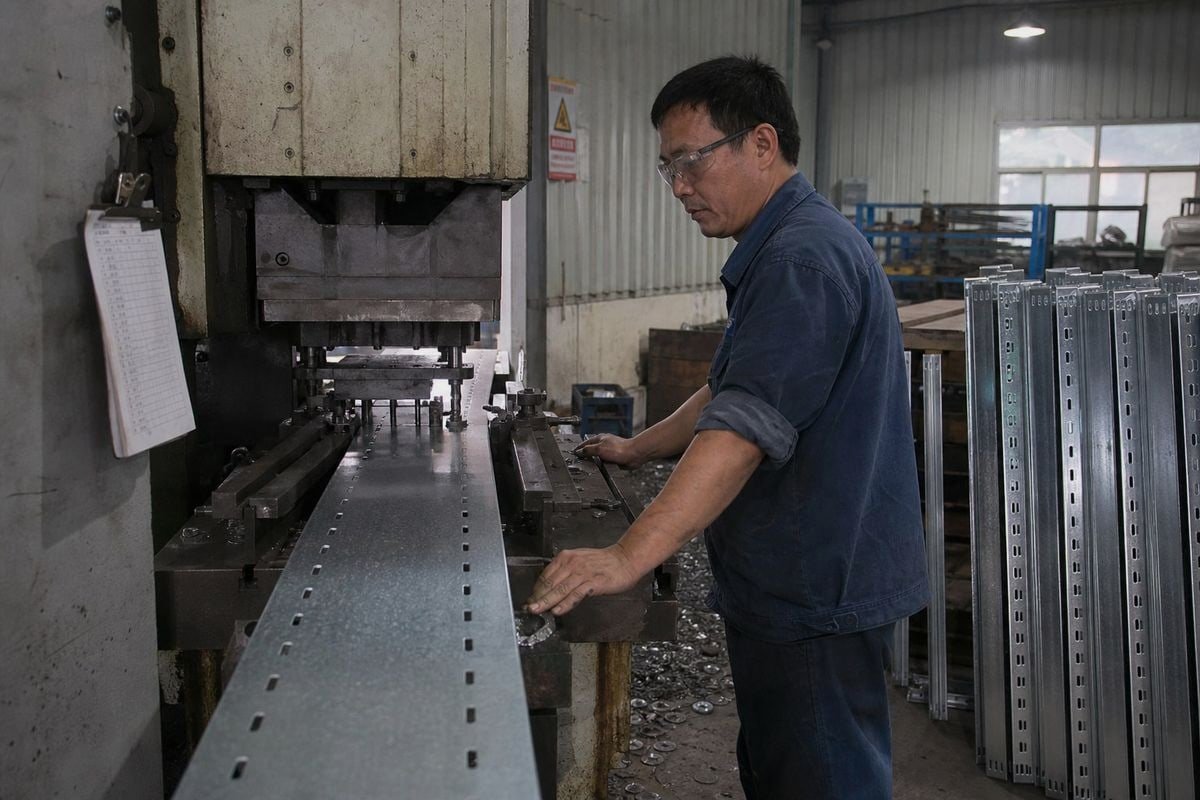
The holes are not decoration. They give a perforated tray 3 a performance mix that neither a ladder tray nor a fully enclosed trunking can match. Power cables generate heat under load. In a solid-bottom trunking, that heat builds up and forces you to derate the cable’s current capacity. The perforations open natural convection paths, so heat escapes and the derating factor drops significantly.
Four Jobs the Perforations Do
- Heat dissipation. Air flows through the slots, cooling power cables and protecting current ratings.
- Cable fixing. You pass a cable tie straight through a slot and lock the cable in place. This is faster and neater than managing loose runs inside enclosed trunking.
- Drainage. In washdown areas or outdoor runs, slots stop water and dust from pooling around cables.
- EMI shielding. The perforated metal base still acts as a partial Faraday cage. It suppresses electromagnetic interference better than an open-rung ladder tray does.
Pattern Options We Produce
| Pattern | Open Area | Best For | Trade-Off |
|---|---|---|---|
| Elongated slots, staggered rows | Medium | General power and control cables | Balanced all-rounder |
| Round holes, dense grid | Low–medium | Heavier loads, more shielding | Less airflow |
| Wide oval slots | High | Hot, dense power runs | Slightly lower stiffness |
| Slotted base plus perforated side walls | Highest | Outdoor solar and coastal runs | Less dust protection |
Be honest about the limits, though. A perforated tray cannot fully seal out dust, water, or small animals entering from below. If your client demands total enclosure, specify trunking with a solid cover instead. For everything in between — which is most industrial cable management system work — the slotted base wins.
How Do I Know If Hot Dipped Galvanized Perforated Cable Tray Fits My Project Requirements?
A project director in Singapore once asked me a blunt question over WhatsApp: “Lily, ladder or perforated for my coastal plant?” My answer depended entirely on his cables and his environment, and yours will too.
Hot dipped galvanized perforated cable tray fits projects needing corrosion protection plus heat dissipation: chemical plants, water treatment works, coastal outdoor runs, and solar farms. Choose it when cables need tie-down fixing, drainage, and lighter tray weight than ladder systems on long spans.
The simplest way to decide is to match the tray type to the environment and the cable load. Here is the framework I use when quoting EPC projects across Southeast Asia and South America.
Environment First, Then Cables
Ask where the tray will live for the next thirty years:
- Chemical plants, paper mills, water treatment plants. Mildly corrosive and humid. Perforated GI tray gives corrosion resistance plus tie-down points and drainage. Strong fit.
- Coastal outdoor cable routes. Salt air attacks thin coatings fast. The thick zinc layer handles it, and the slots shed rainwater. Strong fit.
- Data centers. Here hot dip galvanizing has a hidden advantage: it virtually eliminates zinc whiskers, the microscopic conductive filaments that grow on electroplated finishes and can cause catastrophic short circuits in sensitive equipment.
- Extreme chemical exposure. Stainless steel outperforms galvanized steel here. HDG is the economical middle ground, not the ceiling.
Weight and Structure
Compared with a cable ladder of the same width, a perforated tray is lighter. That lowers the demand on your support brackets and building steel. For rooftop solar arrays and light-gauge structures, this matters. The continuous zinc-coated metal body also serves as a low-impedance grounding path along the run, which helps protect signal cables from adjacent power line noise.
There is a lifecycle angle worth raising with clients too. A maintenance-free service life of thirty years or more in corrosive settings means fewer replacements, less site labor, and a lower total carbon footprint than cheaper finishes that need swapping out every few years.
What Quality Standards Should I Check Before Ordering Hot Dipped Galvanized Perforated Cable Tray?
Quality complaints taught me more than any catalog ever did. Early in my export career, a batch with uneven coating on the slot edges nearly cost us a repeat client, so we rebuilt our QC checklist around measurable standards.
Check zinc coating thickness against ASTM A123 specification or BS 729, verify load bearing capacity per the IEC 61537 standard, confirm sheet thickness of 1.2–3mm, and inspect hole edges, welds, and splice plates for full, smooth coating coverage.
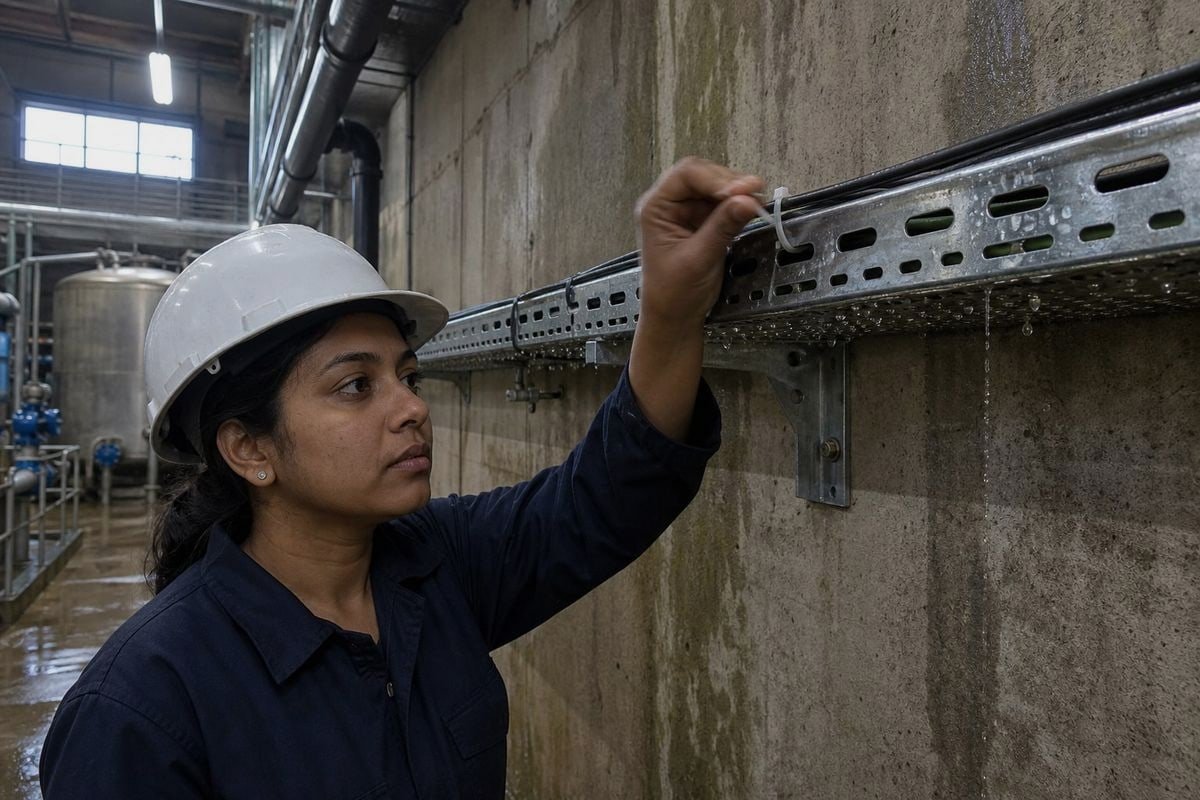
Standards turn a vague promise into a testable spec. When you send an inquiry, do not just write “hot dip galvanized.” Name the standard and the number. Then your incoming inspection has something to measure against, and disputes become simple.
The Checklist I Recommend to Buyers
| Check Item | Reference | What to Verify |
|---|---|---|
| Zinc coating thickness | ASTM A123 specification, BS 729, IS 2629/4759 | Minimum 65μm; typical readings 70–120μm |
| Mechanical performance | IEC 61537 standard | Load bearing capacity at your span and load class |
| Sheet thickness | Your project spec | Commonly 1.2mm to 3mm depending on width and load |
| Dimensions | Drawing approval | Widths from 50mm up to 600mm, some lines to 1000mm |
| Salt spray performance | Vendor test reports | Claims above 1000 hours exist; ask for the actual report |
| Accessories | Same finish standard | Splice plates, covers, bends, and support brackets all HDG |
Three Details Buyers Miss
First, measure coating thickness at hole edges and bends, not just flat surfaces. A magnetic thickness gauge takes seconds per point, and edges are where cheap galvanizing fails. Second, treat vendor service-life claims cautiously. A “30+ years” figure is realistic for HDG in many climates, but ask for salt spray data 4 rather than accepting the number alone. Third, check the accessories. A tray run is only as corrosion-proof as its weakest fitting, and I have seen projects pair HDG trays with electro-galvanized splice plates that rusted first.
At our factory, we photograph coating readings on every export batch before packing. It is a small step, but it prevents the quality disputes and product returns that damage a project schedule far more than any price difference.
Conclusion
Rusting trays, derated cables, and failed inspections all trace back to the wrong specification. Hot dipped galvanized perforated cable tray answers all three — specify the standard, and it delivers for decades.
Footnotes
- Explains the unique chemical bond formed between zinc and steel during the hot-dip galvanizing process. ↩︎
- Outlines the industry standards and methods for inspecting and measuring hot-dip galvanized coating thickness. ↩︎
- Provides a technical overview of different cable tray designs, including perforated and ladder types. ↩︎
- The international standard for salt spray testing used to evaluate the corrosion resistance of coatings. ↩︎