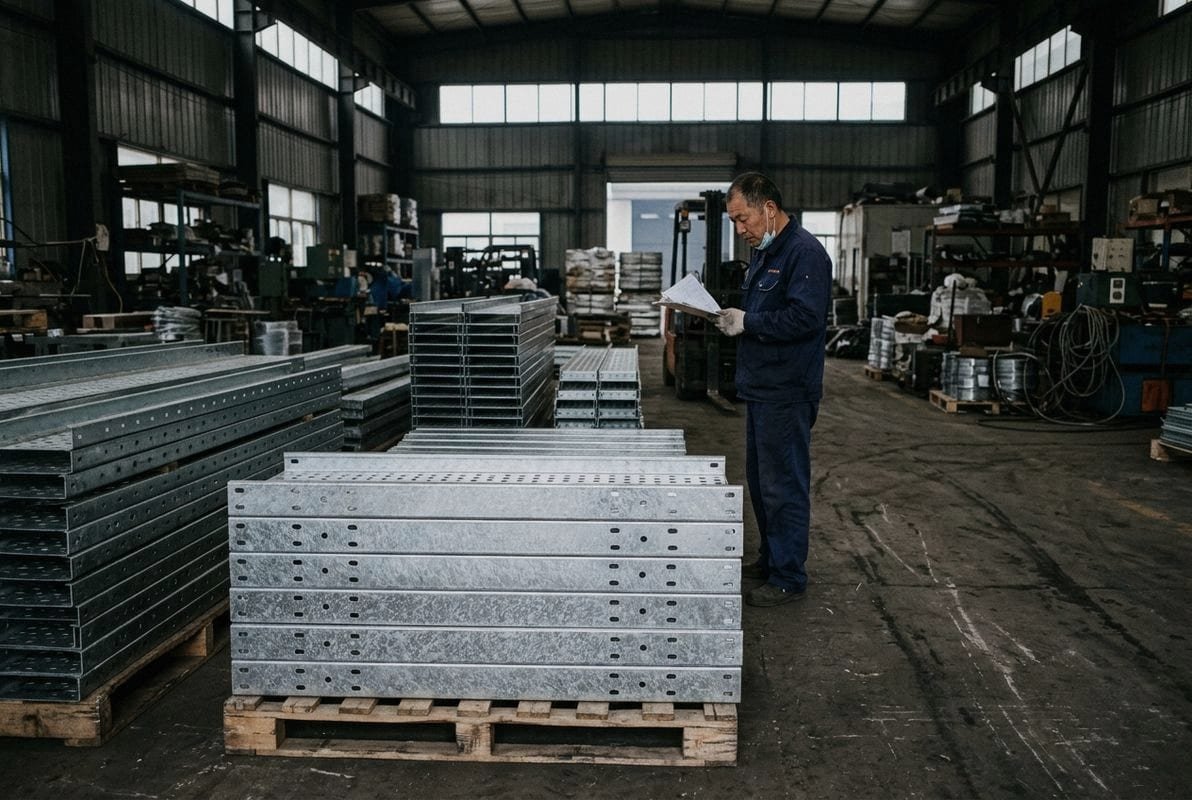
Last year, a water treatment contractor in the Philippines sent us photos of cable trays rusting through after just fourteen months — trays that were sold to him as “galvanized.” That single word, “galvanized,” hides a massive difference in corrosion resistance that costs project managers thousands of dollars in rework.
Hot-dip galvanized cable trays differ from ordinary galvanized trays primarily in zinc coating thickness, bonding method, and corrosion resistance. Hot-dip trays feature a metallurgically bonded zinc layer of 70–120 μm that withstands over 1,000 hours of salt spray testing, while electro-galvanized coatings of 5–30 μm fail within 72–200 hours.
The sections below break down every dimension of this difference — from process chemistry to real-world cable tray lifespan — so you can specify the right surface treatment methods for your next project and avoid costly product returns.
How much longer will hot-dip galvanized trays last in my harsh outdoor project environments?
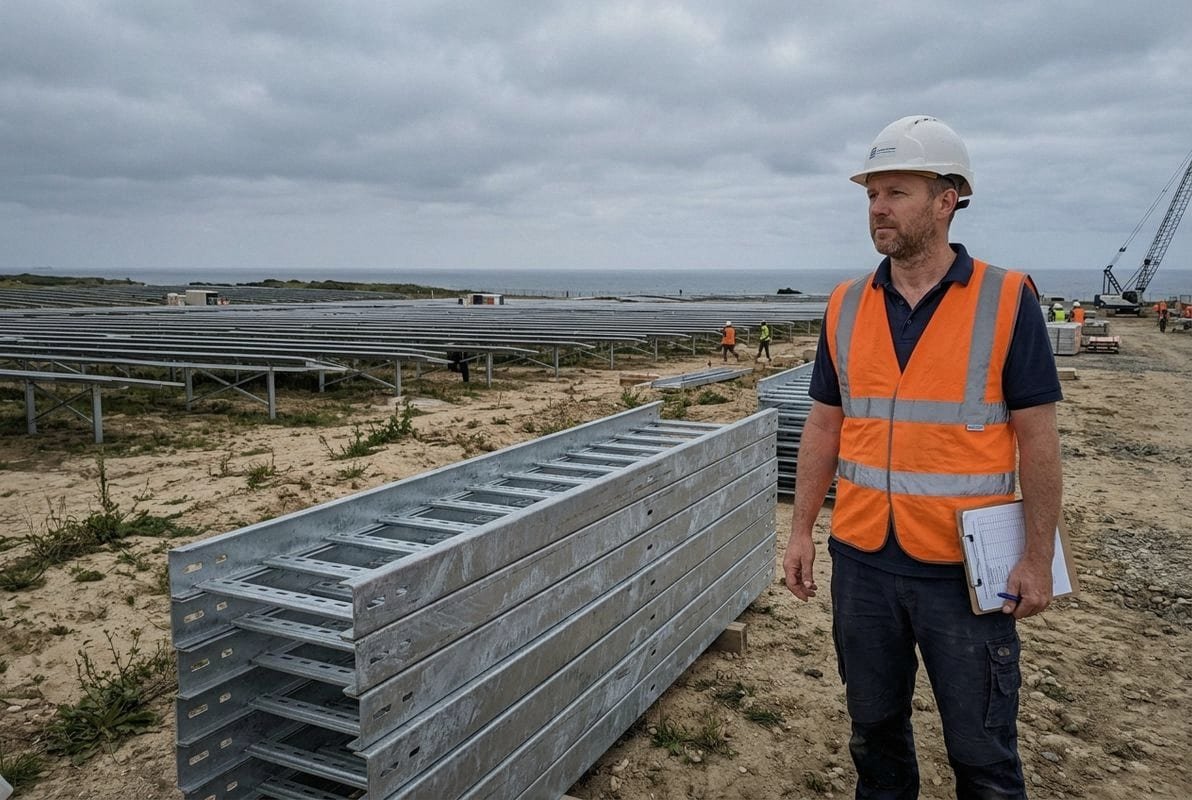
A project director we work with in Singapore once asked us to quote both options for a coastal solar farm. When we laid out the numbers side by side, the service life gap was so wide he could not justify the cheaper option to his client.
In harsh outdoor environments, hot-dip galvanized cable trays typically last 30–50 years, while pre-galvanized cable trays last only 5–10 years. The difference comes from a zinc coating thickness that is three to ten times greater and a metallurgical bond that resists peeling, cracking, and mechanical damage far better.
Why Coating Thickness Decides Everything
Corrosion resistance in a zinc-coated steel tray is largely a function of how much zinc sits between the atmosphere and the steel. The thicker the zinc, the longer it takes for corrosive environments to eat through to the base metal. This is not opinion — it is electrochemistry.
Hot-dip galvanizing immerses the fully fabricated tray into molten zinc at roughly 450 °C. The zinc reacts with the steel surface and forms multiple intermetallic layers of zinc-iron alloy before a final layer of pure zinc solidifies on top. This metallurgical bond is extremely difficult to separate from the steel. On our production line, we routinely measure finished coatings between 70 μm and 120 μm.
Ordinary galvanizing — whether electro-galvanized or pre-galvanized sheet — applies a much thinner layer. Pre-galvanized steel is coated before the tray is cut and formed. Every punched hole, sheared edge, and welded joint is left with bare or near-bare steel. An electro-galvanized coating typically measures 5–30 μm and is held to the steel by physical adhesion, not a chemical bond.
Service Life by Environment Category
The EN ISO 12944 standard 1 classifies atmospheric conditions into corrosivity categories C1 through CX. Here is how each galvanizing method performs across them:
| Corrosivity Category | Typical Environment | HDG Cable Tray Expected Life | Ordinary Galvanized Expected Life |
|---|---|---|---|
| C1 – Very Low | Heated interiors, offices | 50+ years | 10–15 years |
| C2 – Low | Unheated storage, rural areas | 40–50 years | 7–10 years |
| C3 – Medium | Urban or mild industrial | 30–40 years | 5–7 years |
| C4 – High | Industrial, moderate salinity | 20–30 years | 2–4 years |
| C5 – Very High | Coastal, aggressive industrial | 15–25 years | 1–2 years |
| CX – Extreme | Offshore, chemical splash zones | 10–15 years (often needs duplex) | Not recommended |
For projects in Southeast Asia, Africa, and South America — our primary export regions — most outdoor sites fall into C3, C4, or C5. At C4 and above, pre-galvanized cable trays simply cannot survive long enough to justify the installation labor.
The Self-Healing Advantage
Hot-dip galvanized coatings provide sacrificial protection 2. Zinc is more electrochemically active than steel. When a scratch exposes the steel underneath, surrounding zinc corrodes preferentially and deposits protective zinc salts over the wound. This self-healing effect works only when there is enough zinc mass around the damaged area. A 70 μm coating has the reserve to heal small scratches. A 12 μm electro-galvanized coating does not. Once scratched, ordinary trays rust at the damage point and the corrosion spreads beneath the remaining coating.
Is the extra cost of hot-dip galvanizing worth the investment for my long-term infrastructure?
When we quote projects, the hot-dip galvanized option often comes in 30–50 % higher than the electro-galvanized alternative. That price gap makes procurement managers hesitate. But a lesson we learned early in our export business is that the purchase order is only the first chapter of the cost story.
Yes, the extra cost is almost always worth it for outdoor and industrial infrastructure. Hot-dip galvanized trays require near-zero maintenance and last 30–50 years, while ordinary trays need recoating or replacement every 5–10 years — making the total lifecycle cost of the cheaper option two to four times higher.
Breaking Down the True Cost
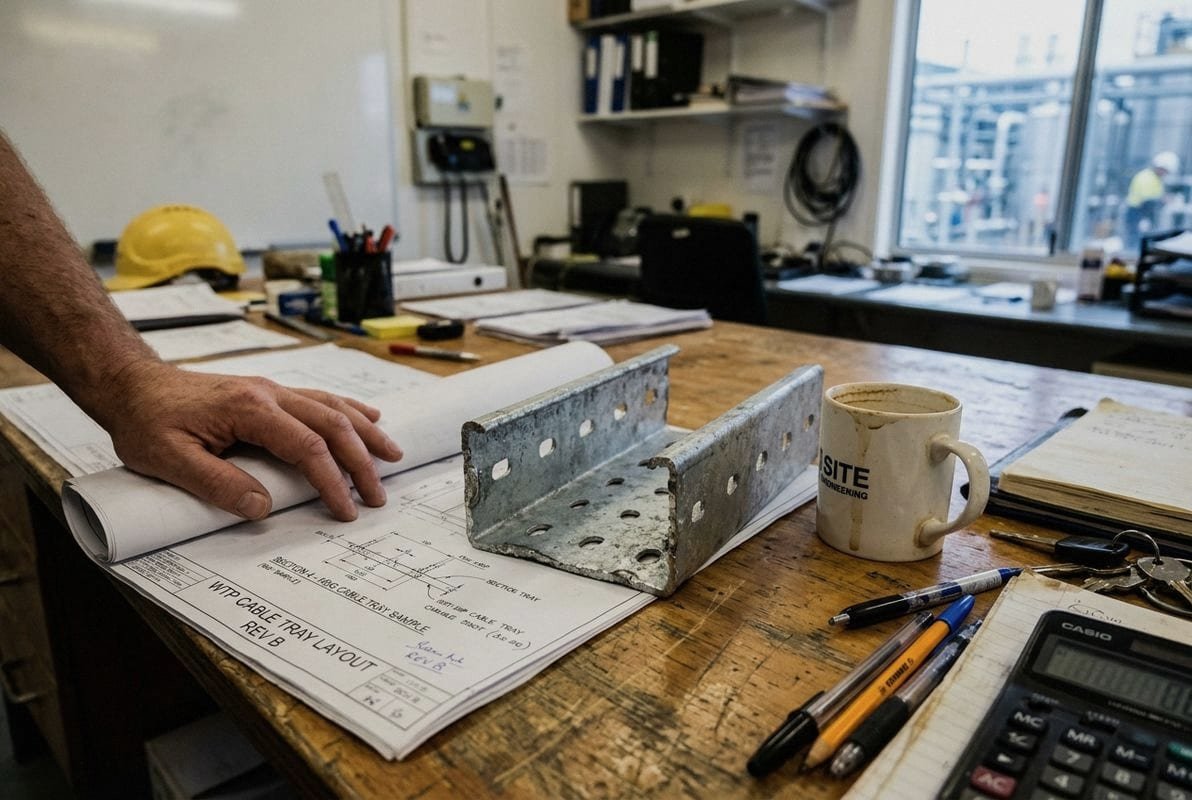
The upfront price difference between an electro-galvanized coating and a hot-dip galvanized coating is real. But infrastructure decisions should be evaluated on total cost of ownership 4, not just the line item on the purchase order.
Consider a hypothetical 1,000-meter cable tray run for a solar farm in a C4 coastal zone:
| Cost Factor | Hot-Dip Galvanized | Ordinary (Pre-Galvanized) |
|---|---|---|
| Initial Material Cost | $12,000 | $8,500 |
| Installation Labor (one-time) | $5,000 | $5,000 |
| Maintenance (per event) | ~$0 over 30 years | $3,000 every 4–5 years |
| Replacement Cost (material + labor) | None within 30 years | Full replacement at year 8–10: $13,500 |
| Total 30-Year Cost | ~$17,000 | ~$44,500+ |
These numbers are illustrative, but the ratios are consistent with what our EPC clients report. The ordinary tray’s low sticker price is deceptive.
When Ordinary Galvanized Trays Make Sense
I do not recommend hot-dip galvanizing for every project. For clean, dry, indoor environments — think data centers, shopping malls, or climate-controlled office buildings in C1–C2 zones — pre-galvanized cable trays perform adequately and save budget. The smoother surface finish of electro-galvanized trays is also preferred for aesthetic indoor installations.
The Hidden Cost of Product Returns
For project contractors, a failed tray means more than replacement material. It means crane time, scaffolding, project delays, and reputation damage. One of our repeat buyers in Thailand told us he switched entirely to hot-dip after a single batch of pre-galvanized trays developed rust streaks within a monsoon season. The return logistics and reinstallation cost him more than the original order value. This is the hidden cost that procurement spreadsheets miss.
Duplex Systems for Extreme Environments
In CX-rated environments — offshore platforms, chemical splash zones — even hot-dip galvanizing alone may not be enough. The current industry trend is duplex coating 5: hot-dip galvanizing plus a paint or powder coat on top. This combination can double the service life beyond what either coating achieves alone. We have supplied duplex-coated trays for water treatment projects in South America where acidic atmospheric conditions degrade zinc faster than normal. Zinc magnesium aluminum alloys are also gaining traction as next-generation coatings, but hot-dip galvanizing remains the proven baseline for most infrastructure projects.
How can I accurately test the zinc coating thickness to ensure my trays meet QC standards?
During a factory audit last quarter, a buyer from Singapore brought his own coating thickness gauge and tested every fifth tray in the batch. That level of diligence is exactly what separates smooth project deliveries from quality control nightmares. Accurate zinc coating thickness 6 measurement is not difficult, but it does require the right tools, the right method, and clear acceptance criteria.
You can accurately test zinc coating thickness using a magnetic or eddy-current coating thickness gauge calibrated to a known standard. Take at least five readings per tray piece on flat surfaces away from edges. For hot-dip galvanized trays, the average must meet or exceed 70 μm per ASTM A123, while electro-galvanized coatings must meet the specified minimum, typically 12–25 μm.
Tools You Need
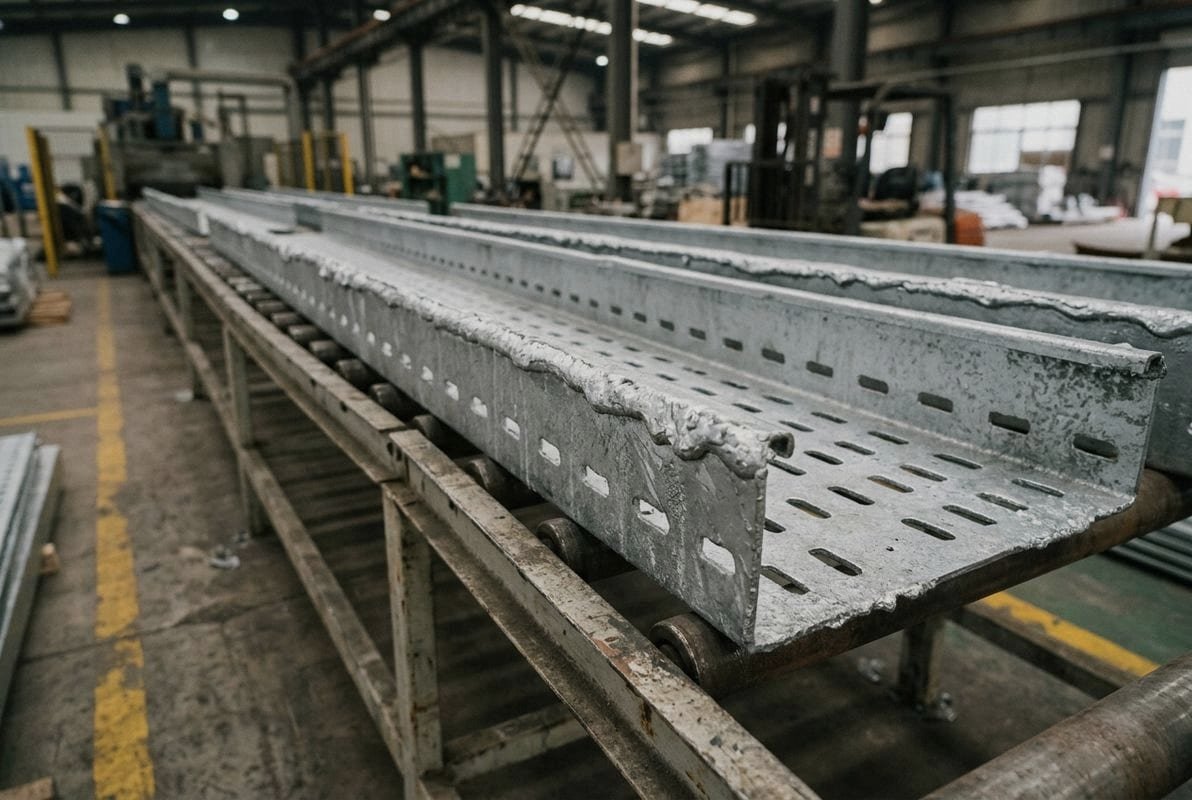
The most common field instrument is a digital coating thickness gauge that uses either the magnetic induction method 7 (for non-magnetic coatings on ferrous substrates) or the eddy-current method. For zinc on steel, magnetic induction is the standard. Good gauges cost between $200 and $1,500. Cheap gauges drift. Invest in a calibrated unit.
Step-by-Step Testing Process
- Calibrate the gauge on a bare steel sample and on certified thickness foils before each testing session.
- Select measurement points. The ASTM A123 8 specification and IEC 61537 standard both require multiple readings. Take at least five spots per piece — center, both sides, and near each end — avoiding edges and corners where zinc tends to pool thicker.
- Record each reading. Calculate the arithmetic average. Compare the average and the minimum individual reading against the specification.
- Interpret results. If the average is below the minimum, the piece fails. If one reading is below 80 % of the minimum, the piece also fails.
Acceptance Criteria by Galvanizing Type
| Parameter | Hot-Dip Galvanized (ASTM A123) | Electro-Galvanized (Typical Spec) |
|---|---|---|
| Minimum Average Thickness | ≥ 70 μm (for steel ≥ 6 mm) | ≥ 12 μm |
| Minimum Local Thickness | ≥ 56 μm | ≥ 8 μm |
| Adhesion Test | Must pass bend or impact test | Must pass cross-cut (tape) test |
| Salt Spray Test (Neutral) | > 1,000 hours to red rust | 72–200 hours to red rust |
| Visual Appearance | Uniform spangled or matte gray | Bright, smooth, mirror-like |
Common QC Pitfalls
On our production floor, we have seen a few recurring issues that cause measurement errors:
- Testing on curved surfaces gives inconsistent readings. Always test on flat sections of the tray side rail or base.
- Zinc drips or lumps at drainage holes inflate the average. These should be noted but excluded from the average calculation.
- Temperature matters. Gauges calibrated at 20 °C may drift at 40 °C on a hot warehouse floor. Re-zero the gauge if the ambient temperature changes significantly.
Salt spray testing is the gold-standard lab method for validating corrosion resistance after measuring thickness. We send tray samples to third-party labs for neutral salt spray testing per ASTM B117 whenever a buyer requires a test certificate. The correlation between coating thickness and salt spray hours is well established: thicker zinc equals longer protection, no exceptions.
Which galvanizing process should I specify to avoid rust and product returns in my solar or water treatment projects?
Two years ago, we helped a water treatment plant contractor in the Philippines choose between hot-dip and electro-galvanized trays. The plant sat 800 meters from the coast in a high-humidity tropical zone. The answer was obvious to us, but the contractor’s original spec simply said “galvanized” without specifying the process. That one missing word nearly led to a costly mistake.
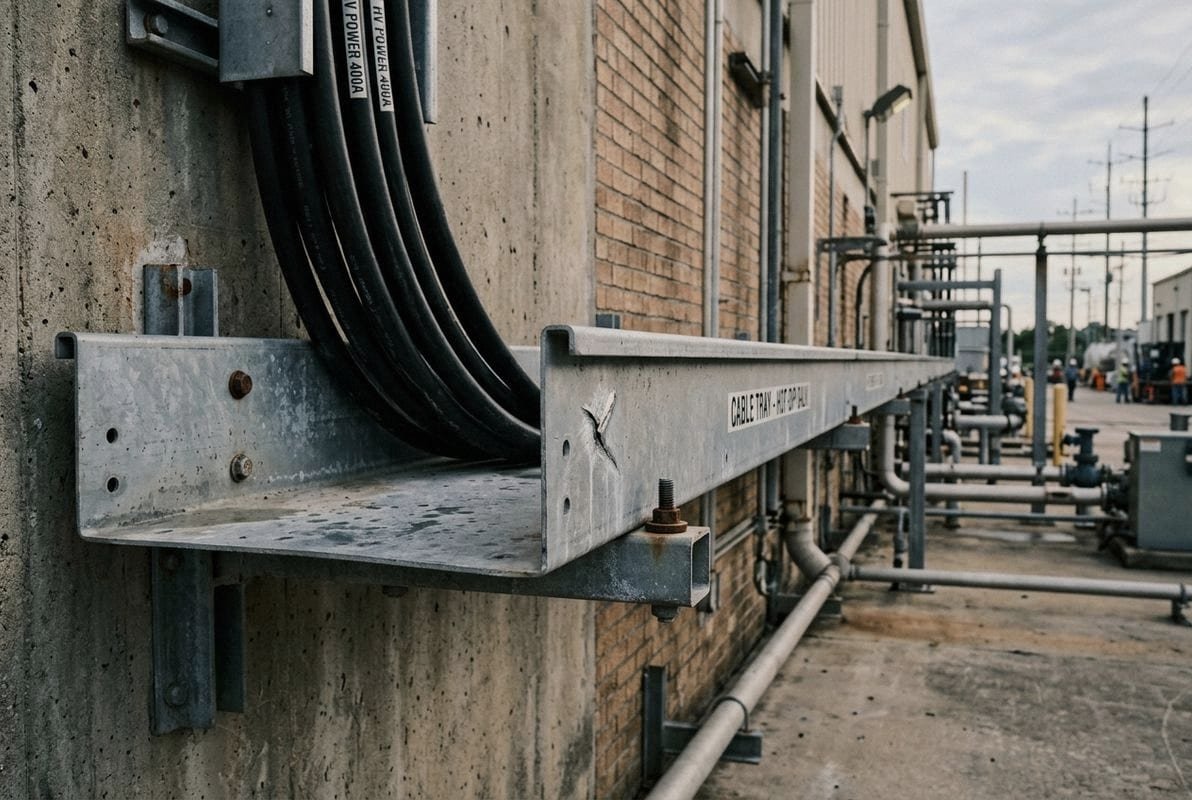
For solar farms, water treatment plants, and any project exposed to moisture, salt, or chemical vapors, you should specify hot-dip galvanized cable trays that comply with ASTM A123 or equivalent standards. This ensures a minimum 70 μm zinc coating with full post-fabrication coverage — the only reliable way to prevent rust and eliminate product returns in corrosive environments.
Why “Galvanized” Is Not Enough on a Spec Sheet
The word “galvanized” covers at least three distinct surface treatment methods:
- Pre-galvanized (GI sheet): Zinc applied to flat steel before fabrication. Cut edges and welds are bare.
- Electro-galvanized: Zinc deposited by electric current after fabrication, but very thin.
- Hot-dip galvanized (HDG): Full immersion in molten zinc after fabrication. All surfaces coated.
If your purchase order just says “galvanized,” the supplier will choose the cheapest method. In our experience shipping to Southeast Asia and South America, this ambiguity is the number-one cause of product returns related to premature rust.
Matching the Process to Your Project
| Project Type | Typical Corrosivity | Recommended Process | Why |
|---|---|---|---|
| Solar farm (coastal) | C4–C5 | Hot-dip galvanized | Constant UV, rain, salt air; needs thick coating and edge protection |
| Solar farm (inland, dry) | C2–C3 | Hot-dip galvanized or pre-galvanized with edge sealing | Lower corrosion risk, but outdoor exposure still degrades thin coatings |
| Water treatment plant | C4–C5 | Hot-dip galvanized (or duplex) | Chemical vapors, condensation, and high humidity attack thin coatings rapidly |
| Indoor data center | C1 | Pre-galvanized | Dry, climate-controlled; no corrosion risk |
| Petrochemical facility | C5–CX | HDG + duplex or aluminum alloy | Aggressive chemicals require maximum protection |
How to Write the Specification
When you write or review a cable tray specification for a solar or water treatment project, include these minimum details:
- Galvanizing process: State “hot-dip galvanized after fabrication” explicitly.
- Standard: Reference ASTM A123 or ISO 1461 9.
- Minimum coating thickness: Specify ≥ 70 μm average, ≥ 56 μm local minimum.
- Testing requirement: Request a coating thickness test report and, where budget allows, a salt spray test certificate.
- Edge and weld coverage: State that all cut edges, punched holes, and welded joints must be coated.
Aluminum as an Alternative
In some chemical environments, aluminum cable trays 10 — specifically marine-grade 6063-T6 alloy — outperform even hot-dip galvanized steel. Aluminum does not rely on a sacrificial coating; its corrosion resistance is intrinsic. Field modifications like drilling or cutting do not create weak points the way they do on zinc-coated steel. However, aluminum costs more and has lower load capacity per kilogram. For most solar and water treatment projects, hot-dip galvanized steel remains the best balance of performance, strength, and cost.
Avoiding the Cold Galvanizing Trap
When hot-dip galvanized trays are damaged during transport or installation, the standard field repair is zinc-rich paint — sometimes called “cold galvanizing.” This paint provides some sacrificial protection, but it is not equivalent to the original factory coating. The bond is weaker, the thickness is hard to control, and the repair area becomes the weakest link. On our end, we pack trays with edge protectors and use reinforced bundling to minimize transit damage. Prevention is always cheaper than repair.
Conclusion
Choosing between hot-dip and ordinary galvanized cable trays is not a minor procurement detail — it determines whether your infrastructure survives decades or fails within years. Specify the right process, verify zinc coating thickness at the factory, and protect your project investment from the start.
Footnotes
- Provides an authoritative overview of the international standard for corrosion protection of steel structures. ↩︎
- Explains the electrochemical principle behind zinc’s protective action in galvanizing. ↩︎
- Details a common method for evaluating corrosion resistance of materials and coatings. ↩︎
- Discusses the long-term financial evaluation of infrastructure investments through life-cycle cost analysis. ↩︎
- Describes an advanced corrosion protection system combining galvanizing with paint or powder coating. ↩︎
- Explains the importance of zinc coating thickness in corrosion protection and relevant standards. ↩︎
- Describes a common, non-destructive technique for measuring coating thickness from a leading manufacturer. ↩︎
- References the official ASTM standard for hot-dip galvanized coatings on iron and steel products. ↩︎
- Provides information on the international standard for hot-dip galvanized coatings on fabricated articles. ↩︎
- Offers a comparison and advantages of aluminum cable trays as an alternative material. ↩︎