Every time our production floor ships a batch of hot-dip galvanized marine cable trays to a shipyard in Singapore or an offshore oil and gas platform project in Southeast Asia, I think about the same thing: will this tray survive decades of salt spray, vibration, and tropical humidity without failing?
To choose hot-dip galvanized marine cable trays correctly, evaluate zinc coating thickness (minimum 85 µm for marine zones per ISO 1461), verify compliance with IEC 61537 and IEC 60092-352, match the tray type to corrosion severity zones, and confirm DNV or ABS classification society approval before ordering.
This guide breaks down the critical decisions you need to make — from coating specs to certification requirements to sourcing strategy — so you can avoid costly failures and project delays.
What Coating Thickness Do I Need for Long-Term Corrosion Resistance in Marine Environments?
A project contractor in the Philippines once asked me why two batches of galvanized cable trays, both labeled “HDG,” performed so differently after eighteen months at sea cable ventilation 1. The answer came down to one number: zinc coating thickness 2.
For long-term corrosion resistance in marine environments, hot-dip galvanized cable trays need a minimum zinc coating thickness of 85 µm (microns) per ISO 1461 for steel ≥6 mm, though many offshore specifications demand 100–120 µm to survive persistent salt spray environments beyond 15 years.
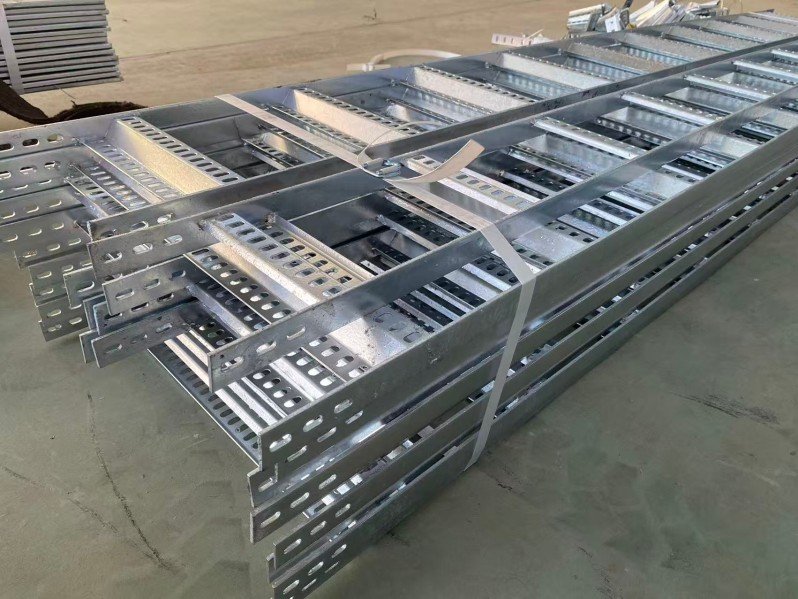
How Hot-Dip Galvanizing Works
The process is straightforward but precise. Steel is submerged in molten zinc 3 at approximately 450°C (842°F). At that temperature, zinc bonds metallurgically with the steel surface. It forms multiple zinc-iron alloy layers, not just a surface paint. This is why HDG outperforms electro-galvanizing or spray coatings — the bond is part of the metal itself.
The zinc layer acts as a sacrificial barrier 4. When exposed to moisture, salt, or chemicals, the zinc corrodes first. It protects the base steel underneath. This “self-healing” property means minor scratches from installation — inevitable in tight ship corridors — get some protection as zinc migrates to cover exposed spots.
Why Thickness Matters More Than You Think
Not all HDG is equal. The corrosion resistance class of your cable tray depends directly on the zinc layer’s thickness. A tray with 45 µm of zinc might last five years in a sheltered indoor area. That same tray on a semi-exposed deck near the engine room exhaust? Maybe three years before rust appears. Understanding how hot-dip and ordinary galvanized cable trays differ in corrosion resistance is essential when specifying for marine zones.
Here is a practical guide based on what we see in actual project specifications:
| Marine Zone | Minimum Zinc Thickness | Expected Service Life | Recommended Tray Type |
|---|---|---|---|
| Indoor ship areas (low salt exposure) | 45–65 µm | 10–15 years | HDG perforated cable tray |
| Sheltered decks / engine rooms (moderate) | 85–100 µm | 15–20 years | HDG cable ladder systems |
| Semi-exposed decks (high) | 100–120 µm | 10–15 years (with maintenance) | HDG with duplex coating |
| Open decks / splash zones (extreme) | N/A — HDG not recommended | — | Stainless steel 316L or FRP |
The Limitation You Must Acknowledge
HDG is cost-effective and reliable for moderate marine zones. But persistent salt exposure will eventually consume the zinc layer. On open decks and submerged zones, a stainless steel 316L comparison shows SS316 is clearly superior because of its molybdenum content, which resists pitting and crevice corrosion. The trade-off is cost — SS316 trays can be three to five times more expensive.
Our recommendation to clients: use a zone-based selection strategy. HDG for internal decks, sheltered areas, and engine rooms. Reserve SS316 or FRP for the harshest zones. This balances harsh environment durability with budget reality.
Verifying Thickness on Delivery
When you receive a shipment, use a magnetic thickness gauge 5 (per ISO 2178) to spot-check at least five points on each tray. Check the side rails, rungs, and any bends. Bends and corners tend to have thinner coatings. If any reading falls below your specification, flag it immediately. We include coating thickness test reports with every shipment, but I always tell buyers: trust, but verify.
How Can I Verify Quality Control Standards Before Placing a Bulk Order?
Last year, a client sourcing cable ladder systems for a water treatment facility near the coast learned a hard lesson: the factory photos looked great, but the delivered trays had uneven zinc coverage, rough dross inclusions, and side rails that didn’t align with the fittings. Quality control starts long before shipping.
Before placing a bulk order, request the factory’s ISO 9001 certificate, demand salt spray test reports per ISO 9227, require coating thickness certificates per ASTM A123 standards, inspect sample trays for dimensional accuracy, and insist on pre-shipment third-party inspection at the production facility.
Pre-Order Verification Checklist
Quality control is not a single step. It is a system. Here is how I walk our buyers through the process:
Step 1: Factory Documentation Review. Ask for ISO 9001 quality management certification. This is the baseline. Then request the raw material certificates (mill test certificates) for the base carbon steel. The steel must be chemically cleaned and pickled before galvanizing. Poor base metal preparation means poor zinc adhesion — no matter how thick the coating.
Step 2: Sample Evaluation. Before committing to thousands of meters, order samples. Check these points:
- Zinc coating uniformity (no bare spots, no excessive dross)
- Dimensional accuracy (rail height, rung spacing, perforation alignment)
- Fit with accessories (covers, bends, tees, couplers)
- Edge finish (no sharp burrs that could damage cable insulation)
Step 3: Test Reports. The two critical tests for marine applications are:
| Test | Standard | What It Proves | Minimum Requirement |
|---|---|---|---|
| Salt spray test | ISO 9227 | Hours of salt fog resistance before white/red rust | 500+ hours (white rust), 1000+ hours (red rust) |
| Coating thickness | ASTM A123 / ISO 1461 | Zinc layer depth in microns | 85 µm minimum for marine |
| Load test | IEC 61537 | Load bearing capacity under rated span | Must match project specifications |
| Adhesion test | ASTM A123 (bend test) | Zinc won’t flake when tray is bent or cut | No peeling or cracking |
Step 4: Pre-Shipment Inspection. For bulk orders — especially for offshore oil and gas platforms — I strongly recommend hiring a third-party inspection company 6 (SGS, Bureau Veritas, or TÜV) to inspect at the factory before loading. They check dimensions, coating, packaging, and labeling. This costs a fraction of what a rejected shipment would cost.
The Hidden Quality Killer: Post-Galvanizing Handling
Even a perfectly galvanized tray can be ruined by poor handling. Trays stacked without spacers can trap moisture and develop “wet storage stain” (white rust) during shipping. We use wooden spacers and protective packaging — those white woven polyester straps you see on our bundled trays are not decorative. They keep the trays separated and ventilated.
What to Do When Something Goes Wrong
Build return and rework clauses into your purchase agreement. Specify the acceptable quality level (AQL) for defects. Our standard practice is AQL 2.5 for minor defects and AQL 1.0 for major defects. If a tray section fails the coating thickness check or shows visible bare spots, it gets rejected and replaced — no negotiation.
Which Certifications Should I Require for Offshore and Shipbuilding Cable Tray Projects?
When a project director in Singapore sent us a spec sheet for an FPSO vessel refit, the certification requirements filled two pages. At first glance, it seemed excessive. But every line item existed because someone, somewhere, had experienced a failure that those standards were designed to prevent.
For offshore and shipbuilding cable tray projects, require IEC 61537 for structural performance, IEC 60092-352 for marine electrical installation, ISO 9227 for salt spray corrosion testing, IMO fire safety compliance, and DNV type approval or equivalent from ABS or Lloyd’s Register classification societies.
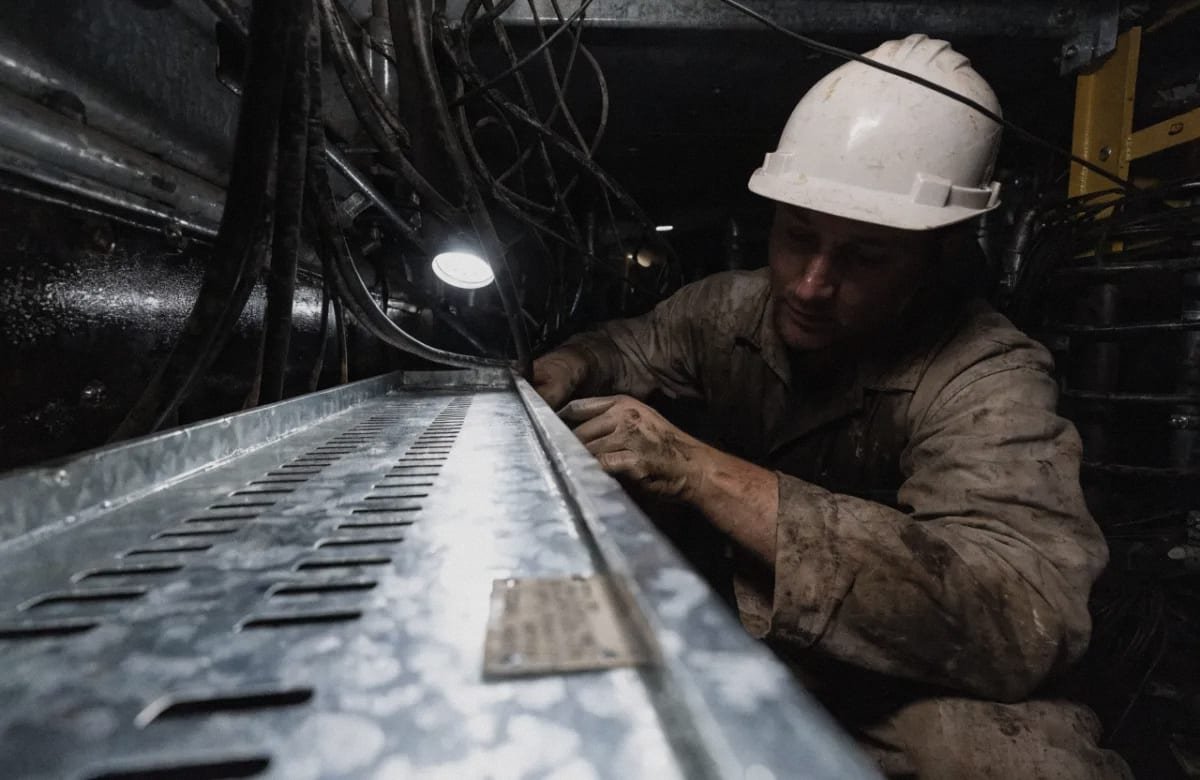
The Non-Negotiable Standards
Let me break these down so you understand what each one actually covers and why it matters:
IEC 61537 — This is the structural backbone standard. It defines how cable tray and cable ladder systems must be tested for load bearing capacity, torsional rigidity, and deflection. If a supplier cannot provide IEC 61537 test reports, walk away. Without this, you have no verified data on whether the tray can hold the cables you plan to install.
IEC 60092-352 — This standard is specific to electrical installations on ships. It covers cable routing, grouping, separation of power and signal cables, and support system requirements. Your cable tray must be designed to facilitate compliance with this standard.
ISO 9227 — The salt spray test standard. This is your proof of corrosion resistance. For marine applications, demand at least 500 hours to white rust and 1000 hours to red rust. Some offshore specifications under NORSOK M-501 require even more aggressive testing.
IMO Fire Safety — The International Maritime Organization 7 sets fire resistance grades from A-0 to A-60. Cable trays that pass through fire-rated bulkheads must have appropriate fire seals. The tray material itself must meet smoke generation and toxicity limits.
Classification Society Approvals
Classification societies 8 are the gatekeepers of marine safety. The three you encounter most are:
| Classification Society | Abbreviation | Regions of Influence | What Their Approval Covers |
|---|---|---|---|
| Det Norske Veritas | DNV | Europe, global offshore | Material, design, fire rating, corrosion |
| American Bureau of Shipping | ABS | Americas, Asia | Structural adequacy, material certification |
| Lloyd’s Register | LR | UK, global marine | Design review, type testing, factory audit |
DNV type approval is the most commonly requested in our export markets. Obtaining it means the product design and manufacturing process have been audited and certified. It is not just a paper exercise — DNV sends inspectors to the factory.
CE Marking and Beyond
For projects in the European Union, CE marking is mandatory. It declares conformity with EU directives on safety, health, and environmental protection. While CE is not marine-specific, many EPC contractors include it as a blanket requirement.
Why Certifications Protect You, Not Just the Project
From a procurement perspective, certifications are your insurance policy. If a cable tray fails on a vessel and causes downtime, the first question the project owner asks is: “Did the tray meet the spec?” If you can show DNV approval, IEC test reports, and ISO 9227 salt spray data, you are protected. If you cannot, the liability falls on you.
I always tell our buyers: the time to verify certifications is during supplier qualification, not after the containers have shipped. Send us your project spec sheet early. We will map our documentation to your requirements and flag any gaps before production begins.
How Do I Balance Customization Needs with Delivery Lead Times When Sourcing from China?
One of the most stressful conversations I have is when a buyer needs 3,000 meters of perforated cable tray design in non-standard widths, with custom perforation patterns, specific zinc coating thickness requirements — and they need it in four weeks. Customization and speed pull in opposite directions, but with the right approach, you can have both.
To balance customization with delivery speed, finalize all technical drawings and coating specifications before production starts, consolidate orders to minimize tooling changes, choose a supplier with in-house galvanizing capability, and plan orders 8–12 weeks ahead for complex marine-grade cable management projects.

Why Marine Projects Demand More Customization
Standard industrial cable trays come in fixed widths (100 mm, 200 mm, 300 mm, etc.) and standard lengths (usually 2.4 m or 3 m). Marine and offshore projects rarely fit neatly into standard sizes. Ships have curved corridors. Engine rooms have tight clearances. Offshore platforms require unusual bend radii and non-standard mounting configurations.
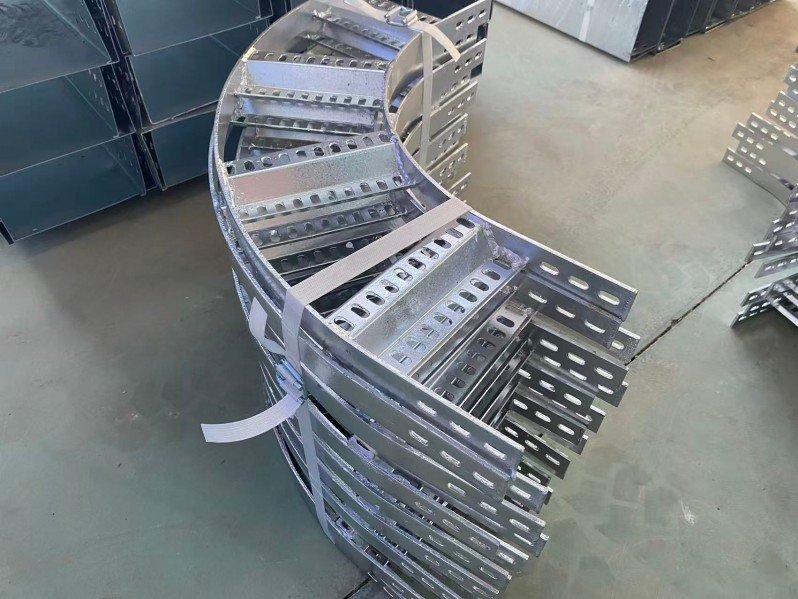
The curved 90-degree bend sections we produce — like those C-shaped arcs you see stacked and strapped on our warehouse floor — are a good example. Each project may need a different radius, a different rail height, or a different perforation pattern. These are not pulled off a shelf. They are fabricated to order.
The Customization–Lead Time Trade-Off
Here is a realistic timeline breakdown for custom marine cable tray orders sourced from China:
| Order Phase | Standard Products | Custom Products | What Causes Delays |
|---|---|---|---|
| Drawing approval | 1–3 days | 5–10 days | Multiple revision cycles |
| Raw material procurement | Stocked | 5–7 days | Non-standard steel gauges |
| Fabrication | 7–10 days | 10–20 days | Custom tooling, special perforations |
| Hot-dip galvanizing | 3–5 days | 3–5 days | Queue at galvanizing facility |
| QC and packing | 2–3 days | 3–5 days | Additional inspection points |
| Shipping (sea freight to SE Asia) | 10–14 days | 10–14 days | Port congestion, vessel schedules |
| Total | ~4–5 weeks | ~6–9 weeks | — |
Strategies That Actually Work
Lock drawings early. The single biggest cause of delays is drawing revision loops. Get your engineering team to finalize dimensions, material grade, coating spec, and accessory list before you issue the purchase order. Changes after production starts mean rework, scrap, and lost time.
Consolidate by project phase. Instead of ordering small batches for each deck or zone, consolidate into fewer, larger orders. This reduces tooling changes on our production line and lets us batch the galvanizing process efficiently.
Choose suppliers with in-house galvanizing. If your cable tray manufacturer subcontracts the HDG process to a separate facility, you add transit time, handling risk, and coordination complexity. Our facility handles fabrication and coordinates galvanizing in a controlled loop, which cuts lead time and reduces the chance of handling damage. Learning how to choose the best hot-dip galvanized ladder cable trays from China can help you evaluate suppliers more effectively.
Build buffer into your schedule. Marine projects are notorious for schedule changes. But if you plan your cable tray procurement 8–12 weeks ahead of installation, you have room to absorb minor delays without impacting the critical path.
Accessories and Fittings: The Forgotten Bottleneck
Trays are only part of the system. You also need covers, bends, tees, reducers, risers, vibration-resistant fasteners, heavy-duty support brackets, and expansion connectors (required every 25–30 meters to handle thermal expansion 9). If these are custom too, they need their own lead time. I have seen projects where the straight tray sections arrived on time, but the 90-degree bends were three weeks late — and the entire installation stalled.
Our approach: we treat accessories as part of the same production order, not an afterthought. When a buyer sends us the cable routing layout, we calculate every fitting needed and include them in the same production schedule.
Cable Fill Rate and Future Expansion
One more point that affects your order quantity: do not fill trays to 100% capacity. The standard recommendation is a maximum 40–50% fill rate. cable fill rate 10 This allows for cable ventilation (preventing overheating), easy maintenance access, and room for future cable additions. Under-ordering tray width to save money is a false economy — you will end up buying more trays later or overheating your cables now.
Conclusion
Choosing hot-dip galvanized marine cable trays is a system decision — coating thickness, zone classification, certifications, quality verification, and sourcing strategy must all align. For projects involving GI ladder type cable trays for crude oil refinery projects, many of the same coating and certification principles apply. Get the details right upfront, and you protect your project for decades.
Footnotes
- Standard guidelines for electrical safety, including cable tray fill and ventilation requirements. ↩︎
- Explains the metallurgical process and coating depth science referenced for marine corrosion resistance. ↩︎
- Background on zinc’s properties supports the described immersion galvanizing temperature and bonding process. ↩︎
- Explains the electrochemical sacrificial protection principle behind zinc coatings on steel. ↩︎
- Official ISO standard for non-magnetic coating thickness measurement on magnetic substrates. ↩︎
- Explains the role of independent testing, inspection, and certification bodies in global trade. ↩︎
- Official site of the UN agency responsible for safety and security of shipping. ↩︎
- Provides background on the role and authority of maritime classification societies like DNV and ABS. ↩︎
- Explains the physical phenomenon requiring expansion connectors every 25-30 meters in tray runs. ↩︎
- Electrical codes govern recommended cable fill ratios to prevent overheating and allow maintenance access. ↩︎