
An FRP walkway that flexes underfoot or yellows in two summers is a costly mistake LEED v4.1 1. I have seen both, and our fiberglass grating line taught me how to avoid them.
To choose an FRP walkway, calculate your load and clear span first, let those numbers decide molded or pultruded grating, then lock the resin system, surface finish, and fasteners to your environment. Verify test reports and certifications, and compare prices only after the specification is fixed.
That order matters. Most buyers start with price. I want to show you why that fails, and what to ask instead. The four questions below follow the same order we use when we quote a project.
How do I determine the right load rating for my FRP walkway?
A project director in Singapore once sent me a WhatsApp photo of a sagging walkway and asked what went wrong. The panel was fine. The span was not.
Determine the load rating by listing every load on the FRP walkway, including people, tools, carts, and concentrated loads, then measure the clear span between supports. Ask the supplier for design load, load type, predicted deflection, and required panel depth, and pick the panel whose grating span table covers both.

The load rating is the first number in my selection summary, and it is the one buyers get wrong most often. A panel does not have one strength. It has a strength at a given span. Change the support spacing and you change everything.
Start with the clear span, not the panel
I always ask for the distance between supports before I ask about the load. A 38 mm molded panel that carries a technician easily on a 600 mm span will feel like a trampoline on a 1,200 mm span. It may not break. It will still feel unsafe, and people will stop using the route.
That is why deflection matters as much as load bearing capacity. Most industrial buyers accept a small deflection limit for pedestrian comfort. Heavy carts need a tighter limit. So I ask for both numbers in writing.
Here are the five numbers I request before I release any quote:
| Number to request | Why it matters | What happens if you skip it |
|---|---|---|
| Clear span between supports | Sets the real strength of the panel | Panels sag or supports get over-built |
| Design load (kPa or lbs/sq ft) | Defines uniform load from people and stock | Under-rated panel on heavy areas |
| Load type (uniform or concentrated) | Carts and jacks create point loads | Local cracking around wheel paths |
| Predicted deflection at that load | Controls comfort and fastener stress | Loose clips and rattling panels |
| Required panel depth | Links span, load, and deflection together | Wrong thickness ordered, costly re-order |
Some product guidance quotes high-quality panels at around 250 to 500 lbs per square foot. I treat that as a range, not a promise. The real rating must come from the manufacturer’s grating span table for the exact panel, mesh, and depth you buy.
Molded vs pultruded: let the calculation decide
Once I have span and load, the molded vs pultruded choice almost makes itself. This is the point of my one-sentence rule. The numbers should force the format, not the catalog.
| Factor | Molded fiberglass grating | Pultruded fiberglass grating |
|---|---|---|
| Strength direction | Bi-directional, square mesh | Unidirectional, along bearing bars |
| Best span range | Shorter spans, roughly under 4 ft | Longer spans, roughly over 6 ft |
| Impact resistance | Higher, thick reinforced walls | Good, but bars can split under edge impact |
| Cutouts and penetrations | Easy, cut anywhere | Needs framing at cut edges |
| Chemical severity | Higher resin content, better in harsh service | Lower resin content, check exposure |
| Concentrated loads | Spreads load across the grid | Higher stiffness under point loads |
Between 4 and 6 feet, I run both options against the grating span table and let deflection decide. If your layout has many drains, pipe penetrations, or odd shapes, molded wins even at longer spans, because you can add a support instead of framing every cut.
What certifications should I check before choosing an FRP walkway supplier?
Before any fiberglass grating leaves our yard in Tai’an, we pull sample panels for a burn test and a load check. Buyers should expect the paperwork behind them.
Check for third-party test reports, not brochures: ASTM E84 Class 1 or equivalent fire and smoke ratings, ASTM or ISO load and deflection tests, OSHA-compliant slip and opening specifications, local building code approvals, and, for green projects, verified EPDs or LCAs aligned with LEED v4.1.

A glossy datasheet is not a certificate. I have lost orders to suppliers who printed “fire retardant” on a catalog page with nothing behind it. I have also won those same customers back a year later. So I treat documentation as a filter, not a formality.
Fire and smoke come first
For indoor plants, tunnels, and offshore platforms, fire performance is usually the hardest requirement. Ask for the flame spread report. ASTM E84 Class 1 is the common benchmark buyers in Singapore and the Philippines quote to me. Some projects also ask for smoke toxicity data. If your site has strict smoke limits, a phenolic resin system is often the only answer, and the supplier should say so instead of guessing.
Fire ratings are project-specific. A coastal boardwalk does not need the same report as a substation walkway. Match the document to the risk, and do not pay for a rating you will never need.
Structural and safety documents
Load claims should trace back to ASTM or ISO test methods 2 on the actual panel depth and mesh. Ask which laboratory ran the test and when. Ask if the test panel matches your resin.
Walkway safety also touches OSHA safety standards 3 for walking-working surfaces. Opening size, guardrail attachment, and anti-slip surface requirements come from those rules or the local equivalent. Your supplier should be able to show which mesh sizes meet them.
Green building and site support
Solar and water treatment EPC clients increasingly ask for an Environmental Product Declaration 4 or a Life Cycle Assessment. These support LEED v4.1 credits. Not every supplier has them yet. Ask early.
Finally, check what support the supplier gives after the sale. Fastener spacing drawings, thermal expansion notes, and sealing protocols for cut edges are part of a serious quote.
| Document | What it proves | Red flag |
|---|---|---|
| ASTM E84 or equivalent report | Flame spread and smoke class | Only a catalog claim, no lab name |
| ASTM or ISO load test | Design load and deflection per span | Test on a different panel depth |
| Slip resistance data | Anti-slip surface performance wet and dry | Vague “non-slip” wording |
| Local code approval letter | Acceptance by the site authority | Supplier has never shipped to your country |
| EPD or LCA | Green building credit eligibility | Requested only after the order is placed |
| Installation guide | Clip spacing, expansion gaps, sealing | Guide covers a different product line |
How can I ensure the FRP walkway fits my project’s environmental conditions?
My hardest lesson came from a coastal water treatment plant order. We quoted a standard polyester panel to win on price. Two years later, the customer wanted vinyl ester.
Match the FRP walkway to its environment by choosing the resin system for the actual chemicals, concentrations, and temperatures on site, specifying UV inhibitors and a surfacing veil for outdoor exposure, and confirming corrosion resistance data for marine, wastewater, or washdown areas before you approve the quote.
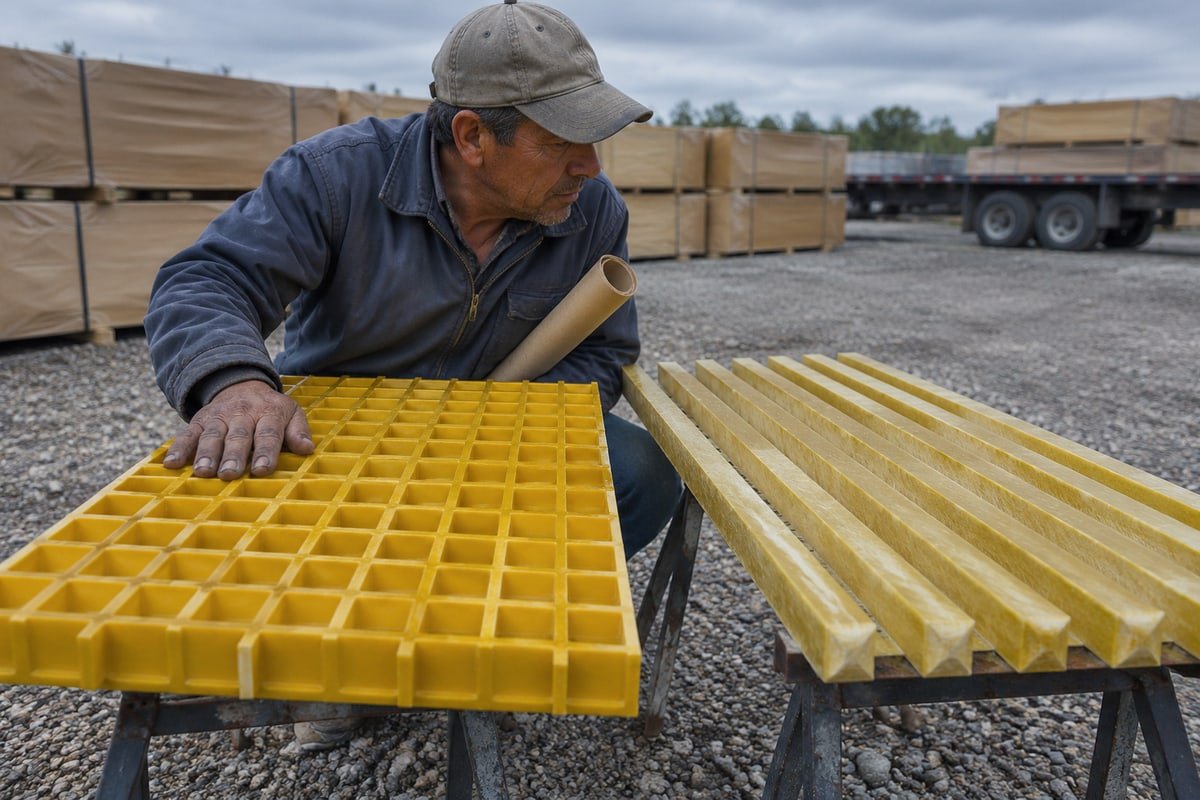
FRP is not one material. That is the first thing I tell new buyers. The glass fiber gives strength. The resin gives corrosion resistance, chemical resistance 5, and UV stability. Save money on the resin and you lose all three. I follow a simple five-step process for every environment check.
Step 1: Write down the real exposure
I ask for a list, not a description. Which chemicals? What concentration? What temperature? How often is the area washed down? Is there salt spray? “Harsh environment” tells me nothing. “Sodium hypochlorite dosing area, splash only, ambient 35°C” tells me everything.
Step 2: Pick the resin system from that list
| Resin system | Typical fit | Where I would not use it |
|---|---|---|
| Orthophthalic polyester | Dry indoor, light duty, budget rooftops | Any chemical or marine site |
| Isophthalic polyester | General outdoor, mild moisture, most solar plants | Acid or solvent exposure |
| Vinyl ester | Wastewater, coastal, chemical plants, washdown zones | Rarely, mainly cost-sensitive dry sites |
| Phenolic | Enclosed spaces needing low smoke plus chemical resistance | Sites without a fire or smoke requirement |
The exact match must come from the supplier’s chemical compatibility chart. Concentration and temperature change the answer. A resin that handles 5 percent acid at 25°C may fail at 50°C.
Step 3: Protect against sunlight
Outdoor walkways need UV inhibitors in the resin and a synthetic surfacing veil on top. Without the veil, the resin erodes and glass fibers stand proud. Installers call this fiber blooming. It looks bad and it itches. It also opens the panel to water. When we developed our outdoor yellow panels, the veil was the one item we refused to make optional.
Step 4: Check drainage and temperature swings
Open mesh drains water and reduces ice. Deep square cells also let debris fall through. Consider expansion too. FRP moves less than steel with temperature, but it still moves. Long runs in a tropical rooftop need gaps.
Step 5: Decide honestly between FRP and steel
Some buyers push back and say steel is cheaper. Sometimes they are right. A dry, temporary, indoor platform with a tight budget can use galvanized steel. But in wet, coastal, or chemical service, the corrosion resistance of FRP wins on lifecycle cost. Paint, rust repairs, and replacement will cost more than the resin upgrade. That is the lesson from my coastal plant.
What customization options should I ask my supplier about for FRP walkways?
Every quote forces one trade-off in our office: heavier grit for traction, or a smoother top that cleans easily. I never decide that alone. I ask what walks on it.
Ask your supplier about surface texture options such as grit, meniscus, or diamond plate, safety colors, panel depth and mesh size, factory cutouts and edge banding, fastener and clip types, thermal expansion allowances, and extras like embedded RFID tags, acoustic damping profiles, or take-back recycling programs.

Customization is where a walkway becomes a fit for your site instead of a stock item. It is also where the last part of my rule applies: resin first, then surface treatment, then fittings. Only after that do I compare price.
Surface treatment: match the texture to the hazard
Integrated grit gives the strongest anti-slip surface for oily or icy areas. It is also the hardest to clean. A meniscus top, the concave surface formed during molding, drains well and suits wet washdown floors. Diamond plate covered panels suit areas where small tools or debris would fall through open mesh. More grit is not always safer. On a food plant floor, grit traps residue and creates its own hazard.
Color is a safety choice too. Our yellow panels mark access routes and edges. Gray blends into plant floors. Green is common on boardwalks. Pigment does not change strength, but it changes how people move.
Fittings and installation methods
I ask about fasteners on every order, and I refuse to strip them from a quote to hit a price. Loose panels are the most common complaint I hear after delivery, and it is almost never the panel. It is the clip.
| Customization item | Question to ask | My note |
|---|---|---|
| Mesh size and panel depth | Does it meet opening limits and the span table? | Deeper is not always better; check weight for lifting |
| Factory cutouts | Can you cut penetrations and seal the edges? | Sealed edges stop water entering the fibers |
| Hold-down clips | Stainless or FRP? How many per panel? | Marine sites need stainless, not zinc |
| Thermal expansion gap | What gap per meter of run? | Ask for a drawing, not a verbal answer |
| Edge banding | Are cut edges sealed with matching resin? | Unsealed edges fail first |
| Embedded RFID or fiber optic sensors | Can panels be tagged for maintenance logs? | Useful on large EPC sites with hundreds of panels |
| Acoustic damping profile | Does the mesh reduce foot noise? | Matters in indoor urban plants |
| Take-back program | Do you recycle decommissioned panels? | Growing request from green building clients |
Some of these options are new. Embedded sensors for structural health monitoring are still rare, but large solar and water treatment projects now ask about them. Take-back programs that turn old FRP into cement kiln fuel or aggregate are also appearing. Ask, and you will learn how mature your supplier really is.
Packaging and logistics count as customization
The last customization is often forgotten. Panels shipped loose arrive chipped. We pallet, shrink-wrap, and load with a forklift into the container ourselves, and for Southeast Asian clients we often consolidate grating with cable tray orders to cut freight. Delivery delays and damaged returns are the two pain points buyers raise most, so ask how the supplier packs before you ask how much it costs.
Conclusion
Choose an FRP walkway by numbers first: load and span, then resin, surface, and fasteners, then price. Skip that order and you pay twice. Tell me your span; I’ll calculate.
Footnotes
- Official program for the green building rating system mentioned for environmental compliance. ↩︎
- Official site for ASTM standards used to verify structural and fire performance of FRP panels. ↩︎
- U.S. government agency defining safety requirements for industrial walking and working surfaces. ↩︎
- International organization providing standards for environmental labels and product declarations. ↩︎
- Authoritative encyclopedia entry explaining the property of materials to resist chemical attack. ↩︎