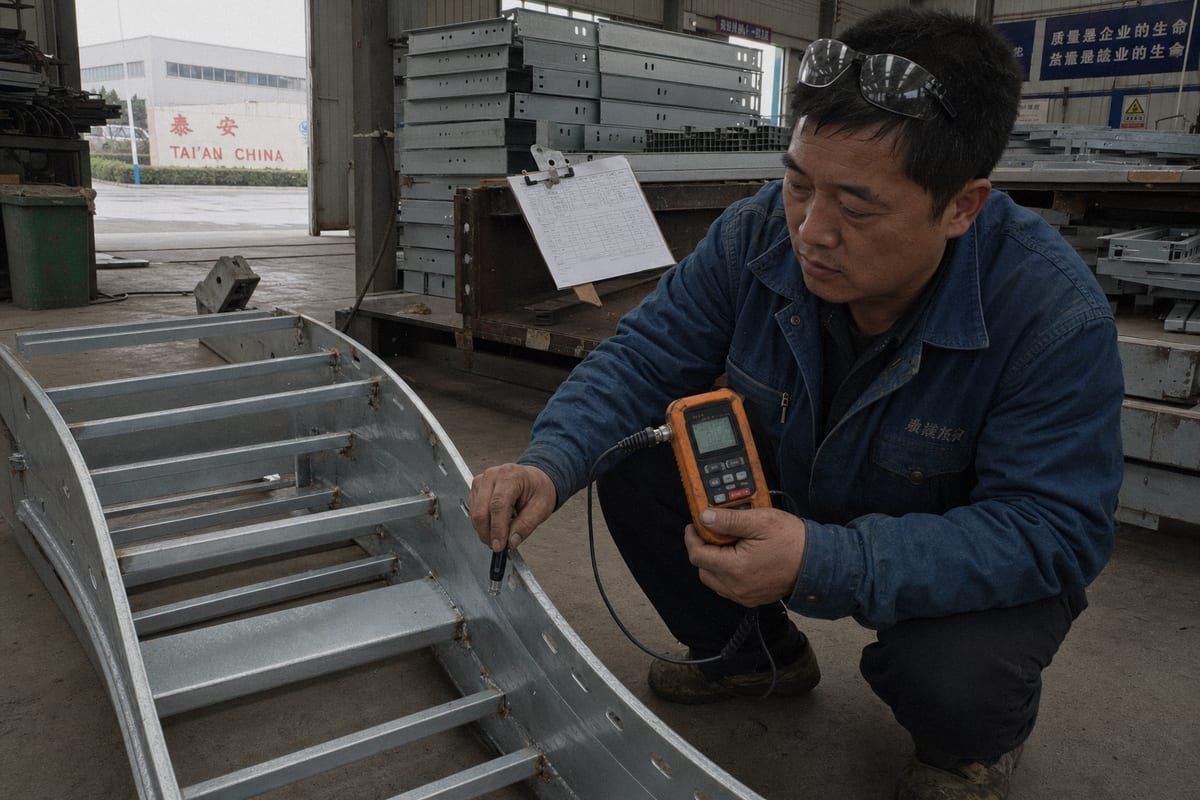
Recently, our factory quoted zinc coating thickness for ladder cable trays going to a Mongolian refinery EPC project, and the spec sheet raised more questions than answers.
For ladder cable trays in Mongolian refinery EPC projects, specify hot-dip galvanized zinc coating of 75 µm minimum and 85–100 µm average, per ASTM A123 or ISO 1461. This covers the C4–C5 refinery corrosivity category, Mongolia’s extreme climate, and abrasive Gobi conditions.
That is the short answer. But the numbers alone do not protect your project magnetic thickness gauge 1. Let me walk you through how we arrive at these figures, and what else you must check.
How do I determine the right hot-dip galvanizing thickness for Mongolia’s harsh climate conditions?
During a technical review call with an EPC engineer sourcing through our Tai’an workshop, the first thing I asked was not about thickness. It was about steel gauge and site exposure.
Match zinc thickness to steel thickness and environment. ISO 1461 requires roughly 45–70 µm depending on section thickness, but Mongolia’s refinery service demands 75–85 µm minimum, plus a 10–15 µm erosion margin in Gobi wind-sand zones, targeting 85–100 µm average.
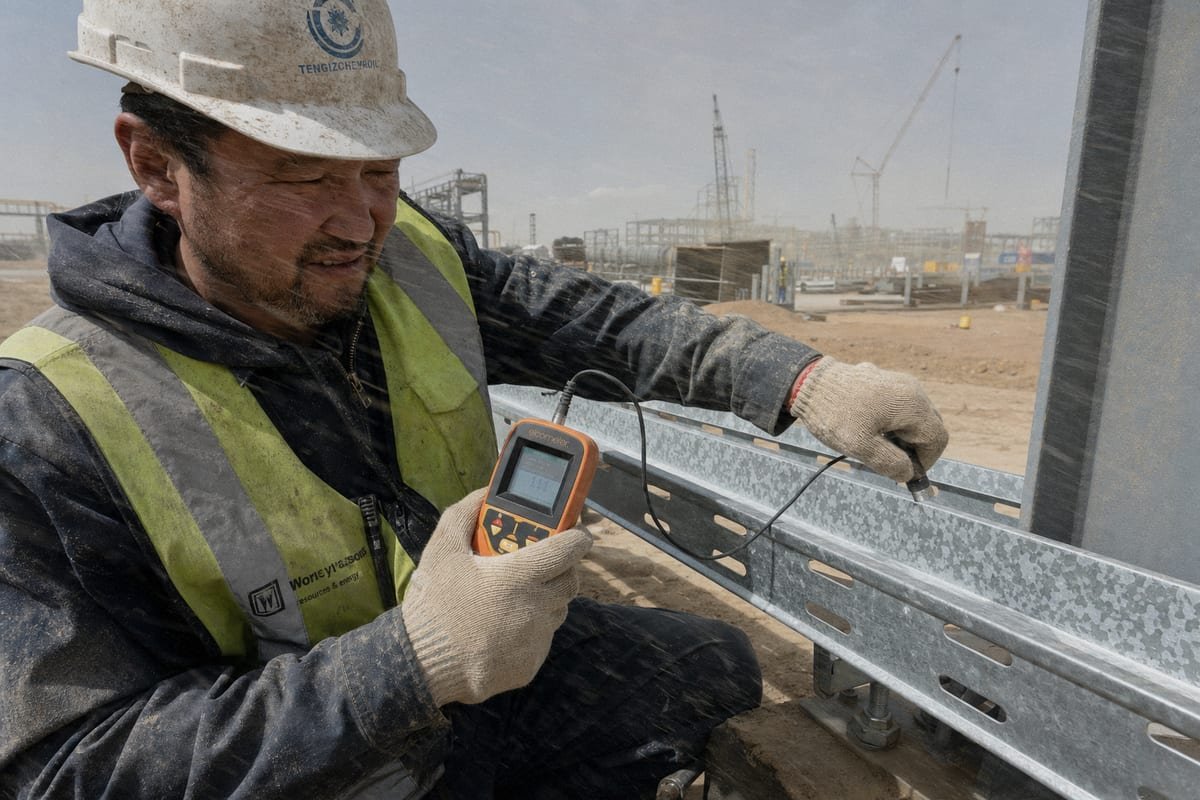
There is no single universal “correct” number. Hot-dip galvanizing standards link micron coating thickness 2 to the base steel thickness. A 2 mm tray rung and a 6 mm side rail legitimately carry different minimums under ISO 1461 specifications. So when you write a spec, you must think in layers: the compliance floor, the refinery target, and the local climate adjustment.
Start with the standard baseline
Here is how the compliance floor typically maps out under ISO 1461:
| Steel Section Thickness | ISO 1461 Minimum Average Zinc | Typical Tray Component |
|---|---|---|
| 1.5–3 mm | ~45 µm | Rungs, covers, light accessories |
| 3–6 mm | ~55 µm | Side rails, splice plates |
| Over 6 mm | 70–85 µm | Heavy side rails, support brackets |
These are baselines, not refinery choices. Around 60 µm suits indoor or mild outdoor exposure. Aggressive humid or industrial zones 3 need 70–85 µm. Chemical plants and refineries often need more than 85 µm.
Then adjust for Mongolia
Mongolia adds three specific stresses. First, the extreme continental climate swings from -40°C to +40°C. Coatings much above 100 µm can become brittle under this thermal cycling, so an 80–85 µm range balances corrosion resistance with ductility. Second, wind-borne sand in Gobi regions acts as a constant abrasive, which justifies that 10–15 µm erosion margin. Third, the hyper-arid air slows formation of the protective zinc carbonate patina, so freshly galvanized trays face early white rust 4 risk if stored badly. Thicker zinc buys time while the patina forms.
In our experience shipping to harsh-climate projects, service life expectancy roughly doubles when you move from 55 µm to 85 µm in a C4 environment. That is why we push clients toward the upper band, not the bare minimum.
Which zinc coating standards should I specify for refinery EPC projects to satisfy owner and inspection requirements?
A Singapore project director I work with once had a shipment questioned on site because the spec said “galvanized” with no standard cited. That one missing line cost him three weeks of clarification emails.
Specify ASTM A123 or ISO 1461 for hot-dip galvanizing after fabrication, reference ISO 12944 corrosivity category C4 or C5, and require NEMA VE 1 compliance for tray structure. State both minimum spot thickness and average thickness, or coating mass in g/m², explicitly.

Refinery owners and third-party inspectors do not accept vague language. They want a named standard, a measurable number, and a clear measurement convention. Here is how the main references compare:
| Standard | Scope | What It Controls |
|---|---|---|
| ASTM A123 5 standards | HDG on fabricated steel products | Coating grade by material category and thickness |
| ISO 1461 specifications | Batch galvanizing process after fabrication | Minimum local and mean coating thickness |
| ISO 12944 | Corrosivity classification | Defines C4, C5-I environment categories for refineries |
| NEMA VE 1 compliance | Cable tray manufacture and testing | Structural loading, dimensions, tray classification |
Why hot-dip after fabrication matters
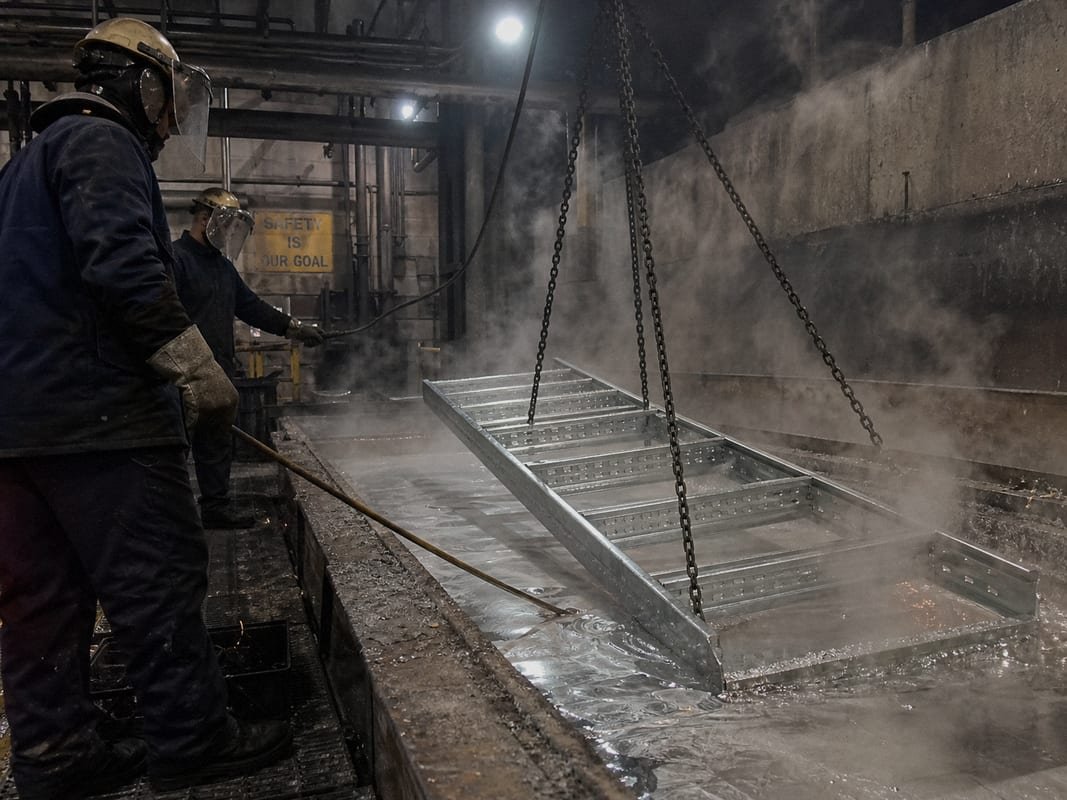
The batch galvanizing process dips the fully welded tray into molten zinc. Every weld, cut edge, and rung gets a continuous metallurgical bond. Pre-galvanized or electrogalvanized trays carry a far thinner coating, often under 20 µm, and their cut edges stay exposed. For refinery service, they are simply not the same protection class. Refinery atmospheres carry moisture, dust, sulfur-containing gases 6, and occasional chemical contamination. That combination pushes many process areas into the C4 or even C5-I environment bracket.
Avoid the units trap
Some documents quote mean coating mass, like 610 g/m². Others quote average thickness, around 75–86 µm. Others quote minimum spot thickness. These are not interchangeable. When we prepare technical submittals for EPC clients, we always state all three so the owner, the inspector, and our production team read the same number. Do not compare figures across specs unless you confirm which convention applies.
How can I verify zinc coating thickness and quality before shipment to avoid QC issues on site?
One habit we built into our QC routine after an early shipment dispute: every galvanized batch now gets a documented thickness map before it goes anywhere near a container.
Verify coating with a calibrated magnetic thickness gauge at multiple points per component, checking both average and minimum spot values against ASTM A123 or ISO 1461. Add visual inspection of welds and edges, adhesion checks, and a signed inspection report with photos before shipment.
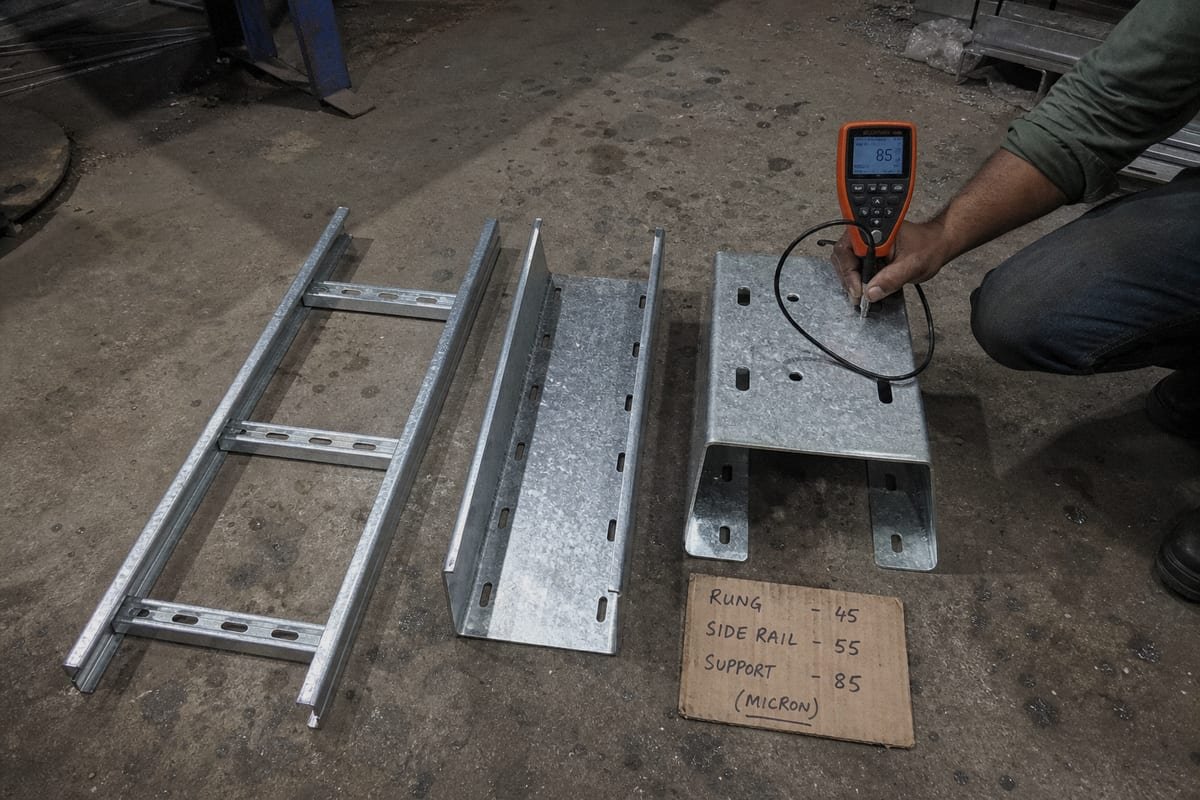
Thickness numbers alone do not guarantee quality. From my experience, most premature corrosion problems come not from insufficient zinc, but from poor fabrication, damaged coatings during handling, or untreated cut edges and welds. So a proper pre-shipment inspection covers the whole corrosion protection system, not just one gauge reading.
A practical pre-shipment inspection sequence
- Calibrate the gauge. Use a magnetic non-destructive thickness gauge, zeroed on bare steel and verified with a reference foil.
- Measure in a grid. Take at least five readings per side rail and several per rung set. Record average and minimum spot values separately.
- Inspect welds and cut edges. These are the first failure points. Check for bare spots, flux inclusions, and rough zinc spikes.
- Check coating uniformity and adhesion. Look for flaking, blisters, or dross. High-adhesion Class A galvanizing matters because trays face rough long-haul transport across Mongolian terrain.
- Confirm repair provisions. Any touched-up area should use zinc-rich repair paint with 90%+ zinc dust, and repair kits should ship with the trays for site touch-ups.
- Document everything. Photos, gauge readings, batch numbers, and a signed report keep site QC arguments short.
Some owners also request salt spray testing 7 on sample pieces as supporting evidence. It is not a substitute for thickness measurement, but it demonstrates the corrosion resistance class of the finished coating. We also advise clients on storage: keep trays ventilated and off wet ground, because Mongolia’s dry air delays the protective patina and stacked wet trays develop white rust fast.
Will thicker zinc coating affect my cable tray’s lead time, cost, and customization options for this project?
The trade-off I weigh most often with EPC buyers is not thickness versus price. It is thickness versus predictability of delivery, because refinery schedules punish late steel more than expensive steel.
Moving from standard to heavy galvanizing typically adds 8–15% to material cost and a few days of process time, mainly from longer zinc immersion and stricter QC. It rarely limits customization, but fittings, elbows, and accessories must be ordered galvanized after fabrication together.
Let me break down where the real impacts sit, because buyers often overestimate one factor and ignore another.
Cost, time, and design impact at a glance
| Factor | Impact of Heavier Coating | Practical Note |
|---|---|---|
| Zinc material cost | Moderate increase | More zinc mass per m²; zinc price fluctuates |
| Process time | Slightly longer | Extended immersion in the batch galvanizing process |
| QC and documentation | More checkpoints | Grid measurements, reports, photos add hours not weeks |
| Customization | Minimal restriction | Custom widths, radii, and elbows galvanize the same way |
| Packing and freight | Slightly heavier | Marginal weight gain; sturdy pallet packing matters more |
Where lead time really slips
In our production planning, the coating itself is rarely the bottleneck. Delays usually come from three places. First, incomplete specs that force clarification rounds mid-production. Second, mismatched accessories, where trays arrive at 85 µm but brackets and clamps were sourced pre-galvanized. Third, rework after a failed inspection, which can cost two full weeks. All three are avoidable with a complete technical submittal agreed before fabrication starts.
Customization stays wide open. Our clients regularly order non-standard rung spacing, custom bend radii on 90-degree elbows, and reinforced side rails over 6 mm. Those heavier sections actually take zinc better, which supports the 85 µm target. My advice: lock the coating spec, steel gauges, and accessory list in one document, then confirm the service life expectancy assumption with the owner. A slightly higher unit price on properly galvanized trays is far cheaper than a return shipment or a site rejection.
Conclusion
Underspecify zinc and your refinery trays corrode early. Overspecify and coatings crack in Mongolia’s cold. Target 75–100 µm under ASTM A123 or ISO 1461, verify before shipment, and protect the whole system.
Footnotes
- Technical guide on using magnetic gauges to measure non-magnetic coating thickness on ferrous substrates. ↩︎
- Official ISO standard defining the requirements for micron coating thickness on batch galvanized steel products. ↩︎
- Wikipedia entry for ISO 12944, which classifies industrial zones and other environments by their corrosivity. ↩︎
- Scientific explanation of white rust formation on galvanized steel due to moisture and lack of air. ↩︎
- Standard specification for zinc coatings on iron and steel products, essential for refinery project compliance. ↩︎
- Information on sulfur-based gases which contribute to the high corrosivity of refinery environments. ↩︎
- Official ASTM standard for operating salt spray (fog) apparatus, used to test coating corrosion resistance. ↩︎