
Half the HDG cable tray RFQ checklists reaching our Tai’an office say only “quote galvanized tray.” We cannot price that, and the buyer ends up with five incomparable bids.
An HDG cable tray RFQ checklist should state tray type, length, width, side rail height, thickness, quantity, covers, indoor or outdoor use, cable loads, support span, galvanizing standard and coating thickness, fittings, test documents, packaging, Incoterm, and delivery date, so every supplier quotes the same scope.
That is a long list. It does not need to be a long document. Below I break it into four groups: technical specs, galvanizing, delivery, and quality control Incoterms 1. I will also show where I see RFQs go wrong.
What Technical Specifications Should I Define Before Requesting a Quote?
A project director in Singapore once sent me a route length and nothing else. I had to ask seven questions before I could open a quote sheet.
Define tray type (ladder, perforated, or solid), length, width, side rail height, material thickness, quantity per size, cover requirement, indoor or outdoor use, cable weight, support span distance, and whether quantities were counted from drawings. These eleven items let suppliers quote the same product.
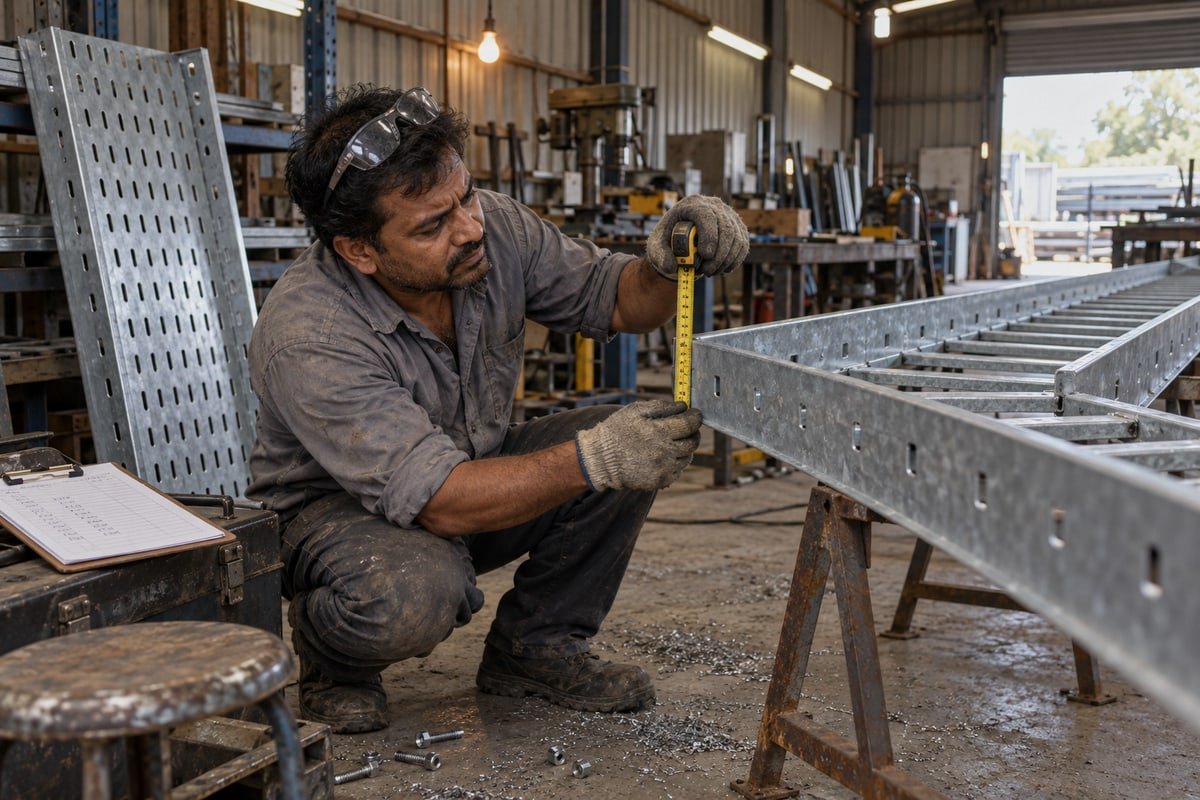
The questions we ask before opening a quote sheet
In our office, every quote starts with the same short list. If the RFQ answers it, we can price the job the same day. If not, we go back and forth on WhatsApp for a week. The list is simple on purpose.
| Item | Why it matters to the price | Example of a complete entry |
|---|---|---|
| Length | Sets section count and container loading | 3,000 mm straight sections |
| Width | Sets usable cable space and cost per meter | 300 mm nominal, 280 mm clear inside |
| Height (side rail height) | Sets stiffness and cable fill depth | 100 mm |
| Thickness | Drives steel cost and load bearing capacity | 2.0 mm rails and rungs, 1.2 mm cover |
| Quantity | Per size, not just total meters | 120 pcs 300×100, 60 pcs 200×100 |
| Cover needed? | Separate item, separate price | Yes, solid cover with hold-down clamps |
| Indoor or outdoor? | Decides coating, drainage, and fittings | Outdoor, coastal site |
| Counted from drawings? | Tells us how firm the fitting count is | Yes, from route drawings Rev. B |
That last row deserves a note. When a buyer confirms the list came from drawings, I know the elbows, tees, and risers are real counts. When the list is an estimate, we quote fittings as an allowance and flag it in the offer. Those two bids will never look the same.
Ladder type vs perforated: say which one
Ladder type vs perforated is not a cosmetic choice. Ladder tray carries heavier power cables over a longer support span distance and gives better ventilation. Perforated tray suits smaller control and instrumentation cables and supports the cable along its full length. Solid-bottom tray blocks dust and some interference but traps water outdoors. Pick one and write it down. Also state rung spacing or perforation pattern if your cable ties or clamps depend on it.
Load, span, and future capacity
The tray must be sized by the cables, not by the free route width. Give the cable type, outside diameter, weight per meter, the number of each size, and the arrangement, such as single layer, stacked, or trefoil. Then state the support span distance and the allowable deflection. If you want NEMA VE 1 compliance 2, name the load class, for example Class 12C, instead of writing "heavy duty." If you work to IEC 61537 3, state the safe working load and the test span. Add spare capacity as a percentage or reserved width. I see 20 to 30 percent often, but the project engineer should set that number, not the supplier. Finally, separate nominal width from minimum clear internal width. A supplier can meet an outside dimension and still leave you short of cable space.
How Can I Specify Hot-Dip Galvanizing Standards in My RFQ?
A coating gauge reading once settled a dispute for us. The buyer had written "galvanized" and assumed hot-dip. His budget assumed pre-galvanized sheet.
Name the governing standard and edition, such as ASTM A123 or ISO 1461, require hot-dip galvanizing after fabrication, state minimum zinc coating thickness in microns or g/m², define the measurement method, the corrosion category from C1 to C5-M, and the repair procedure for damaged coating.

Pre-galvanized sheet or hot-dip after fabrication?
Both products are "galvanized." They are not the same product, and they do not cost the same. Your RFQ must say which one you want.
| Process | How the zinc gets there | Cut edges and punched holes | Where it fits | What to write in the RFQ |
|---|---|---|---|---|
| Pre-galvanized | Coil is coated before forming and punching | Bare steel, relies on zinc nearby | Dry indoor, light duty | "Pre-galvanized sheet, state coil coating mass" |
| Hot-dip after fabrication | Finished part is dipped in molten zinc | Fully coated, thicker layer | Outdoor, coastal, industrial | "HDG after fabrication to ASTM A123 or ISO 1461 4" |
| Electrogalvanized | Thin electroplated layer | Thin everywhere | Indoor, cosmetic | Do not treat as interchangeable with HDG |
Post-fabrication HDG has its own trade-offs. The part needs vent and drain holes. Long thin sections can distort in the bath. Our drawings allow for that, but the RFQ should accept it too.
Write the number, not the word
ASTM A123 standards 5 tie minimum zinc coating thickness to the steel thickness category. ISO 1461 does the same. One supplier guide quotes 85 microns as a minimum in a BS EN ISO 1461 context. I would not copy that figure as a universal rule. Instead, state the standard, the edition, the steel thickness band, and the measurement method, such as magnetic gauge with a set number of readings per piece. Add appearance limits for bare spots, runs, and zinc build-up in splice holes. State the repair method for damaged areas, usually zinc-rich paint or thermal spray, with a minimum repair thickness. Then restrict field drilling, cutting, and welding. This is why I push buyers toward factory grounding lugs or bite-through splice plates. No-drill grounding keeps the zinc intact on site.
Match the coating to the environmental exposure conditions
"Outdoor" is not a specification. Give the corrosion resistance class, C1 through C5-M per ISO 9223. A dry inland warehouse and a coastal desalination plant are both outdoor. They are not the same job. Buyers often ask me, "Should I just go stainless to be safe?" My honest answer is: sometimes. Severe chloride, chemical splash, or hygienic washdown can justify stainless steel despite its price. Aluminium or FRP make sense where weight or non-conductive properties matter. For most C2 to C4 sites across Southeast Asia, Africa, and South America, our mid-range HDG tray gives the better life-cycle cost. Ask the supplier for a service-life estimate based on site zinc loss rates, not a generic brochure claim. If the owner follows REACH or RoHS, add a lead-free or low-lead zinc bath requirement.
What Delivery and Logistics Details Should I Confirm With My Supplier?
We weigh one trade-off on nearly every Southeast Asia order: ship early in partial lots, or wait and ship complete. The RFQ should decide that, not the forwarder.
Confirm the Incoterm, delivery destination, lead time from approved drawings, partial shipment rules, packaging and transport corrosion protection, container loading plan, price validity, payment terms, warranty, and itemized pricing for tray, fittings, covers, supports, fasteners, and freight. Comparing bids with different scopes or Incoterms is meaningless.
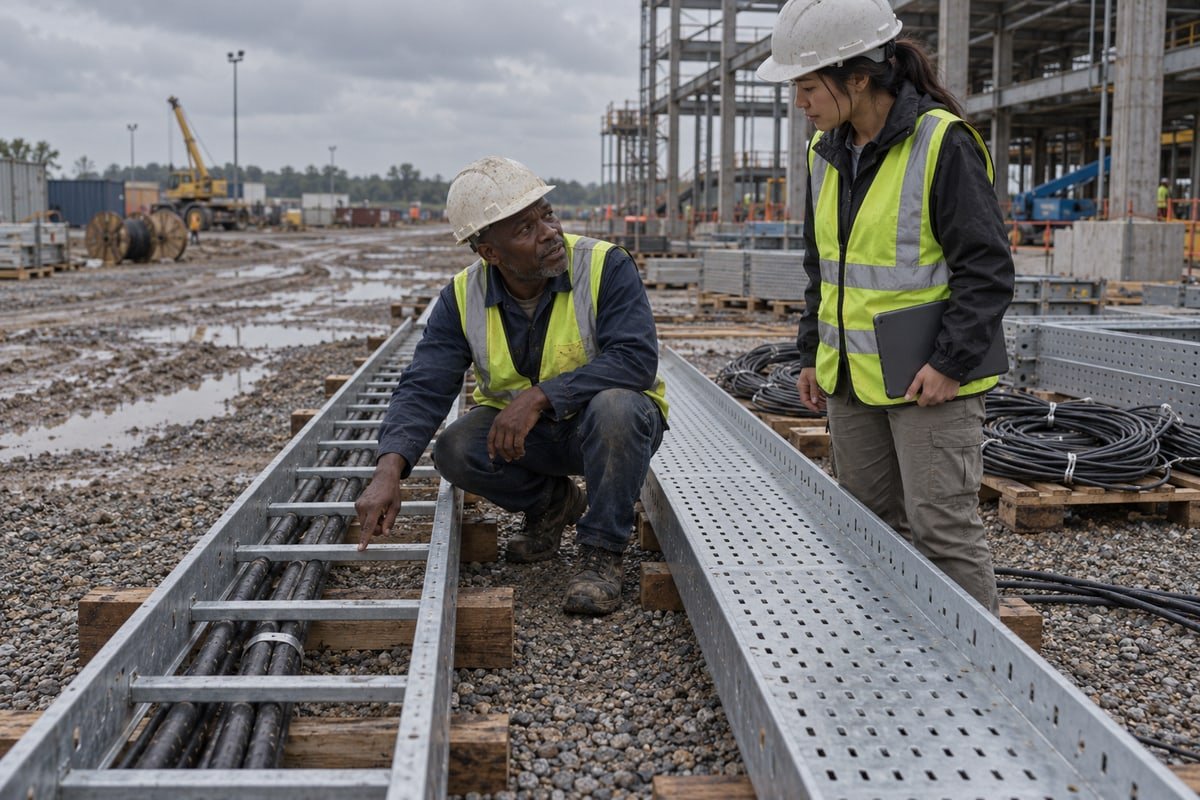
Start with a complete bill of materials
Most RFQ failures I see happen here. The buyer lists straight sections and nothing else. Then the installer discovers the route needs forty elbows. Your bill of materials should cover straight sections, horizontal elbows, vertical inside and outside bends, tees, crosses, reducers, risers, drop-outs, covers with clamps, splice plates, bonding jumpers, brackets, trapeze supports, threaded rod, end caps, dividers, expansion joints, all fasteners, and recommended spares. Ask for each line priced separately with a tag, dimensions, quantity, and unit weight. Also say whether fittings must be factory-made or may be cut on site. If site cutting is allowed, require the supplier's repair and bonding instructions.
Why two similar quotes are not similar
Here is a pattern I see in bid comparisons for a typical 300×100 mm HDG ladder tray package.
| Item | Quote A | Quote B |
|---|---|---|
| Tray, 2.0 mm, 3 m sections | Included | Included |
| Fittings | "To be advised" | Itemized |
| Covers | Excluded | Included |
| Splice plates and bolts | Included | Excluded |
| Incoterm | FOB Qingdao | CIF Singapore |
| Load test evidence | Catalog table | Third-party report |
| Lead time | 25 days from PO | 35 days from approved drawings |
Quote A looks cheaper on the first page. After you add fittings, covers, and sea freight, it may not be. After you add a late drawing approval, the 25 days may become 45. Normalize every bid to the same scope and Incoterm before you compare a single number.
Set the clock and the packing rule
- State whether lead time runs from purchase order or from approved drawings. These are different dates and the gap is where delays hide.
- State whether partial shipments are allowed, and what must be in the first lot.
- Define packaging: pallet type, steel strapping, edge protection, and a barrier against moisture during the voyage. Wet storage stain on fresh zinc is cosmetic, but buyers reject it.
- Ask for a container loading plan so nested trays arrive straight.
- Fix the damage inspection window at arrival and the photo evidence required.
- Add price validity, payment terms, and warranty period so no bid carries a hidden assumption.
Our customers' top pain point is late delivery. We share production photos at cutting, galvanizing, and loading so the buyer sees the clock moving.
How Do I Ensure Quality Control Requirements Are Clearly Stated in My RFQ?
A returned shipment taught me my hardest lesson. The trays met our drawing but not the buyer's unwritten expectation. Now I push for written QC in every RFQ.
State QC as bid requirements, not post-order requests: material test reports, zinc coating inspection records, NEMA VE 1 or IEC 61537 load test reports from accredited labs, ISO 9001 certification, an inspection and test plan, a compliance matrix listing every deviation, and pre-shipment inspection rights.

Documents to demand, and when
The timing matters as much as the list. A certificate requested after the order has no leverage. Put the critical ones at bid stage.
| Document | What it proves | Ask for it at |
|---|---|---|
| Material test reports | Steel grade and actual thickness | Bid stage |
| Zinc coating inspection report | Coating thickness per batch, number of readings | Pre-shipment |
| Load and deflection test report | Load bearing capacity for the quoted size, thickness, and span | Bid stage |
| ISO 9001 certificate | A working quality system | Bid stage |
| UL or CSA listing, where required | Electrical safety for the market | Bid stage |
| Inspection and test plan | Hold and witness points | After order, before production |
| Compliance matrix | Every deviation in one place | Bid stage |
The compliance matrix
I ask buyers to attach a blank matrix to the HDG cable tray RFQ checklist. It has five columns: the RFQ requirement, a status of comply, comply with exception, or not applicable, the supplier comment, the supporting document, and the cost or schedule effect of any exception. This stops suppliers from burying "we offer 1.5 mm instead of 2.0 mm" in a footnote on page nine. It also makes technically different offers comparable in one afternoon.
Declaration or third-party evidence?
Procurement teams ask me, "The supplier signs a declaration of conformity. Is that not enough?" For routine indoor runs, often yes. For long spans, hazardous areas, seismic zones, or C5 sites, no. Require an accredited laboratory test for the actual tray family, size, thickness, and span. A straight-section report does not prove elbow, tee, or splice capacity. Say in the RFQ which components fall under the supplier's structural responsibility. Add grounding and bonding requirements too: electrical continuity across splices, bonding jumpers at expansion joints, and factory lugs so no one drills the zinc. If the owner wants digital asset tracking, specify weather-resistant RFID tags on major sections at the factory. Finally, reserve the right to a pre-shipment inspection by your own staff or a third party. Our small team sends coating readings and photos for every batch, but a buyer's witness point is still the strongest control.
Conclusion
Vague RFQs cost you weeks and returns. Write the HDG cable tray RFQ checklist once, with every item above, and every bid becomes comparable and every tray fits the site.
Interested in sourcing the products mentioned in this article? See details and request a quote here:
Footnotes
1. Official source for international commercial terms used in global trade and shipping contracts. ↩︎
2. The primary industry standard for the manufacturing and performance of metal cable tray systems. ↩︎
3. International standard specifying requirements and tests for cable tray systems and cable ladder systems. ↩︎
4. International standard for hot dip galvanized coatings on fabricated iron and steel articles. ↩︎
5. Official site for the ASTM A123 standard governing hot-dip galvanized coatings on iron and steel products. ↩︎