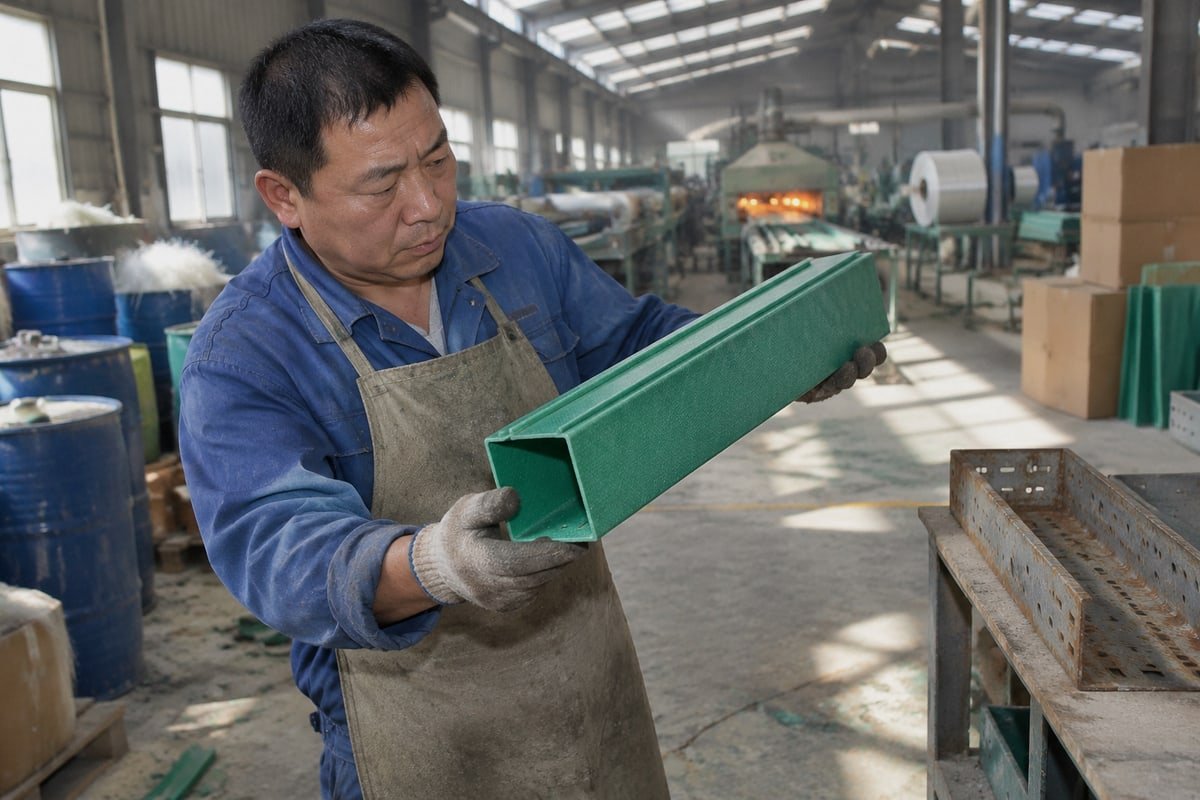
Steel cable tray rusts within a few years on coastal sites, and every replacement stops production. FRP/GRP cable tray, which we pultrude in Tai’an, was built to end that cycle.
FRP/GRP cable tray is a cable support system made from fiberglass reinforced plastic, usually glass fibers set in polyester or vinyl ester resin and formed by pultrusion. It carries and protects electrical cables where steel would corrode, conduct electricity, or add excess weight in chemical, marine, and outdoor sites.
The two names mean almost the same thing. FRP stands for fiber reinforced plastic. GRP stands for glass reinforced plastic. In cable management, both point to the same green or grey fiberglass channel. Below, I compare it with steel, list the real benefits, show where it fits, and explain how to pick a supplier who will not leave your site waiting.
How Does FRP/GRP Cable Tray Differ From Steel Cable Tray?
Every quote we prepare for a Singapore or Philippine site forces one trade-off: a cheaper steel tray today, or a fiberglass tray that outlasts it in salt air.
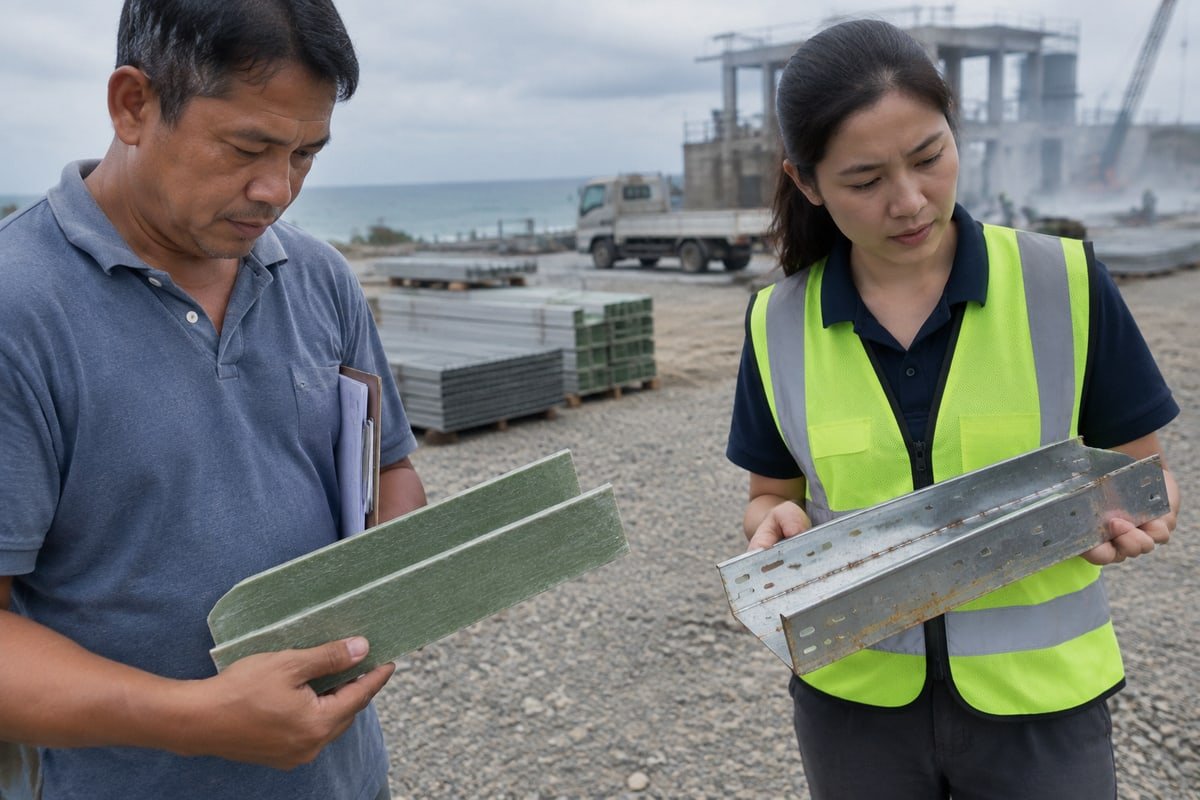
FRP/GRP cable tray differs from steel cable tray in material and behavior. It is a pultruded fiberglass composite, so it does not rust, does not conduct electricity, and weighs far less. Steel is stronger against impact and heat, needs grounding, and relies on galvanizing or paint to resist corrosion.
A Side-by-Side Look
| Property | FRP/GRP cable tray | Steel cable tray |
|---|---|---|
| Material | Glass fiber in polyester or vinyl ester resin, made by the pultrusion process | Carbon steel, hot-dip galvanized, painted, or stainless |
| Corrosion resistance | Built into the material itself | Depends on the coating; fails first at cuts and welds |
| Electrical behavior | Non-conductive and non-magnetic; no tray grounding | Conductive; must be bonded and grounded |
| Weight | Much lighter | Heavy; often needs lifting gear |
| Fire behavior | Depends on the resin; ask for ASTM E84 or UL 94 data | Non-combustible; holds shape longer in fire |
| Impact and high temperature | Lower | Higher |
| Thermal conductivity | Low; does not act as a heat sink | High; passes solar heat to cables |
| Field cutting | Simple saw; seal the cut edge | Cutting breaks the zinc layer |
| Unit price | Higher | Lower |
Where the Differences Come From
Almost every line in that table traces back to the pultrusion process. Continuous glass rovings and mats are pulled through a resin bath 1, then through a heated die. The die cures the profile into its final shape. The result is a channel with a high glass-to-resin ratio, straight edges, and a flat surface. Steel tray, by contrast, is roll-formed or welded from sheet and then galvanized. The zinc layer does the protecting, not the steel. Once that layer is scratched or welded, corrosion starts at that spot.
The Honest Limitations
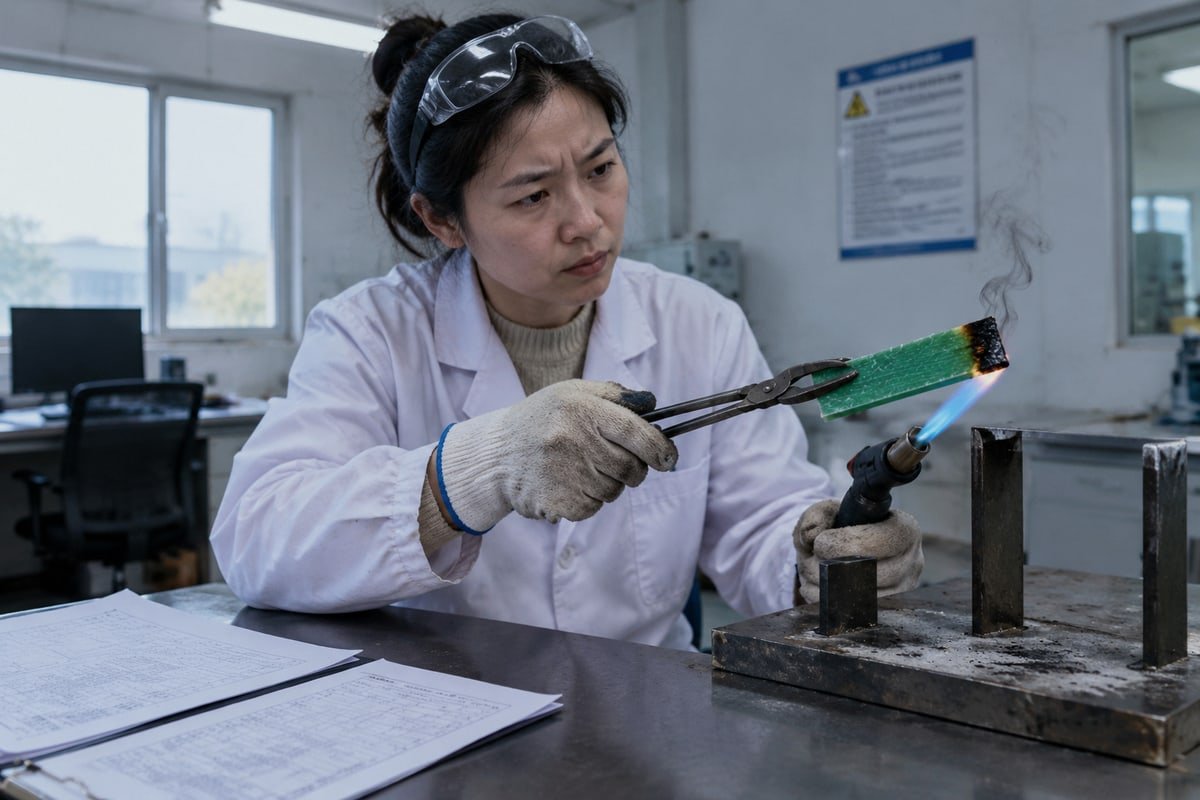
Buyers often ask me whether fiberglass is simply better than steel. It is not. Steel wins on impact resistance, on very high service temperatures, and on fire behavior. A fiberglass composite softens and loses strength in a fire long before steel does. So fire performance must be specified, not assumed. We handle this with a fire retardant resin system 2, and we ask the buyer to state the flame spread and smoke rating the project needs before we run production. For heavy impact zones, a solid-bottom channel with a cover protects the cables better than an open ladder.
Load ratings need the same care. NEMA standards define load and span classes 3 for cable tray, and NEMA FG 1 covers fiberglass systems in particular. Do not assume a fiberglass profile can span the same distance as the steel profile it replaces. Check the support spacing on the drawing.
What Are the Main Benefits of Choosing FRP/GRP Cable Tray for My Project?
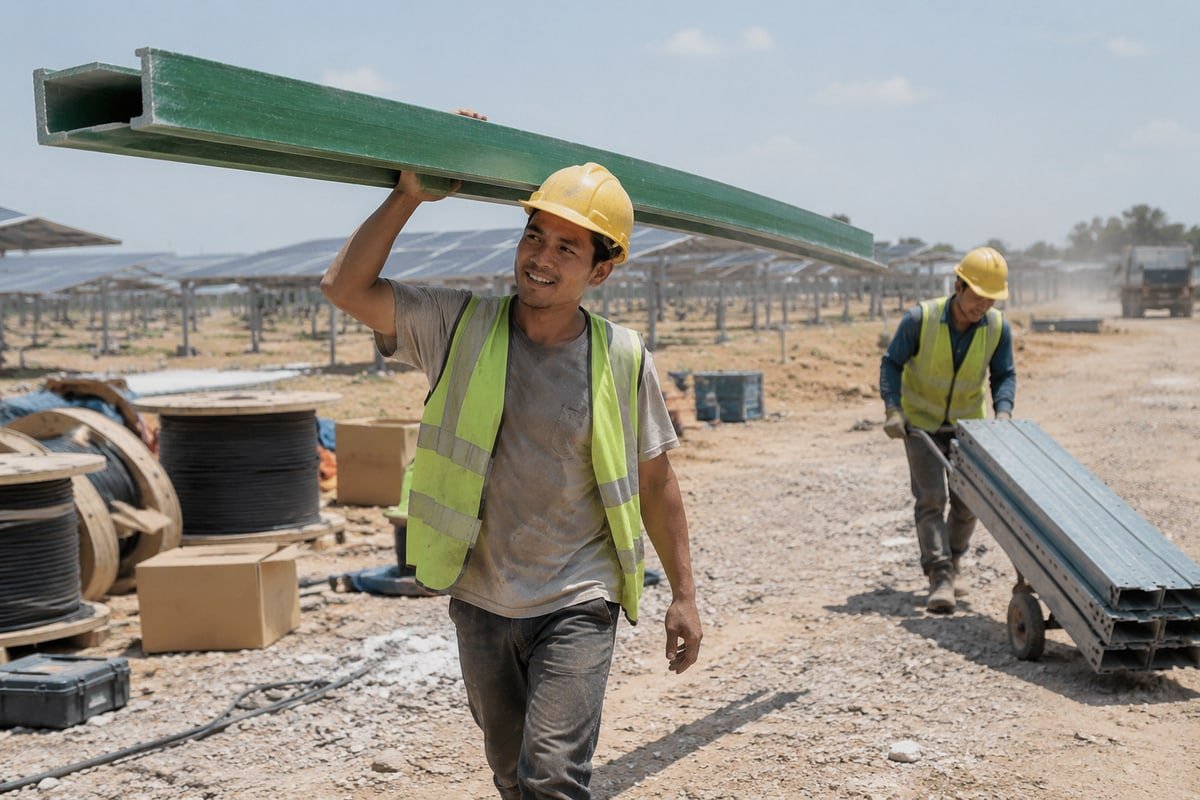
Last month I pulled a freshly pultruded 200 mm channel off our line and lifted it with one hand. That moment sums up half the benefits list.
The main benefits of FRP/GRP cable tray are corrosion resistance, non-conductive safety, low weight, and low maintenance. It needs no grounding, blocks no radio signals, resists UV and chemicals, and installs faster than steel. Over the project life, those savings usually outweigh its higher unit price in harsh sites.
Benefits at a Glance
| Benefit | Technical reason | What it means on site |
|---|---|---|
| Corrosion resistance | The resin matrix is inert to salt, moisture, and many acids and alkalis | No repainting, no rust streaks, no replacement cycle |
| Non-conductive properties | Glass and resin carry no current | No touch voltage, no tray grounding, no eddy current losses |
| Low weight | High glass-to-resin ratio profile | Two workers can lift and fix by hand; lighter supports |
| Electromagnetic transparency | Non-magnetic composite | No interference with 5G and IoT sensor signals |
| Low thermal conductivity | The composite does not act as a heat sink | Steadier cable temperature in hot sun |
| UV protection | Surface veil with UV inhibitors | No fiber blooming or chalking after years outdoors |
| Low maintenance | No coating to inspect or repair | Fewer shutdowns for tray work |
Benefits Most Datasheets Skip
Two points get less attention. First, electromagnetic transparency. Metal tray around high-capacity power cables can carry eddy currents, and those currents waste energy as heat. Metal also reflects radio signals 4, which matters when 5G repeaters and IoT sensors share the same route. Fiberglass does neither. Second, temperature. A steel tray in direct sun heats up and passes that heat to the cables. The composite conducts far less heat, so the cables see a calmer temperature.
There is also appearance. Because pultrusion forms the channel in one piece, the lines stay straight and the surface stays flat. In a clean manufacturing hall or a public facility, that looks tidier than an angle-steel frame with weld beads. Our green channels leave the die with a smooth resin skin and no sharp burrs, and we add a UV veil to the outer layer for outdoor jobs.
Is It Always the Cheaper Choice? No.
Here is the decision logic I share with buyers. First, judge how corrosive the environment is. Second, estimate the full lifecycle cost 5, including repainting, downtime, and replacement. Third, and only then, compare unit price. Fiberglass costs more per meter than galvanized steel. In a dry office corridor, that extra cost buys nothing. In salt air or acid mist, it buys years of quiet service. Looking ahead, resin makers are also introducing bio-based resins and recycled glass fibers, which should lower the embodied carbon of these systems further.
Which Industries and Applications Are Best Suited for FRP/GRP Cable Tray?
A project director in Singapore once messaged me on WhatsApp asking if he should switch his whole office tower to fiberglass. I told him no.
FRP/GRP cable tray suits industries where steel corrodes or conducts danger: chemical plants, refineries, wastewater treatment, offshore platforms, coastal substations, tunnels, solar farms, and power plants. It is best for humid, salty, chemical, or UV-heavy sites, and is usually unnecessary in dry indoor commercial buildings.
Where Steel Struggles and Fiberglass Wins
| Environment | Why steel struggles | Fit for FRP/GRP cable tray |
|---|---|---|
| Offshore and marine applications, wind turbine towers | Salt spray and chloride pitting attack the zinc layer | Excellent |
| Chemical plants and refineries | Acid and alkali fumes eat coatings and welds | Excellent; pick the resin for the chemical resistance needed |
| Wastewater and water treatment | Constant humidity, hydrogen sulfide, chlorine | Excellent |
| Coastal substations and power plants | Salt plus eddy current losses around power cables | Excellent |
| Tunnels and metro lines | Damp, hard to reach, strict smoke rules | Good, with fire retardant resin and test data |
| Solar farms | UV, rain, remote sites with little maintenance | Good, with UV veil |
| Dry indoor office buildings | Steel performs fine and costs less | Usually unnecessary |
Matching the Tray Type to the Job
The environment picks the material. The cable load picks the shape.
- Ladder type cable tray suits heavy power cables that need airflow and easy pull-in. Offshore platforms and power plants use it most.
- Perforated tray suits mixed power and control cables that need some ventilation and a flat bed.
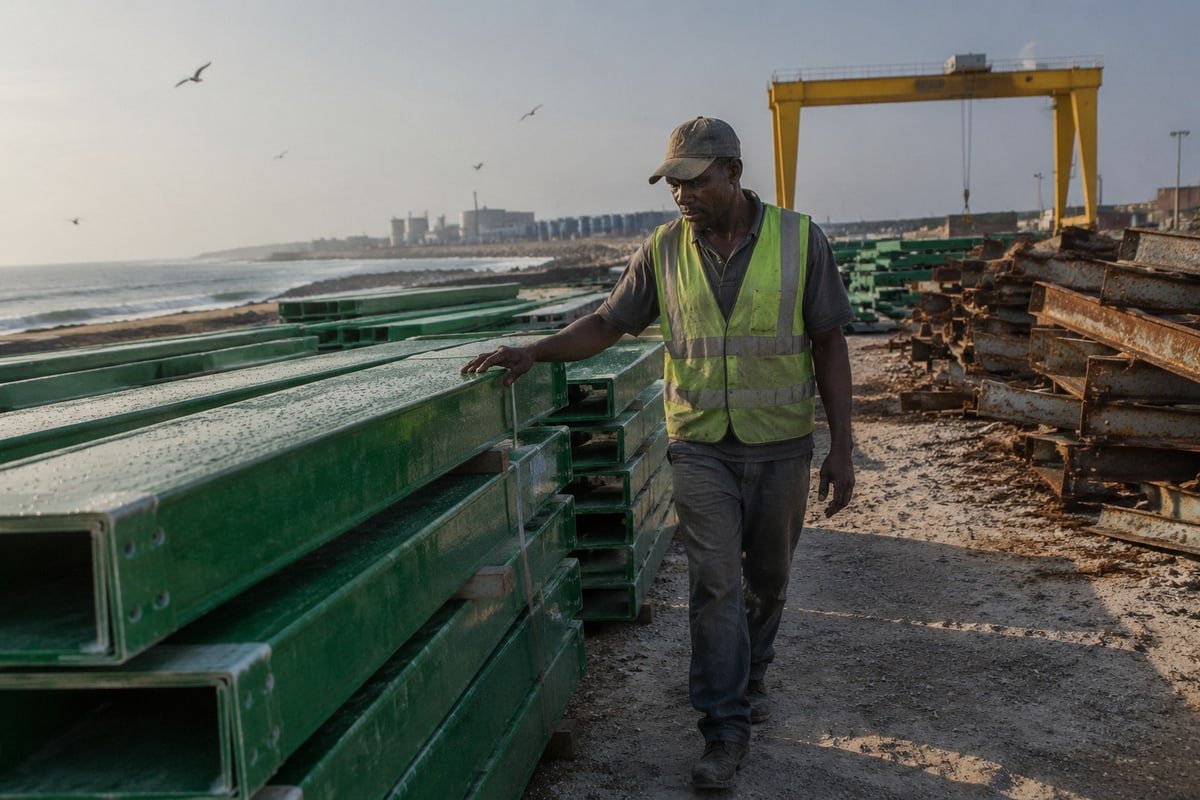
- Solid-bottom channel with cover suits dust, splash, sunlight, and light mechanical protection. Our standard trough is this type. It measures 200 mm by 200 mm with a 3.5 mm wall, and we cut it to the length the drawing calls for. Flat cover panels ship alongside.
- Small channel or trunking suits instrument and data cables along walls or under walkways.
The Rule I Give Every Buyer
I think of fiberglass tray as special equipment for hostile places. In a dry office it is over-specified and uneconomic. Move the same tray to an offshore wind tower, an underground tunnel, a chemical workshop, or a coastal substation, and its value shows at once. In those places, steel faces fast corrosion, electrochemical risk, and painful maintenance access. The composite sidesteps all three. For that Singapore tower, I suggested fiberglass only for the rooftop plant room and the basement pump area, and galvanized steel everywhere else. He kept his budget, and the wet zones got the right material.
How Do I Choose the Right FRP/GRP Cable Tray Supplier for My EPC Project?
Running a three-person export office taught me that a late container hurts a project director more than a slightly higher unit price ever will.
To choose the right FRP/GRP cable tray supplier for an EPC project, check four things: resin and pultrusion quality with test reports, load bearing and fire data against NEMA and ASTM standards, customization and drawing support, and proven delivery control with clear QC records and packing for export.
A Five-Step Checking Process
- Confirm the resin system in writing. Polyester covers general corrosion. Vinyl ester gives stronger chemical resistance. A fire retardant grade is needed where flame spread is regulated. Ask which standard the fire data follows.
- Ask for load bearing capacity data at your actual support spacing. A load-span table referenced to NEMA standards for fiberglass tray tells you more than any glossy brochure.
- Check dimensional control. On our 200 mm by 200 mm channel we measure wall thickness against the 3.5 mm drawing value and check the ends for squareness. Covers and joints only fit when the profile stays true.
- Test the development process with a drawing, not a phone call. A supplier who turns a sketched custom width into a production drawing quickly will save you weeks later.
- Look at how they pack and schedule. Open channels nest inside each other. Stacked properly, they fill a container well, but only if the loading plan is done before the trucks arrive.
Questions That Expose a Weak Supplier
| Question to ask | Good answer | Warning sign |
|---|---|---|
| What is your lead time for 2,000 m of a custom width? | A dated schedule with a buffer | “Very fast” |
| Can I see pre-shipment photos and dimension records? | Yes, for every batch | Only after final payment |
| What happens if a batch arrives out of tolerance? | Replacement terms written in the contract | Silence |
| Who answers my WhatsApp at 9 pm Singapore time? | A named engineer | A shared sales inbox |
| Do you offer OEM/ODM development? | Yes, with drawing review | Catalogue items only |
Why Small Teams Can Win Here
Our office in Tai’an is three people. That sounds like a weakness for a large EPC package. In practice it means the person who quotes your job is the same person who checks the loading plan and sends the photos. Delivery delays, quality problems, and returns are the three pain points every project director tells me about, and all three come from gaps in communication. Fewer hands, fewer gaps. What we will not do is pretend to hold every certificate. If a project requires a specific third-party test, we say so and arrange it up front rather than promise it after the deposit.
Conclusion
Steel trays keep failing in salt, acid, and damp. Each failure costs money and downtime. Use FRP/GRP cable tray where the environment demands it, and pick a supplier who delivers.
Footnotes
- Technical description of the resin impregnation stage in the pultrusion manufacturing process. ↩︎
- Scientific overview of additives and resins designed to improve the fire resistance of composites. ↩︎
- Official repository for NEMA standards defining performance and load classifications for cable tray systems. ↩︎
- Scientific explanation of electromagnetic waves used for wireless communication and their interaction with materials. ↩︎
- Economic methodology for assessing the total cost of ownership over an asset’s useful life. ↩︎