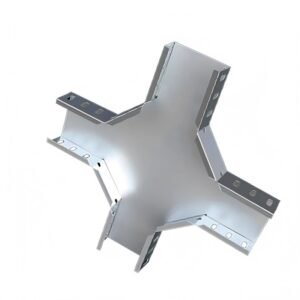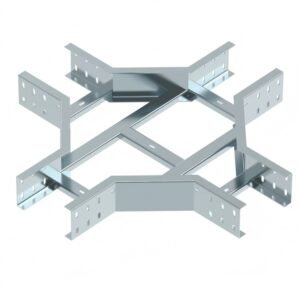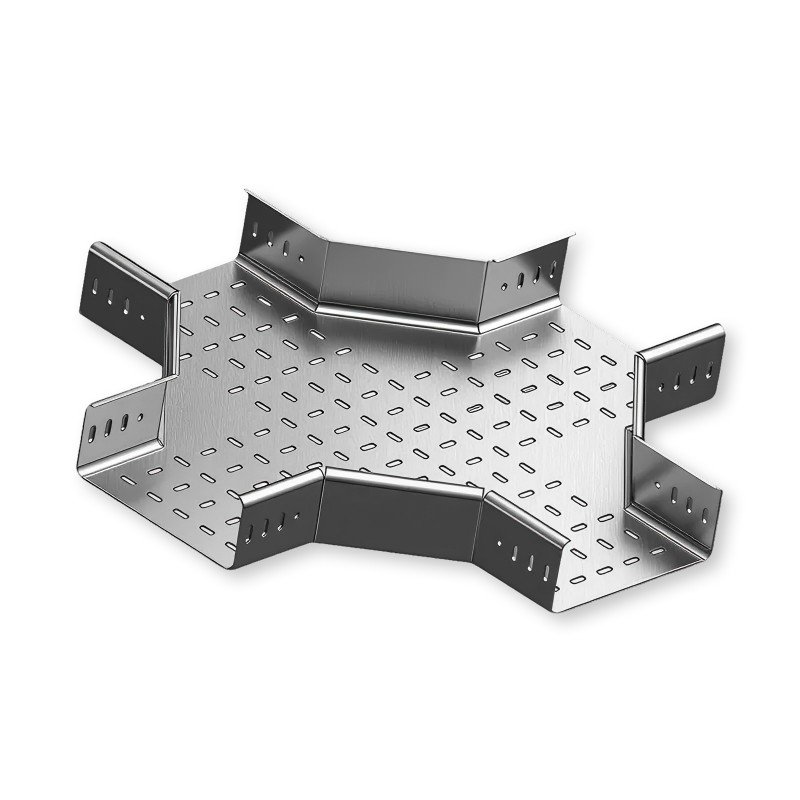
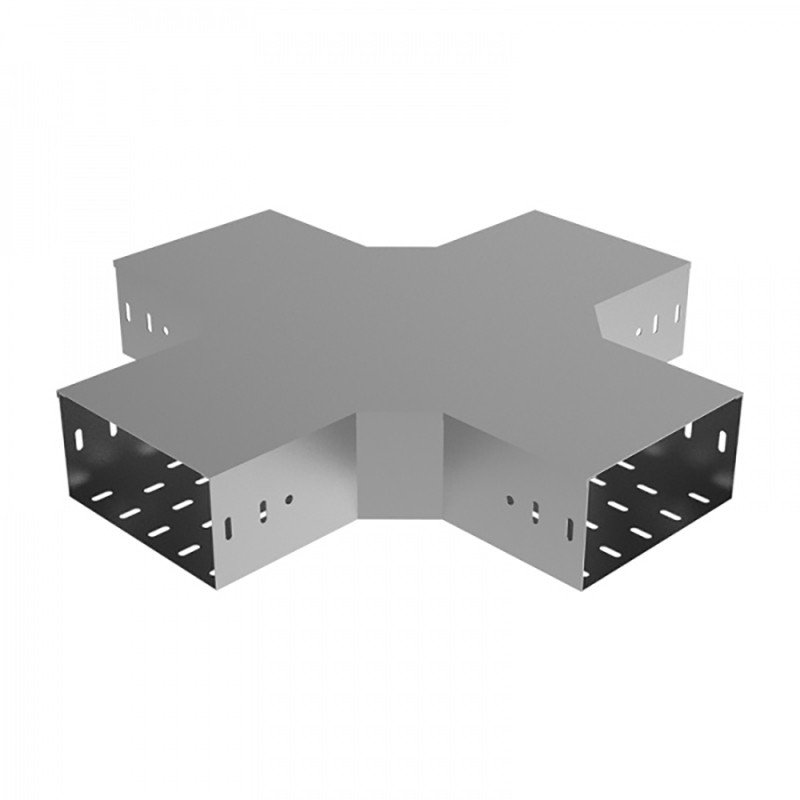
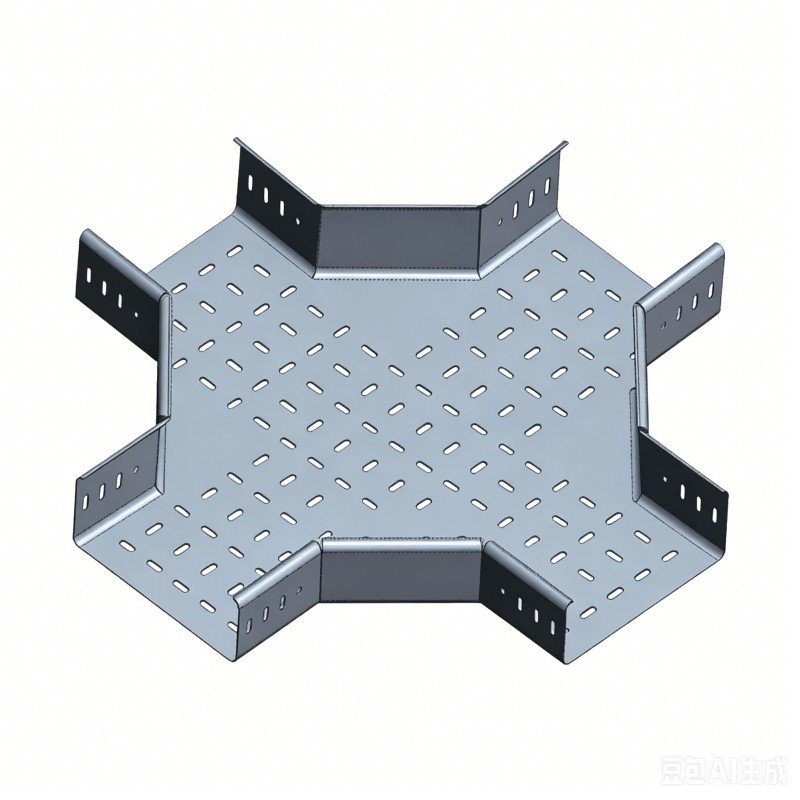
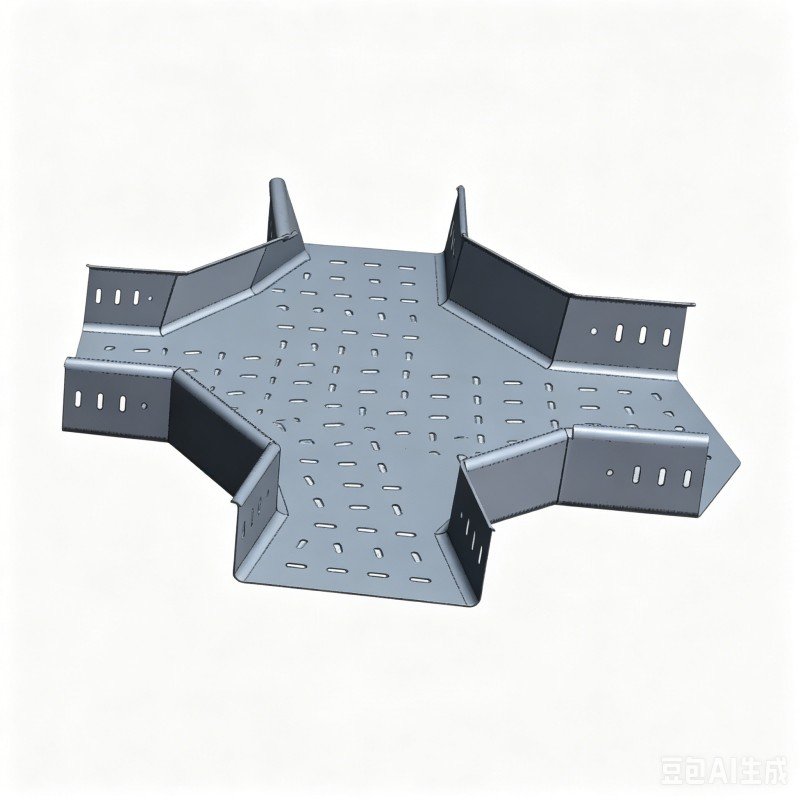
Perforated cable tray four cross, also known as perforated cable tray cross junction or four-way perforated cable tray fitting, is specially designed and engineered for creating four-way intersections in perforated cable tray systems, allowing cables to branch in four directions from a single junction point. As the reliable cable tray manufacturer, Lanye brand custom perforated cable tray four cross is available in various configurations, materials, sizes and forms to suit the location and requirements of the installation. Our perforated cable tray four cross can be used in almost any places including data centers, commercial buildings, industrial facilities, power plants, hospitals, airports, and large-scale cable management installations, etc.
A perforated cable tray four cross is a pre-fabricated fitting used to create a four-way junction in a perforated cable tray system, allowing cables to branch off in four directions (straight through and perpendicular left and right) from a central intersection point. Unlike tees which provide three-way junctions, the four cross provides true four-way branching, making it essential for complex cable routing in large facilities where cable paths must distribute to multiple zones.
Perforated cable tray four cross is commonly fabricated using carbon steel grades Q195 or Q235, as well as stainless steel 304/316 and aluminum. The tray features a perforated bottom pattern matching straight sections, ensuring consistent airflow and cable support through the junction. The four cross is manufactured through standard procedures such as punching, bending, and welding, carried out by a flexible automatic production line, with the same surface finish as straight sections (pre-galvanized, hot-dip galvanized, stainless steel, or aluminum).
Galvanized perforated cable tray four cross exhibits excellent qualities including high strength, a robust design, durability, and resistance to rust. The perforated bottom provides excellent ventilation for cable heat dissipation while offering continuous cable support. The four-way design allows complex cable distribution patterns without requiring multiple separate fittings. These characteristics make it an ideal choice for cable management in large-scale installations where cable paths must radiate from central distribution points. Perforated cable tray four cross is the reliable cable management solution to ensure the longevity and proper functioning of cables in complex routing applications.
| Function | Description |
|---|---|
| Four-Way Branching | Allows cables to route in four directions from a single junction |
| Cable Support | Continuous support through intersection point |
| Ventilation | Perforated bottom maintains airflow for heat dissipation |
| Cable Organization | Clean, organized distribution to multiple zones |
| Space Efficiency | Single fitting replaces multiple tee fittings |
| Easy Installation | Pre-fabricated design simplifies complex intersections |
| Feature | Four Cross | Tee Fitting | Cross Fitting (90° all branches) |
|---|---|---|---|
| Number of Branches | 4 | 3 | 4 |
| Typical Configuration | Straight + left + right | Straight + one side | All four directions equal |
| Best Application | Distribution hub | Branch to one side | Intersection of two runs |
| Space Required | Largest | Moderate | Same as four cross |
| Complexity | High | Moderate | High |
| No | Type | Tray Width (mm) | Tray Height (mm) | Thickness (mm) | Material | Weight (kg/pc) |
|---|---|---|---|---|---|---|
| 1 | Lanye-PFC-1 | 100 | 50 | 1.2 | Pre-galvanized Steel | 6.5 |
| 2 | Lanye-PFC-2 | 150 | 50 | 1.2 | Pre-galvanized Steel | 8.2 |
| 3 | Lanye-PFC-3 | 200 | 75 | 1.5 | Pre-galvanized Steel | 11.5 |
| 4 | Lanye-PFC-4 | 300 | 75 | 1.5 | Pre-galvanized Steel | 15.8 |
| 5 | Lanye-PFC-5 | 300 | 100 | 1.5 | Hot-dip Galvanized Steel | 18.2 |
| 6 | Lanye-PFC-6 | 400 | 100 | 1.5 | Hot-dip Galvanized Steel | 24.5 |
| 7 | Lanye-PFC-7 | 400 | 150 | 2.0 | Hot-dip Galvanized Steel | 32.6 |
| 8 | Lanye-PFC-8 | 500 | 100 | 2.0 | Stainless Steel 304 | 38.4 |
| 9 | Lanye-PFC-9 | 600 | 100 | 2.0 | Stainless Steel 316 | 45.2 |
| 10 | Lanye-PFC-10 | 600 | 150 | 2.5 | Aluminum 6063-T6 | 22.8 |
| Cable Tray Width (mm) | Tray Height (mm) | Overall Size (mm) | Typical Application |
|---|---|---|---|
| 100-150 | 50 | 200-300 | Light duty, data centers |
| 200-300 | 75-100 | 400-600 | Medium duty, commercial |
| 400-600 | 100-150 | 800-1200 | Heavy duty, industrial |
| Parameter | Standard | Custom |
|---|---|---|
| Hole Diameter | 5mm or 6mm | 4mm-10mm |
| Hole Pattern | Staggered | Straight or staggered |
| Open Area | 33% | 20%-50% |
| Edge Distance | 10mm from side rail | As specified |
| Accessory | Availability |
|---|---|
| Cover (Perforated or Solid) | Yes |
| Divider / Separator Kit | Yes |
| Splice Plates and Hardware | Yes |
| Support Brackets | Yes |
| Earth Bonding Kits | Yes |
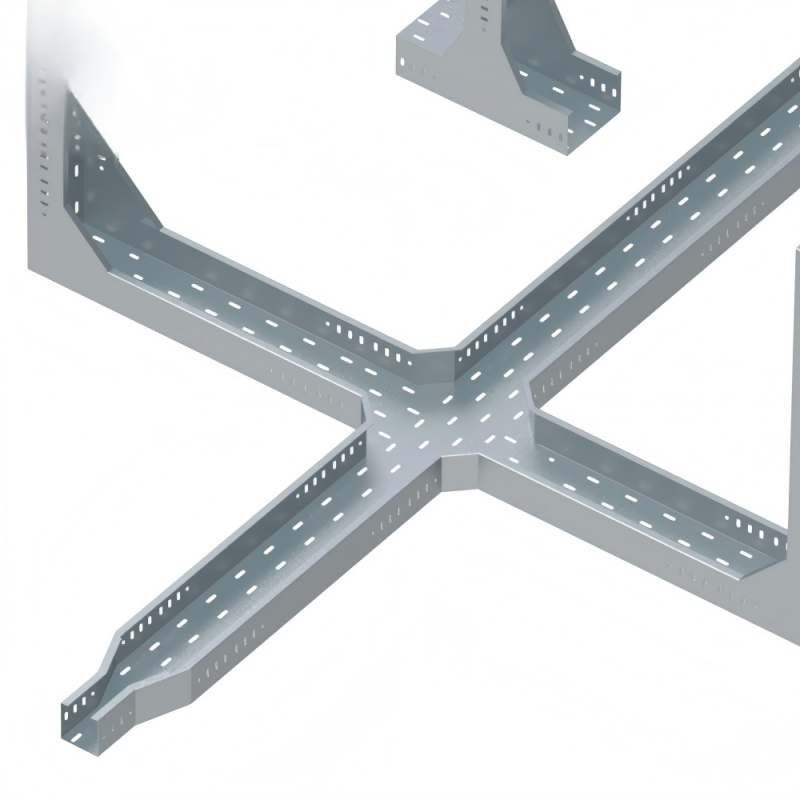
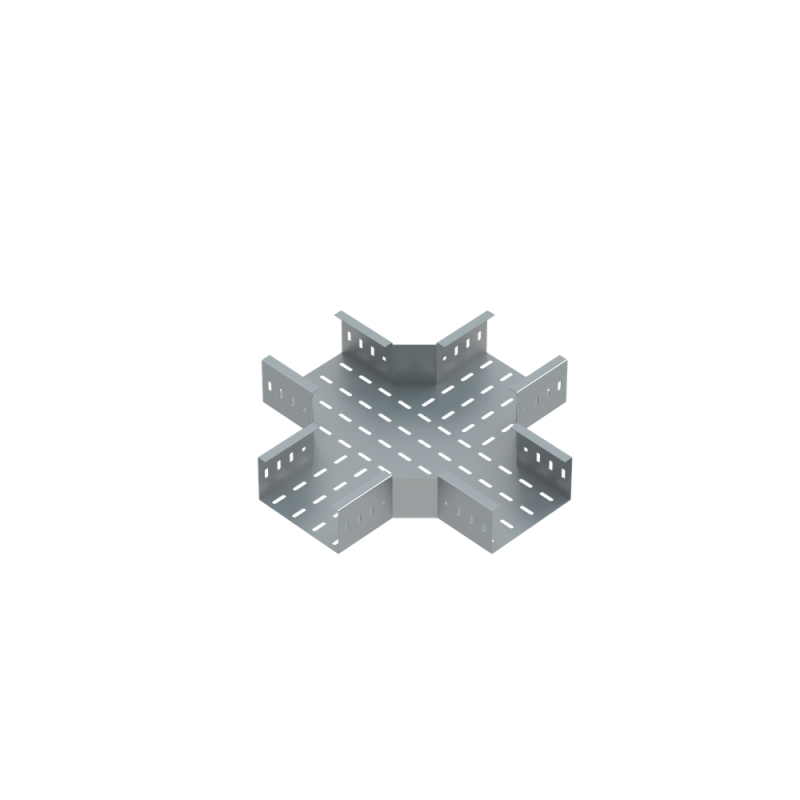
Lanye custom perforated cable tray four cross has the following advantages which make it an excellent choice for efficient cable management solutions.
The four cross fitting allows cables to be distributed in four directions from a single junction point. This is essential for complex cable routing in large facilities where cable paths must radiate to multiple zones, equipment clusters, or distribution panels.
The perforated bottom design maintains consistent airflow through the junction, preventing heat buildup where multiple cable paths converge. This is particularly important in dense cable installations where heat accumulation could degrade cable performance.
The perforated cable tray four cross comes in various sizes, materials, and configurations, allowing customization to suit specific installation needs. Equal crosses have the same width on all four legs, while reducing crosses can have different widths for main and branch runs.
All edges are deburred and rounded to prevent cable jacket abrasion during installation. The perforated bottom also reduces friction compared to solid bottom crosses, making cable pulling through the intersection easier.
The zinc coating (or stainless steel/aluminum material) provides excellent corrosion resistance, safeguarding the four cross from rust and corrosion due to moisture, chemicals, and environmental factors. This feature makes perforated four crosses suitable for indoor and outdoor use.
Each of the four legs includes pre-punched splice holes that align perfectly with straight perforated tray sections, bends, and other fittings. Splice plates, bolts, and grounding jumpers are available for every four cross order.
The four cross is designed with radiused internal corners and smooth transitions to allow cables to flow through the intersection without sharp edges that could damage insulation or impede pulling.
A single four cross can replace multiple tee fittings and additional straight sections, simplifying installation, reducing material costs, and minimizing the number of field connections required.
Custom perforated cable tray four crosses offer OEM/ODM options for tailored solutions to meet specific project requirements, including custom sizes, materials, and perforation patterns.
These custom perforated cable tray four cross solutions come at a competitive factory price, offering cost-effective cable management without compromising on quality or performance.
Perforated cable tray four cross is widely used across many industries where complex cable routing requires four-way distribution from central junction points.
In large data centers, perforated cable tray four crosses are used at main distribution aisles where cable paths branch to multiple server rows, cooling systems, and network equipment. The perforated design allows cooling air to flow freely.
In commercial construction, four crosses distribute power, lighting, and communication cables from main electrical rooms to multiple zones, floors, or tenant spaces.
Industrial facilities use four crosses to distribute control and power cables from central equipment to multiple machines, workstations, or production lines arranged in grid patterns.
In power plants, perforated four crosses route control and auxiliary cables from main cable trenches to multiple equipment locations, panels, and switchgear arranged around central points.
Hospitals require complex cable distribution for medical equipment, nurse call systems, data networks, and power. Four crosses allow organized distribution to patient rooms, operating theaters, and diagnostic areas.
Airports have extensive cable systems for baggage handling, security systems, passenger information displays, and lighting. Four crosses enable efficient distribution to multiple gates, concourses, and check-in areas.
Tunnels, bridges, and subway systems use four crosses to distribute power, lighting, and signal cables from central control points to multiple sections of the infrastructure.
Laboratory complexes often have cable-intensive environments with power, data, and instrumentation cables. Four crosses organize distribution to multiple lab benches and equipment locations.
Determine the optimal location for the four cross fitting. Consider cable entry/exit directions, future expansion needs, and support requirements.
Ensure the four cross is oriented correctly for your cable routing (straight through plus left and right branches). Mark the intended cable paths before installation.
Due to the weight and load concentration at four-way junctions, Lanye recommends placing supports within 12 inches on each side of all four legs. For large four crosses (width over 400mm), additional support under the junction is recommended.
Connect straight perforated tray sections to each of the four legs using splice plates and hardware. Do not fully tighten until all sections are aligned.
If cable separation is required, install divider-compatible inserts that maintain separation through all four legs of the cross.
Route cables through the four cross, respecting minimum bend radii. For large cable bundles, pull cables in stages to avoid overloading the junction.
Secure cables with cable ties. Complete grounding path across all connected sections using bonding jumpers as required.
| Method | Advantages | Disadvantages |
|---|---|---|
| Four Cross (single fitting) | One fitting, clean installation, fewer connections | Higher cost per fitting, requires precise planning |
| Two Tee Fittings | Lower individual fitting cost | Requires two fittings and additional straight sections, more connections |
| Field-Fabricated | Can be adapted on site | Labor intensive, quality varies, no warranty |
Lanye perforated cable tray four crosses are precision-manufactured to match straight sections exactly, ensuring proper fit and alignment.
As a professional cable tray manufacturer, Lanye can provide perforated four crosses based on project drawings, load requirements, and specific routing needs.
Lanye supports OEM and ODM supply for distributors, contractors, and engineering buyers. Private labeling and custom configurations are available.
All Lanye perforated cable tray four crosses undergo strict quality control including dimensional inspection, weld inspection, and finish verification.
A: A perforated cable tray four cross is a four-way junction fitting used in perforated cable tray systems, allowing cables to branch in four directions (straight through, left, and right) from a single intersection point.
A: A tee fitting provides three-way branching (straight through plus one side branch). A four cross provides four-way branching (straight through plus left and right branches), allowing cable distribution to two sides from a single junction.
A: Yes. Lanye offers reducing four crosses where branch legs may be different widths from the main run. Please specify your requirements when ordering.
A: Lanye perforated four crosses are available in pre-galvanized steel, hot-dip galvanized steel, stainless steel 304, stainless steel 316, and aluminum 6063-T6.
A: Due to the concentrated load at four-way junctions, Lanye recommends supports within 12 inches on each side of all four legs. For larger four crosses, additional support under the junction is recommended.
A: Yes. Lanye offers divider-compatible four crosses with pre-slotted side rails that maintain continuous separation through all four legs of the junction.
A: Standard sizes and materials from Lanye typically ship in 5-7 business days. Custom sizes, reducing configurations, or special materials require 10-15 business days.
A: Yes. Lanye offers both perforated and solid covers for four cross fittings, matching the cover type used on your straight sections.
A: For junction fittings, Lanye recommends reducing fill to approximately 60% of straight section capacity to allow for cable bending and intersection congestion. Consult our engineering team for specific calculations.
A: Yes. Lanye offers sample four cross fittings for customer evaluation. Please contact our sales team to discuss sample requirements, size, material, and lead time.