How to Select the Right GI Ladder Cable Tray and Fittings?
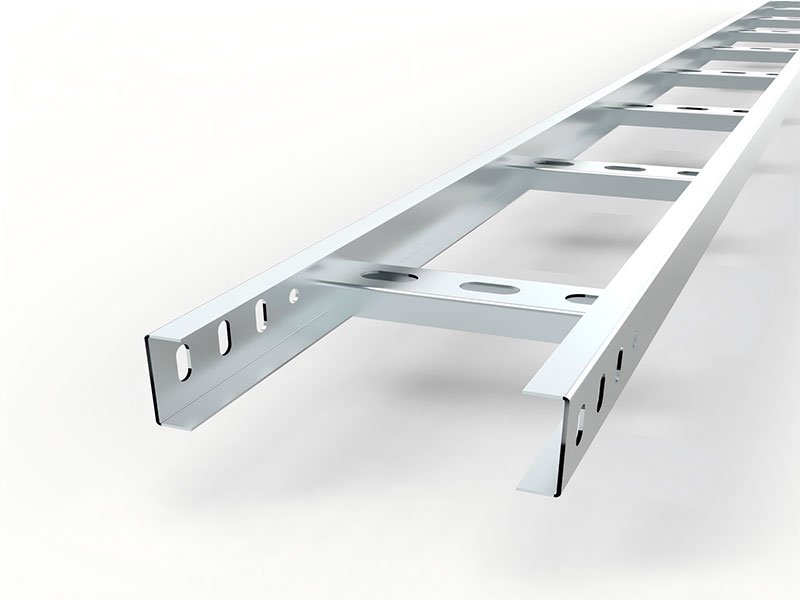
When we first started shipping GI ladder cable tray systems to solar farms in Southeast Asia, the biggest headaches never came from the trays themselves — they came from mismatched fittings, wrong bend radii, and undersized load ratings that nobody caught until cables were already on-site.
Selecting the right GI ladder cable tray and fittings demands a systematic review of cable types, load capacity, environmental exposure, bend radius requirements, and compliance with NEC and NEMA standards. The installation environment and fitting selection matter as much as the tray itself — overlooking either leads to costly rework and safety failures.
This guide walks through every decision point — from material grade and sizing to fittings, bend radius, and the differences between tees, crosses, risers, and reducers. Each section draws on real production and export experience so you can source with confidence.
What Factors Should I Consider When Choosing the Material Grade for My GI Ladder Cable Tray?
A lesson we learned early on our production line: two projects in the same country can need completely different galvanizing specs, simply because one site sits near the coast and the other is inland.
The material grade for a GI ladder cable tray depends on the installation environment — humidity, chemical exposure, UV radiation, and temperature extremes. Hot-dip galvanized steel suits most heavy-duty industrial and outdoor settings, while pre-galvanized finishes work well for controlled indoor environments with lower corrosion risk.
Hot-Dip Galvanized vs. Pre-Galvanized: What Is the Real Difference?
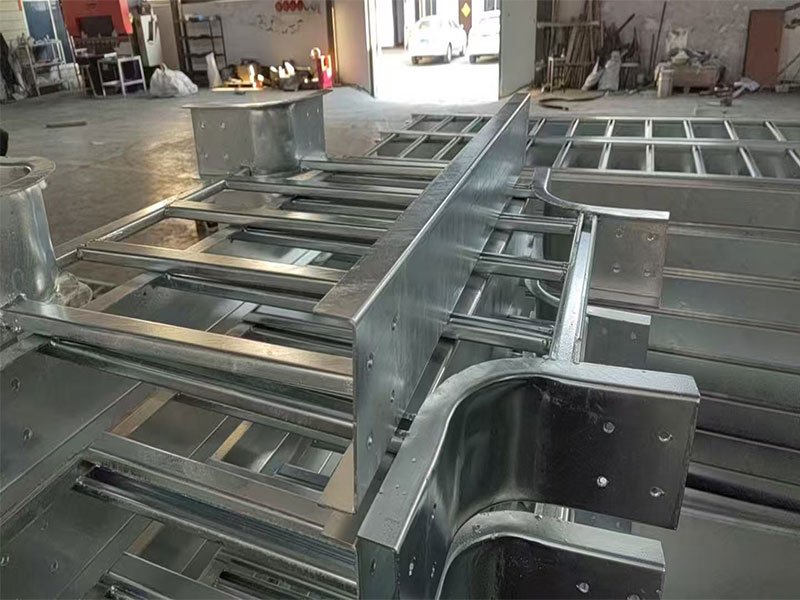
The distinction matters more than most procurement teams realize. A hot-dip galvanized cable tray goes through a bath of molten zinc after fabrication. This coats every cut edge, weld, and bolt hole. A pre-galvanized cable tray uses steel sheet that was zinc-coated before cutting and forming. That means cut edges and welds are exposed bare steel.
For outdoor projects — solar farms, water treatment plants, coastal infrastructure — we always recommend hot-dip galvanized. The coating thickness is typically 65–85 µm, sometimes more. Pre-galvanized coatings run around 20–30 µm. That difference translates directly into years of corrosion resistance.
Material Grade Selection Table
| Factor | Hot-Dip Galvanized | Pre-Galvanized | Stainless Steel | Aluminum |
|---|---|---|---|---|
| Zinc Coating Thickness | 65–85 µm | 20–30 µm | N/A | N/A |
| Corrosion Resistance | High | Moderate | Very High | Moderate–High |
| Best Environment | Outdoor, coastal, industrial | Indoor, dry | Chemical plants, food processing | Lightweight indoor |
| Load Capacity | High | Moderate–High | High | Moderate |
| Relative Cost | Mid-range | Lower | Premium | Mid–High |
| Cut-Edge Protection | Full | None | Full | Full |
When Does Environment Override Everything Else?
I have seen project contractors focus entirely on tray dimensions and ignore the environment. One water treatment project in Africa specified pre-galvanized trays for an outdoor chemical dosing area. Within eighteen months, rust appeared at every joint. The replacement cost was three times the original order.
Here is a simple rule we follow when advising buyers:
- Coastal or high-humidity sites: Hot-dip galvanized, minimum 70 µm coating.
- Indoor commercial or data centers: Pre-galvanized is usually sufficient.
- Chemical exposure or food-grade: Stainless steel or fiberglass cable tray.
- Weight-sensitive overhead runs: Aluminum, if load allows.
Temperature also plays a role. In extreme heat, thermal expansion can stress joints. In freezing conditions, some coatings become brittle. Always confirm the operating temperature range with your supplier before finalizing the material grade.
Electrical Grounding Considerations
Material grade also affects electrical grounding. GI ladder trays can serve as an equipment grounding conductor if they meet NEC Article 392 requirements. The galvanized coating must maintain continuity across joints. When we fabricate trays for projects that require grounding continuity, we include bonding jumpers at every splice. This is a detail that gets missed when fittings are sourced separately from the tray sections.
How Do I Determine the Correct Size and Load Capacity for My Cable Management System?
One trade-off we weigh on nearly every quotation: a buyer wants the narrowest tray possible to save cost, but the cable fill and future expansion demand something wider. Getting this wrong means either wasted material or a system that cannot handle the load.
The correct size and load capacity depend on the total cable cross-sectional area, the combined weight of all cables (current plus future), support span distances, and NEC fill ratio limits. Size the tray to 40% fill at installation to allow room for future cables, and ensure the rated load exceeds total cable weight by a comfortable margin.
Step-by-Step Sizing Process
- List every cable that will run through the tray — type, outer diameter, and weight per meter.
- Calculate total cross-sectional area of all cables.
- Apply the NEC fill ratio: up to 50% for multiconductor cables rated 600V or less. Best practice is 40% at installation.
- Select tray width and depth so the cable bundle fits within the fill limit.
- Calculate total cable weight per meter of tray run.
- Add a growth factor — typically 20–25% for future cables.
- Check the tray’s rated load capacity against the total weight, factoring in the support span.
Common Tray Sizes and Their Typical Applications
| Tray Width (mm) | Tray Depth (mm) | Typical Application | Approximate Load Capacity (kg/m) |
|---|---|---|---|
| 150 | 50 | Light control cables, communication lines | 15–25 |
| 300 | 100 | Medium power distribution, mixed cables | 30–60 |
| 450 | 100 | Heavy power cables, solar string wiring | 50–80 |
| 600 | 150 | Large industrial runs, MV cables | 80–120 |
| 900 | 150 | Major power distribution, EPC backbone | 100–150+ |
These figures vary by manufacturer and material thickness. When we prepare quotations, we always provide a load-span chart specific to the tray profile so the buyer can verify against their engineering calculations.
Why Support Span Matters as Much as Tray Size
A 600mm wide tray rated for 120 kg/m might only achieve that rating at a 2-meter support span. Stretch the span to 3 meters, and the safe load drops significantly. I have seen project engineers specify the right tray but space supports too far apart, leading to visible sag under full cable load.
The relationship is straightforward: longer spans mean lower allowable loads. Always request the load-span table from your supplier. If your project requires longer spans — say, in a large warehouse or solar field — you may need a heavier gauge tray or additional intermediate supports.
NEC Fill Ratio Quick Reference
| Cable Type | Maximum NEC Fill | Recommended Installation Fill |
|---|---|---|
| Multiconductor ≤ 600V | 50% cross-sectional area | 40% |
| Single-conductor ≤ 600V | 40% (sum of diameters ≤ tray width) | 30–35% |
| Multiconductor > 600V | Separated by barrier | Per engineering spec |
| Low-voltage / Communication | 50% | 40% |
Sizing to 40% at installation gives you room for one or two additional cable runs without replacing the entire tray system. For EPC projects where scope changes are common, this buffer has saved our clients from expensive mid-project modifications.
Which Specific Fittings and Accessories Do I Need for a Complete Ladder Tray Installation?
A buyer from Singapore once told me his biggest frustration was not the tray itself — it was arriving on-site and discovering he was missing three elbows, a reducer, and a set of splice plates. Cable tray fittings are the most overlooked items during procurement, and they can halt an entire installation.
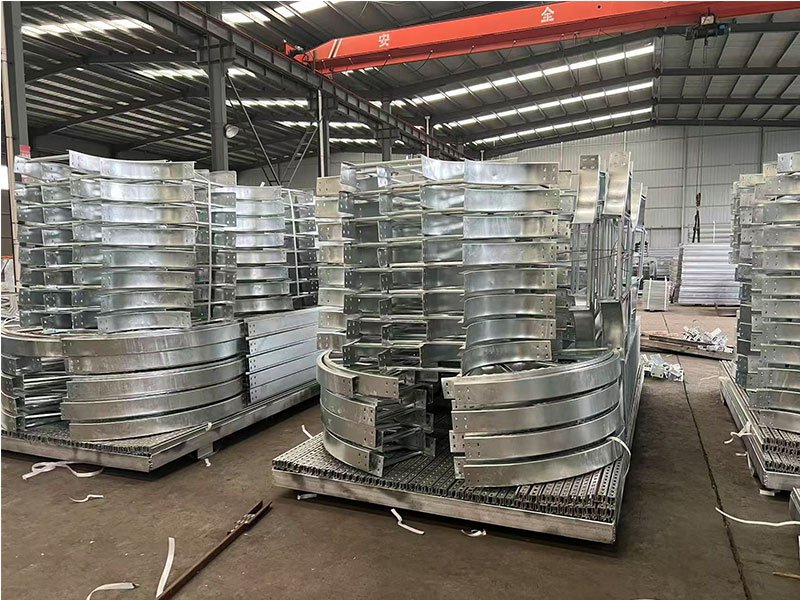
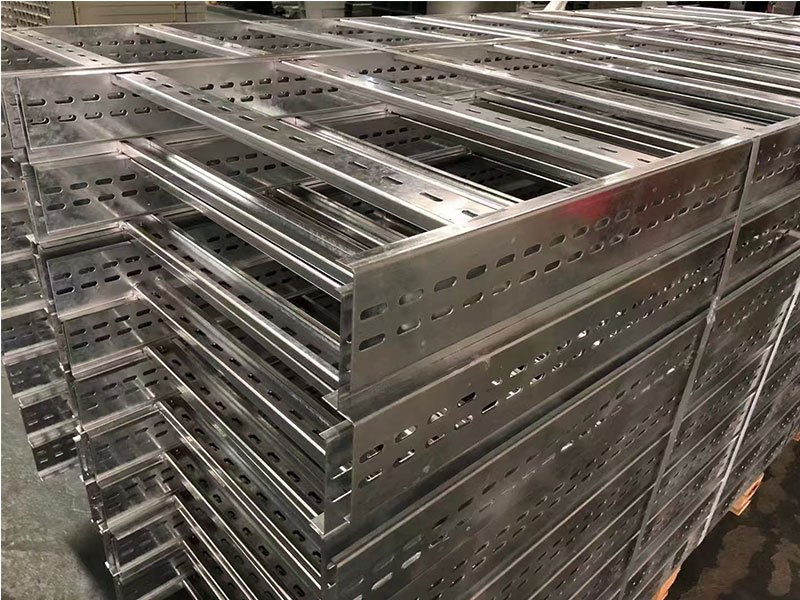
A complete GI ladder cable tray installation requires splice connectors, horizontal elbows (30°, 45°, 60°, 90°), vertical inside and outside risers, tees, crosses, reducers, end caps, support brackets, hold-down clamps, and bonding jumpers. Every directional change, width transition, and mounting point needs a dedicated fitting.
The Core Fittings Checklist
Most cable tray installation projects need the following cable tray accessories at minimum:
- Splice connectors: Join straight tray sections end-to-end. Every joint needs one.
- Horizontal elbows: Change direction on the same plane. Available in 30°, 45°, 60°, and 90° angles.
- Vertical inside risers: Route cables upward from a horizontal run (the tray curves inward).
- Vertical outside risers: Route cables downward from a horizontal run (the tray curves outward).
- Tees: Branch the tray into two directions from a main run.
- Crosses: Branch the tray into three directions from a single intersection point.
- Reducers: Transition between different tray widths — left-hand, right-hand, or symmetrical.
- End caps: Close off the open end of a tray run.
- Support brackets: Wall-mount, ceiling-hang, or floor-stand the tray.
- Hold-down clamps: Secure cables to the rungs, especially on vertical runs.
- Bonding jumpers: Maintain electrical grounding continuity across joints.
How to Estimate Fitting Quantities
The number of fittings depends entirely on the routing layout. Here is a practical approach we use when helping buyers prepare their bill of materials:
- Draw the cable routing path on the floor plan.
- Mark every direction change — each one needs an elbow or riser.
- Mark every branch point — each one needs a tee or cross.
- Mark every width change — each one needs a reducer.
- Count the number of straight sections — each joint needs a splice connector.
- Count the number of support points — each one needs a bracket.
For a typical industrial building, fittings can account for 15–25% of the total cable tray order value. Underestimating this leads to delays. We always recommend ordering 5–10% extra fittings to cover field adjustments.
Why Local Support Under Fittings Matters
Every fitting joint is a potential weak point. NEC and manufacturer guidelines require support brackets directly under or adjacent to fittings. A 90° horizontal elbow, for example, needs a support on each side of the bend. Larger fittings like tees and crosses may need a support directly beneath the intersection.
Skipping these supports causes the fitting to bear the full cable weight unsupported. Over time, this leads to joint separation, sagging, and cable damage. When we ship fittings, we include a support placement guide specific to each fitting type.
How Can I Ensure My GI Ladder Cable Tray Meets the Safety Standards Required for My Industrial Project?
When we calibrate our production tolerances for export orders, the target standard shapes everything — from steel thickness to zinc coating weight to rung spacing. A tray built to NEMA standards differs in measurable ways from one built to IEC specs, and mixing them on-site creates compliance gaps.
To ensure your GI ladder cable tray meets safety standards, verify compliance with NEC Article 392, NEMA VE 1 (tray construction), NEMA VE 2 (installation), and IEC 61537. Confirm the manufacturer provides test reports for load capacity, coating thickness, and electrical continuity. Request third-party certification where required by local codes.
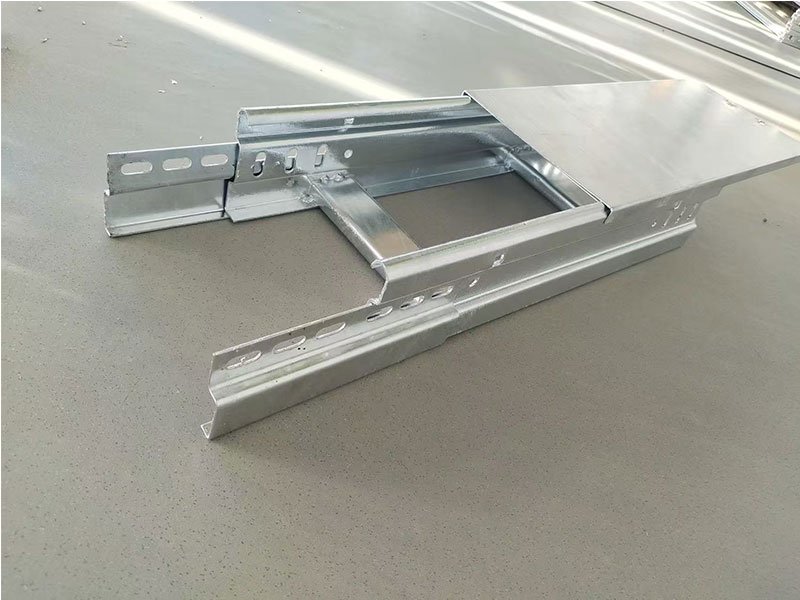
Key Standards and What They Cover
| Standard | Scope | Key Requirements |
|---|---|---|
| NEC Article 392 | Installation rules (USA) | Fill ratios, grounding, cable types, support spacing |
| NEMA VE 1 | Tray construction | Dimensions, load testing, material specs, finish |
| NEMA VE 2 | Installation guidelines | Support methods, grounding, seismic bracing |
| IEC 61537 | International tray standard | Load testing, corrosion testing, dimensional tolerances |
| UL 568 | Product safety listing | Fire resistance, structural integrity |
What to Request from Your Supplier
Compliance is not just about the tray meeting a standard on paper. You need documentation. Here is what we provide to our EPC and wholesale buyers, and what you should request from any supplier:
- Material test certificates (mill certificates) for the steel used.
- Zinc coating thickness reports — measured per ASTM A123 for hot-dip galvanized or ASTM A653 for pre-galvanized.
- Load test reports showing the tray’s performance at specified spans.
- Dimensional inspection reports confirming compliance with NEMA VE 1 or IEC 61537.
- Electrical continuity test results if the tray will serve as a grounding conductor.
Seismic and Vibration Considerations
For projects in earthquake-prone regions or facilities with heavy machinery vibration, NEMA VE 2 provides guidance on seismic bracing. This typically involves lateral bracing at regular intervals and longitudinal restraints to prevent tray movement during seismic events. If your project specification calls for seismic compliance, confirm that your supplier can provide bracing accessories and that the tray system has been evaluated for seismic loads.
Quality Control During Production
On our end, quality control starts with incoming steel inspection and continues through every fabrication step. We check zinc coating adhesion, rung weld strength, dimensional accuracy, and surface finish before packing. For large EPC orders, we invite buyers to conduct pre-shipment inspections or arrange third-party QC. This is especially important for projects in regulated industries like power generation and water treatment, where a failed inspection on-site can delay the entire project timeline.
How to Choose the Correct Cable Tray Bend Radius When Sourcing?
A buyer interaction taught me this lesson clearly: a contractor ordered 300mm radius bends for a tray carrying 35mm diameter armoured power cables. The cable manufacturer specified a minimum bend radius of 6× OD — that is 210mm. It seemed fine on paper. But the cables were stiff, the installation crew struggled to pull them through, and two cables suffered insulation damage at the bend. The problem was not the math. It was choosing the minimum instead of a comfortable margin above it.
The correct cable tray bend radius is determined by the largest cable’s outer diameter multiplied by the manufacturer’s bend radius factor — typically 6× OD for armoured power cables, 7× OD for multi-conductor, and 12× OD for single-conductor cables. Always choose the largest feasible radius within your space constraints to reduce cable stress and extend lifespan.
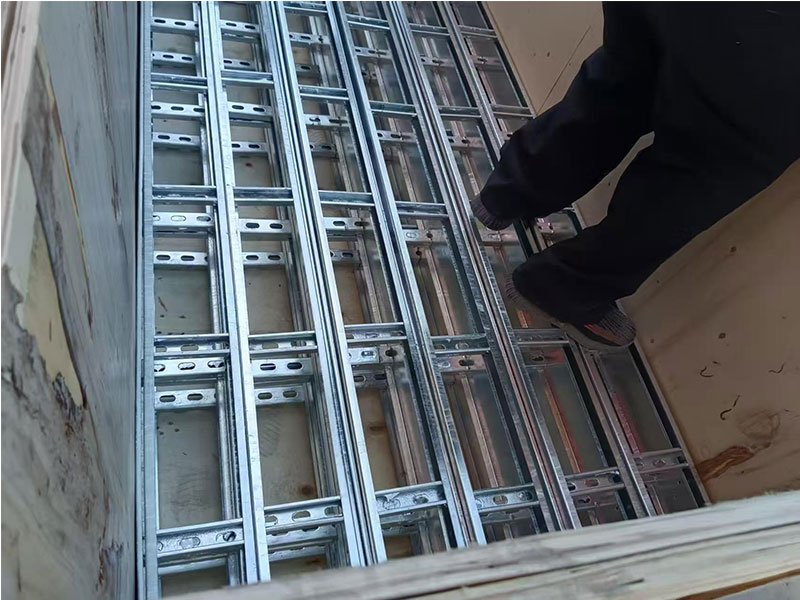
Standard Bend Radius Options
We produce bends in five standard radii. Here is how they map to common cable types:
| Bend Radius | Typical Cable OD Range | Cable Type | Bend Factor Applied |
|---|---|---|---|
| 300mm | Up to 25mm | Light control, communication | 12× for small single-conductor |
| 450mm | 25–40mm | Medium power, armoured | 6–7× OD |
| 600mm | 40–60mm | Heavy power, MV cables | 6× OD |
| 900mm | 60–80mm | Large MV, multi-conductor bundles | 7× OD |
| 1200mm | 80mm+ | Very large single-conductor, fiber optic runs | 10–12× OD |
How to Calculate the Minimum Bend Radius
The formula is simple:
Minimum Bend Radius = Cable Outer Diameter × Bend Factor
The bend factor depends on cable construction:
- Single-conductor, unshielded: 12× OD (per CE Code 12-614)
- Multi-conductor (CSA C68.10): 7× OD
- Armoured power cable: 6× OD
- Fiber optic (under tension): 20× OD
- Fiber optic (installed, no tension): 10× OD
- Ethernet / UTP: 4× OD
Always use the largest cable in the tray to determine the bend radius. If a tray carries a mix of 20mm control cables and 50mm power cables, the bend radius must satisfy the 50mm cable’s requirement.
Space-Constrained Installations
Sometimes the routing path simply does not allow a large radius. In tight mechanical rooms or between closely spaced equipment, you may be forced toward a smaller bend. In these cases:
- Confirm with the cable manufacturer that the chosen radius meets their minimum.
- Consider using cables specifically engineered for low-bend-radius applications.
- If the tray radius must go below the cable’s minimum, consult both the cable and tray manufacturers for a custom solution.
- Limit the total cumulative bend in a single tray run to 360° to avoid excessive stress buildup.
What Specifications to Provide Your Supplier
When you request a quotation for bends, include:
- Bend radius (e.g., 600mm)
- Bend angle (e.g., 30°, 45°, 60°, 90°)
- Tray width and depth
- Material and finish (hot-dip galvanized, pre-galvanized, etc.)
- Whether the bend is horizontal or vertical (inside riser or outside riser)
- Quantity
Providing this information upfront prevents back-and-forth and ensures the bends arrive ready to install. Missing even one detail — like confusing a horizontal elbow with a vertical riser — can cause a fitting that does not match the installation.
What Is the Difference Between Tee, Cross, Outside Risers and Inside Risers, and Reducer?
When we walk new buyers through a fitting catalog for the first time, the most common confusion is between inside risers and outside risers — and when to use a tee versus a cross. These are not interchangeable. Each serves a specific function in the cable tray layout, and choosing the wrong one means rework on-site.
A tee creates a three-way branch from a main tray run. A cross creates a four-way intersection. An inside riser curves the tray upward from horizontal. An outside riser curves the tray downward. A reducer transitions between two different tray widths. Each fitting serves a distinct routing function and cannot substitute for another.
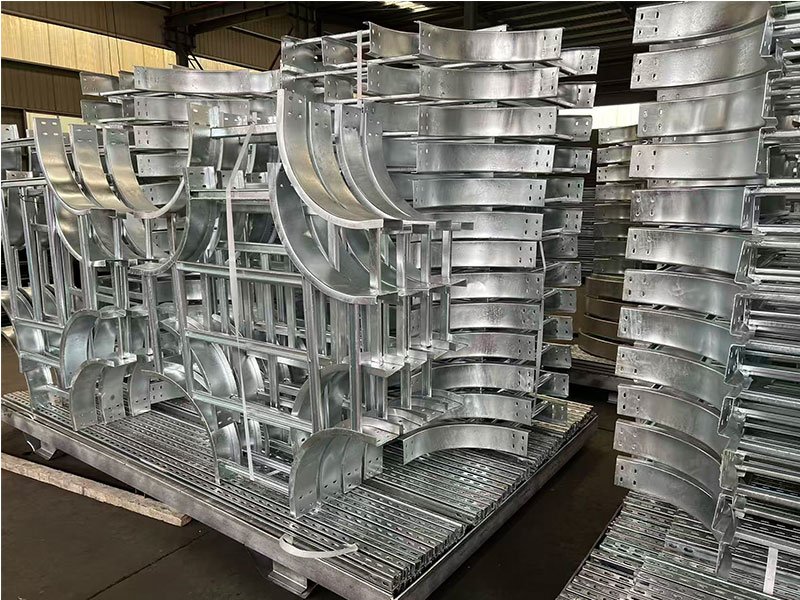
Visual Comparison of Key Fittings
| Fitting | Shape | Direction Change | Typical Use |
|---|---|---|---|
| Tee (T Bend) | T-shaped, 3 openings | Branches one run into two | Splitting a main trunk to feed two zones |
| Equal Cross | Plus-shaped, 4 openings | Branches one run into three | Major intersections, equipment clusters |
| Inside Riser | Curved upward | Horizontal to vertical (upward) | Routing cables from a horizontal run up a wall or column |
| Outside Riser | Curved downward | Horizontal to vertical (downward) | Routing cables from a horizontal run down to equipment |
| Reducer (Left/Right) | Tapered, asymmetric | Width change, same plane | Transitioning from a wide main trunk to a narrower branch |
Tee vs. Cross: When to Use Each
A tee is the most common branching fitting. It connects a main tray run to a single branch at 90°. Use it when cables need to split in one direction — for example, a main corridor tray feeding cables into a side room.
A cross is less common but essential at major intersections. It connects four tray sections at a single point. Use it when two tray runs cross each other and cables need to route in all four directions. Crosses are typical in large industrial plants where multiple cable routes converge at a central point.
If you only need to branch in one direction, a tee is simpler, cheaper, and easier to support. Do not use a cross where a tee will do — the extra opening adds unnecessary complexity and cost.
Inside Riser vs. Outside Riser: The Critical Distinction
This is where most confusion happens. Both are vertical bends, but they curve in opposite directions.
- Inside riser: The tray curves so the cable-carrying surface faces inward (toward the wall or structure). Use this when cables need to go up from a horizontal run.
- Outside riser: The tray curves so the cable-carrying surface faces outward (away from the wall). Use this when cables need to come down from a horizontal run to reach equipment below.
Think of it this way: if you are standing at the horizontal tray and the cables need to climb, you need an inside riser. If the cables need to descend, you need an outside riser.
Getting this wrong means the tray curves the wrong way, and the cables sit on the outside of the bend — unsupported and at risk of falling out. I have seen this mistake on-site more than once. It always results in a replacement order and a delayed installation.
Reducers: Left, Right, and Symmetrical
A reducer connects a wider tray section to a narrower one. This is common where a main trunk feeds into a smaller branch, or where the cable count decreases along a run.
- Left reducer: The tray narrows on the left side (looking in the direction of cable flow).
- Right reducer: The tray narrows on the right side.
- Symmetrical reducer: The tray narrows equally on both sides.
The choice depends on the physical layout. If the tray needs to stay aligned with one wall, use a left or right reducer to keep that side straight. If the tray is centered, a symmetrical reducer keeps the alignment balanced.
Always specify the direction when ordering. A left reducer cannot be flipped to work as a right reducer — the bolt holes and rung alignment will not match.
Practical Ordering Tips
- Count every direction change, branch, vertical transition, and width change on your layout drawing.
- Specify the angle for every elbow and riser (30°, 45°, 60°, 90°).
- Confirm the tray width and depth for every fitting — they must match the tray sections they connect to.
- For reducers, specify both the inlet width and the outlet width, plus the direction (left, right, or symmetrical).
- Order splice connectors for every fitting-to-tray joint.
Conclusion
Selecting the right GI ladder cable tray and fittings is a system-level decision — material grade, sizing, load capacity, bend radius, fittings, and standards compliance all interconnect. Get one wrong, and the entire cable management system suffers. Plan thoroughly, specify precisely, and source from a supplier who understands the full picture.