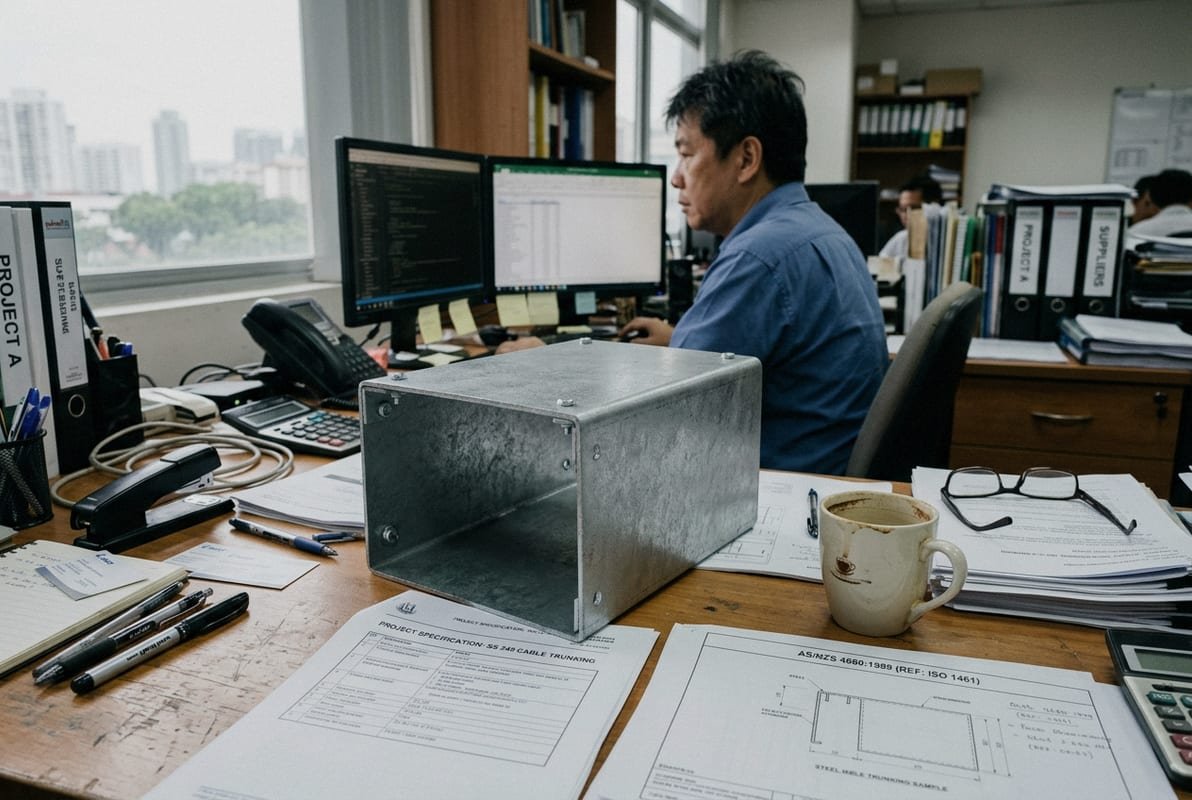
Figuring out HDG cable trunking specs felt overwhelming when I first started coordinating shipments for Singapore projects from our production facility in Tai’an.
To learn HDG cable trunking specs and classifications for Singapore M&E procurement, start by studying Singapore Standard SS 249 and ISO 1461, then master the “width × height × wall thickness” specification language, compare supplier datasheets side by side, and verify hot-dip galvanized coating thickness to ensure corrosion protection in tropical environments.
This guide breaks down every step. I will walk you through compliance standards, dimension selection, quality benchmarks, and how to find the right OEM partner steel surface cable trunking 1. Let us get started.
What specific Singapore M&E standards must I follow for HDG cable trunking compliance?
A question I hear constantly from project directors in Singapore is: “Which exact standard do I write into my tender spec?” When our team prepares export documentation, we cross-reference multiple standards to make sure every shipment clears inspection without surprises Mill Test Certificate (MTC) 2.
For HDG cable trunking in Singapore, you must comply with Singapore Standard SS 249 for steel surface cable trunking, ISO 1461 for hot-dip galvanized coatings, and the Code of Practice for Installation of Fire-Protection (COPIF) rules on cable fill, segregation, and mounting—these three form the compliance backbone for M&E contractors.
SS 249 vs. SS 275: Know the Difference
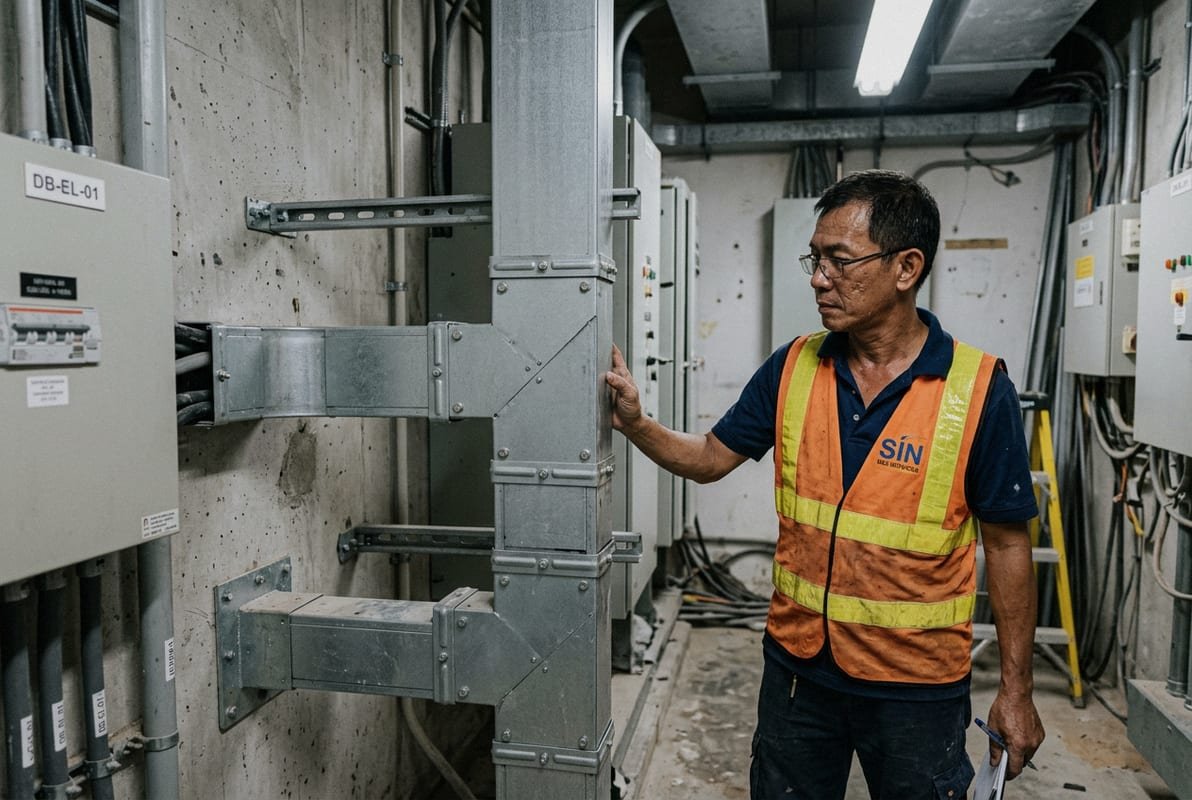
Singapore Standard SS 249 3 covers steel surface cable trunking. It defines material grades, finish types, and dimensional tolerances. Singapore Standard SS 275, on the other hand, covers cable trunking made of insulating material like PVC. If your project calls for HDG steel trunking, SS 249 is your primary reference.
Many M&E contractors confuse the two. I have seen purchase orders referencing SS 275 for a galvanized steel product. That mismatch can delay approvals and force re-submissions.
Understanding SS 249 Class 1
SS 249 Class 1 is designed primarily for indoor use. It typically specifies an electro-galvanized base with an epoxy powder coating of 45–50 microns. This is not the same as true hot-dip galvanized trunking. For outdoor or high-humidity environments—think water treatment plants or rooftop cable management systems—you need full HDG per ISO 1461 4, which delivers a much thicker zinc layer.
ISO 1461: The HDG Gold Standard
ISO 1461 specifies the minimum coating thickness for hot-dip galvanized steel 5. For steel thicker than 6 mm, the minimum average coating is 85 µm. For thinner steel (1.5–3 mm, common in trunking), the minimum is around 45–55 µm. This coating provides the corrosion protection Singapore’s tropical humidity demands.
COPIF Installation Rules You Cannot Ignore
The Code of Practice for Installation of Fire-Protection (COPIF) 6 sets strict rules for cable trunking in Singapore:
| COPIF Rule | Requirement |
|---|---|
| Maximum cable fill | 30% of trunking cross-sectional area |
| Future space allowance | 25% reserved for expansion |
| Access panel size | Minimum 600 × 600 mm |
| Access panel spacing | Every 6 meters |
| Maximum horizontal height | 3.3 meters from floor level |
| Clearance (>400V single-core) | 460 mm from telecom cables |
| Clearance (>400V multi-core) | 300 mm from telecom cables |
Note that the I.E.E. wiring regulations allow up to 45% space factor, but Singapore’s COPIF is stricter at 30%. Always follow the local rule. Overfilling trunking is one of the most common violations I see reported by site inspectors.
Cable Segregation Matters
Cable segregation is mandatory. Power cables and telecommunication cables must be separated—either in different trunking runs or within multi-compartment trunking. This prevents electrical interference. In data centers and hospitals, this requirement is non-negotiable for fire resistance and signal integrity.
How do I choose the right thickness and dimensions for my project’s trunking specifications?
One lesson I learned early on: a procurement manager in Singapore once sent us a Bill of Quantities that listed only trunking lengths—no widths, no heights, no wall thickness. We had to go back and forth for a week before the order was clear. That delay cost both sides time.
To choose the right HDG cable trunking dimensions, first review your project’s electrical drawings and cable schedules, calculate the total cable cross-sectional area, apply the 30% fill rule, then select a trunking size in the standard “width × height × wall thickness” format that accommodates current loads plus a 25% future expansion allowance.
Master the Specification Language
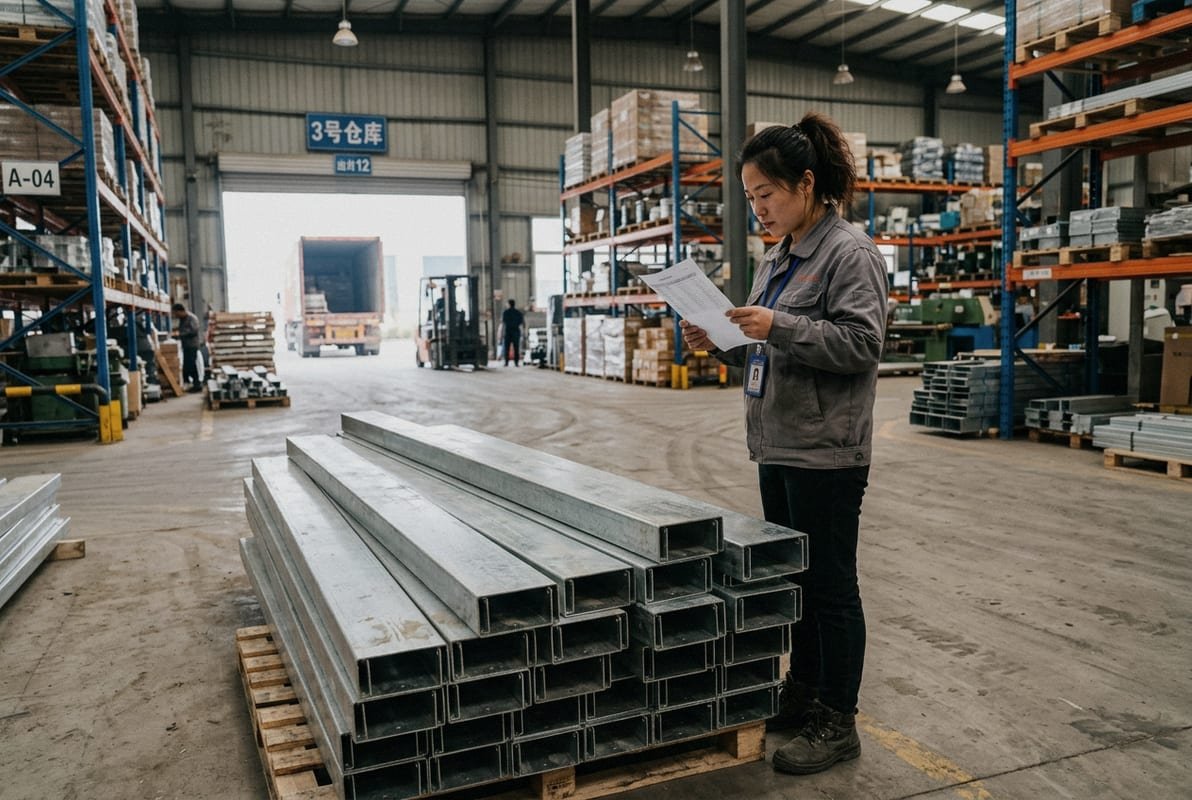
Every supplier in the cable trays and trunking industry uses the same format: Width × Height × Wall Thickness. For example, 300 × 100 × 1.5 mm means the trunking is 300 mm wide, 100 mm tall, and made from 1.5 mm thick steel. Standard lengths are typically 2440 mm per section.
Get comfortable with this format. It is the universal language you will use on every purchase order, every drawing, and every WhatsApp message to your supplier.
Common HDG Trunking Dimensions
Here is a reference table of common sizes we regularly produce and ship for Singapore projects:
| Width (mm) | Height (mm) | Wall Thickness (mm) | Typical Application |
|---|---|---|---|
| 50 | 50 | 0.6–1.0 | Small control cables, residential |
| 100 | 50 | 1.0–1.2 | Light commercial, office fit-outs |
| 150 | 75 | 1.2–1.5 | Medium commercial, data cables |
| 200 | 100 | 1.5 | Industrial facilities, mixed cables |
| 300 | 100 | 1.5–2.0 | Heavy industrial, power cables |
| 400 | 150 | 2.0 | Water treatment plants, large runs |
| 600 | 150 | 2.0–2.5 | Major infrastructure, power plants |
How to Calculate the Right Size
Here is a simple process:
- List every cable that will run through the trunking.
- Find each cable’s cross-sectional area from the manufacturer’s datasheet.
- Add them all up.
- Divide the total cable area by 0.30 (the 30% fill rule). This gives you the minimum trunking cross-sectional area.
- Add the 25% future expansion allowance on top.
- Pick the nearest standard trunking size that meets or exceeds this number.
For example, if your total cable cross-section is 4,500 mm², divide by 0.30 to get 15,000 mm². A 300 × 100 mm trunking has an internal area of roughly 30,000 mm². That gives you plenty of room for the 25% future allowance.
Wall Thickness and Load Capacity
Thicker walls mean higher load capacity. But they also mean higher weight and higher cost. A 0.6 mm wall works for small indoor runs with light cables. For outdoor runs or heavy power cables, you need 1.5 mm or thicker. When we prepare quotations, we always ask about the installation environment and expected cable weight per meter before recommending a thickness.
Trunking Type: Why Solid (Enclosed) Trunking Dominates
HDG solid-bottom cable trunking is fully enclosed. Cables sit inside a protective channel with a cover on top. This design provides maximum shielding against electromagnetic interference 7, dust, and moisture. For sensitive computer cables, communication cables, and fire resistance rated systems, solid trunking is the standard choice. In environments like water treatment plants—where corrosion protection is critical—it is almost always the default.
What quality control benchmarks should I set to ensure my HDG coating lasts in humid environments?
A buyer we work with closely once received a batch of trunking from another supplier that started showing rust spots within six months of installation at a coastal industrial site in Jurong. The root cause was simple: the zinc coating was too thin. That experience taught both of us to never skip coating verification.
Set these QC benchmarks for HDG cable trunking: verify minimum zinc coating thickness per ISO 1461 (45–85 µm depending on steel thickness), require a mill test certificate for every batch, conduct adhesion tests on arrival, and inspect for coating uniformity—especially at bends, joints, and cut edges where corrosion starts first.
Why Coating Thickness Is Everything
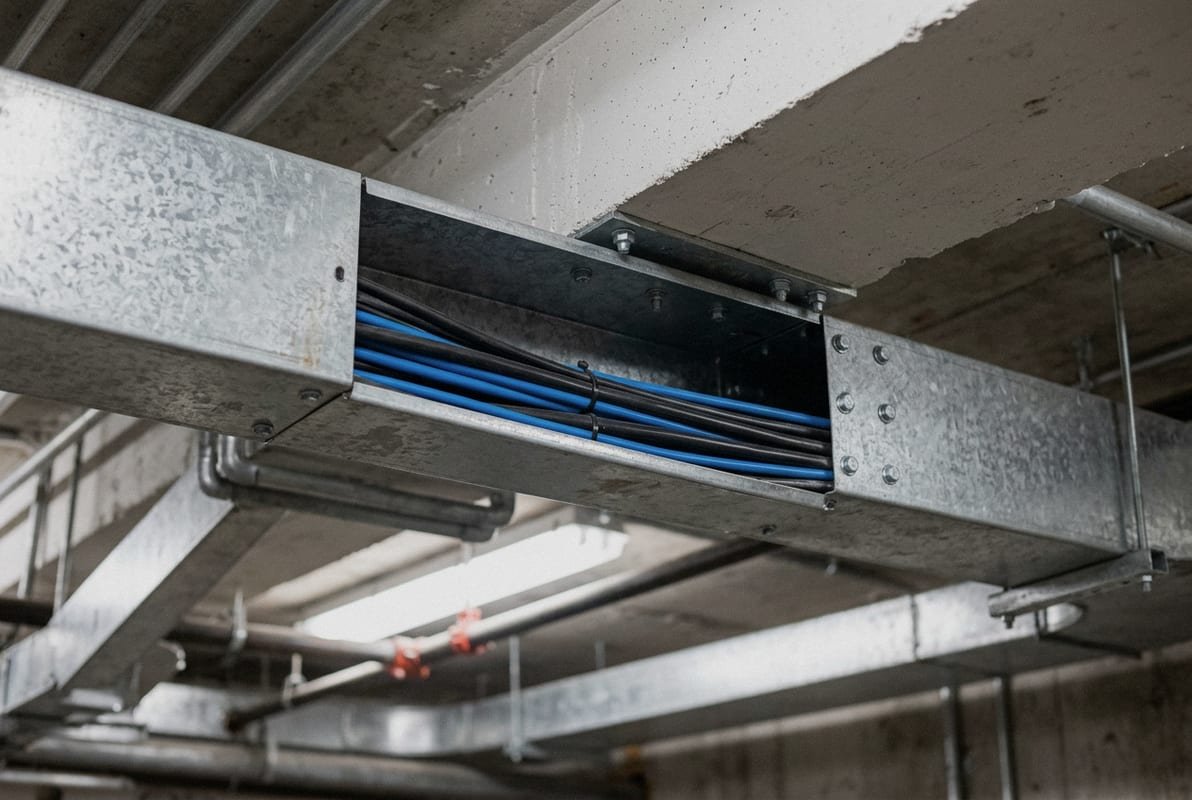
Singapore sits just one degree north of the equator. Humidity regularly exceeds 80%. Salt-laden air affects coastal zones. In this environment, a thin galvanized layer fails fast. The ISO 1461 standard exists precisely for this reason. It sets minimum zinc coating thicknesses based on the steel’s base thickness.
| Steel Thickness | Minimum Local Coating (µm) | Minimum Average Coating (µm) |
|---|---|---|
| ≥ 6 mm | 70 | 85 |
| 3 mm to < 6 mm | 55 | 70 |
| 1.5 mm to < 3 mm | 35 | 45 |
| < 1.5 mm | 35 | 45 |
For typical trunking steel at 1.5–2.0 mm, aim for at least 45 µm average. Many of our clients in Singapore specify 55 µm or higher for outdoor installations. We test every batch on our line with a magnetic coating thickness gauge 8 before packing.
HDG vs. Pre-Galvanized vs. Epoxy Coating
This is where confusion happens most often. Let me break it down plainly:
- Hot-Dip Galvanized (HDG): The finished trunking is dipped into a bath of molten zinc. This creates a thick, metallurgically bonded coating. Best for outdoor and humid environments.
- Pre-Galvanized (PG): The steel sheet is galvanized before fabrication. Cut edges and welds are left unprotected. Suitable only for dry indoor environments.
- Epoxy Powder Coating: Applied over a base metal (often electro-galvanized). Gives a clean finish and color options—white, orange, grey, red, ivory beige. Typical thickness is 45–50 microns. Good for indoor use per SS 249 Class 1.
For a deeper comparison of these finishes when sourcing from China, see how hot-dip galvanized, pre-galvanized, and zinc magnesium aluminum compare. For Singapore projects near the coast, in industrial zones, or at water treatment facilities, HDG is the only finish that reliably lasts. Pre-galvanized trunking will rust at every cut and every joint.
Your QC Checklist
When shipments arrive, here is what to check:
- Mill Test Certificate (MTC): Confirms steel grade, zinc bath composition, and coating thickness.
- Coating Thickness Test: Use a magnetic gauge. Test at least five points per trunking section—including edges, bends, and flat surfaces.
- Visual Inspection: Look for bare spots, drips, rough patches, or uneven coating. Some roughness is normal for HDG, but bare spots are not acceptable.
- Adhesion Test: A simple bend test per ISO 1461 can confirm whether the zinc layer is properly bonded to the steel.
- Dimensional Check: Verify width, height, and wall thickness against the purchase order. Tolerances should be within ±1 mm for dimensions and ±0.1 mm for wall thickness.
Protecting Cut Edges and Field Modifications
Even the best HDG coating is vulnerable where you cut or drill on site. Instruct your installation team to apply cold galvanizing spray (zinc-rich paint) to all field-cut edges. This simple step prevents the most common point of failure.
How can I find a reliable Chinese OEM partner who understands my Singapore delivery and customization needs?
Three years ago, when I started handling cable management systems for Southeast Asian projects, the number one complaint I heard from Singapore-based project directors was not about price. It was about delivery delays and inconsistent quality between batches. Finding a factory that truly understands the rhythm of an M&E project schedule makes all the difference.
To find a reliable Chinese OEM partner, request product selection manuals from multiple suppliers, verify their export experience to Singapore, confirm they can customize dimensions and coatings to your specs, ask for QC documentation upfront, and test with a small trial order before committing to large volumes.
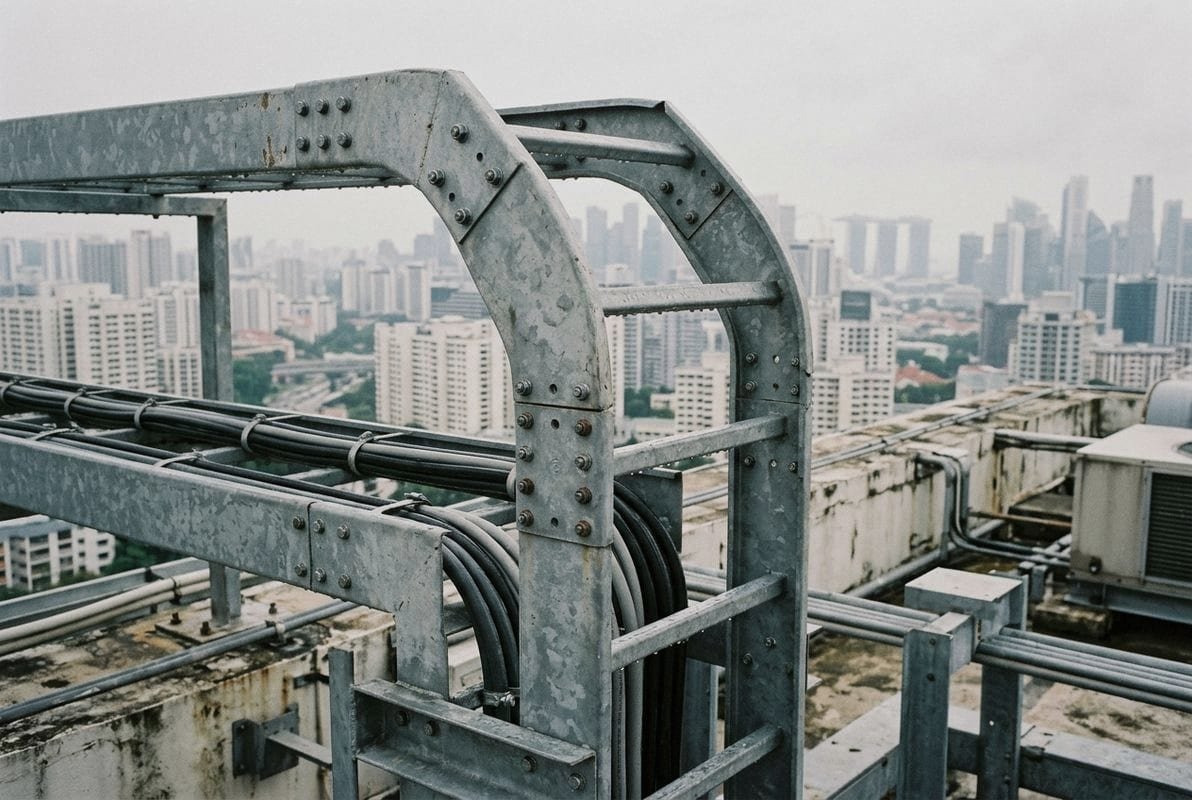
Step 1: Request Detailed Product Manuals
Before you place a single order, ask potential suppliers for their full product selection handbook. A serious manufacturer will have one. It should include a complete spec table with all available dimensions, load ratings, coating options, and accessory lists. Compare at least three suppliers side by side. This is the fastest way to build your product knowledge and understand the market range.
When we send our catalogs to buyers, we include load test data, coating specifications, and accessory compatibility charts. If a supplier cannot provide these basics, move on.
Step 2: Verify Singapore-Specific Experience
Not every Chinese factory understands Singapore’s requirements. Ask these questions:
- Have you exported HDG cable trunking to Singapore before?
- Can you provide documentation referencing SS 249 or ISO 1461?
- Do you understand COPIF cable fill and spacing rules?
- Can you label and pack to Singapore site delivery requirements?
A supplier with real Southeast Asia export experience will know about BCA approvals, common M&E contractor expectations, and the typical project timeline pressures you face.
Step 3: Evaluate Customization Capability
Singapore projects often require non-standard dimensions, special fittings (T-junctions, 90-degree elbows, reducers), and specific coating thicknesses. Your OEM partner should offer OEM/ODM collaborative development. On our production line, we can adjust width, height, wall thickness, and coating within a few days of confirming drawings. We also produce matching accessories—joints, tapping screws, bolts, nuts, and copper earth links—so everything arrives as one coordinated shipment. For guidance on evaluating galvanized perforated, solid, ladder, or mesh cable trays for Singapore EPC projects, understanding the full product range helps you assess a supplier’s breadth of capability.
Step 4: Assess Delivery Reliability
Delivery delays kill projects. Ask for the supplier’s typical lead time and their track record. A good benchmark for standard HDG trunking is 15–25 days from order confirmation to port. For highly customized orders, allow 25–35 days. Make sure the supplier provides a production schedule and updates you at key milestones: material procurement, fabrication, galvanizing, QC, and packing.
What to Look for in a Trial Order
| Evaluation Criteria | What to Check |
|---|---|
| Dimensional accuracy | Measure width, height, thickness against PO specs |
| Coating quality | Thickness gauge readings, visual inspection |
| Packing quality | No damage in transit, proper bundling and labeling |
| Documentation | MTC, packing list, commercial invoice accuracy |
| Communication speed | Response time during production, proactive updates |
| Accessory completeness | All fittings, screws, and earth links included |
Integrating with Modern Workflows
Many M&E contractors now use Building Information Modeling (BIM) 9 for design coordination. If your OEM partner can provide trunking models in standard BIM-compatible formats, it speeds up clash detection and quantity take-offs. When we receive BIM-based BOQs, we can match production exactly to the model—reducing errors and waste.
Also consider sustainability. Cable trays and trunking made from recyclable steel with HDG finish align well with Singapore’s green building initiatives. Hot-dip galvanized steel is fully recyclable, and the long lifespan of HDG reduces replacement frequency.
Conclusion
Learning HDG cable trunking specs for Singapore M&E procurement takes structured effort—but the payoff is fewer delays, fewer returns, and stronger supplier relationships. Start with the standards, master the dimensions, verify the coating, and test your partner.
Footnotes
- Defines the product type covered by Singapore Standard SS 249. ↩︎
- Explains the purpose and contents of a Mill Test Certificate for material quality assurance. ↩︎
- Provides requirements for steel surface cable trunking and accessories in Singapore. ↩︎
- Specifies requirements and test methods for hot-dip galvanized coatings on iron and steel articles. ↩︎
- Explains the process, benefits, and applications of hot-dip galvanized steel for corrosion protection. ↩︎
- Outlines fire safety regulations and requirements for buildings in Singapore. ↩︎
- Defines electromagnetic interference and its impact on electronic devices and systems. ↩︎
- Describes the principle and application of magnetic gauges for measuring coating thickness. ↩︎
- Authoritative and comprehensive Wikipedia article on Building Information Modeling. ↩︎