Every Singapore EPC project I quote involves one recurring headache: choosing the wrong cable tray type leads to costly rework, failed inspections, and missed deadlines in a climate that punishes shortcuts.
To choose galvanized perforated, solid, ladder, or mesh cable trays for Singapore EPC projects, match each tray type to your cable category, load capacity requirements, ventilation needs, corrosion exposure level, and compliance with local standards like SS249 and IEC 61537 before finalizing procurement.
This guide breaks down each tray type, the galvanization standards that matter in tropical humidity, supply chain strategies, and customization options. I have organized it around the four questions Singapore project directors ask me most often.
How do I determine if perforated, ladder, or mesh trays are best for my Singapore project’s specific load and ventilation needs?
A conversation with a project director in Jurong changed how our engineering team frames this question. He didn’t need “the best tray.” He needed four different trays for four different zones — and the logic behind each pick.
Determine the best tray by mapping each cable category — heavy power, control/instrumentation, secondary distribution, or data/telecom — to the tray type that meets its specific load capacity requirements and ventilation requirements while fitting the installation environment.
Start With Cable Categories, Not Tray Catalogs
The biggest mistake I see is choosing a tray first, then forcing cables into it. Flip the process. List every cable type on your single-line diagram. Group them by voltage level and function. Then assign each group to the tray type engineered for it.
Here is the decision matrix we share with our EPC clients:
| Cable Category | Recommended Tray Type | Why This Tray Wins |
|---|---|---|
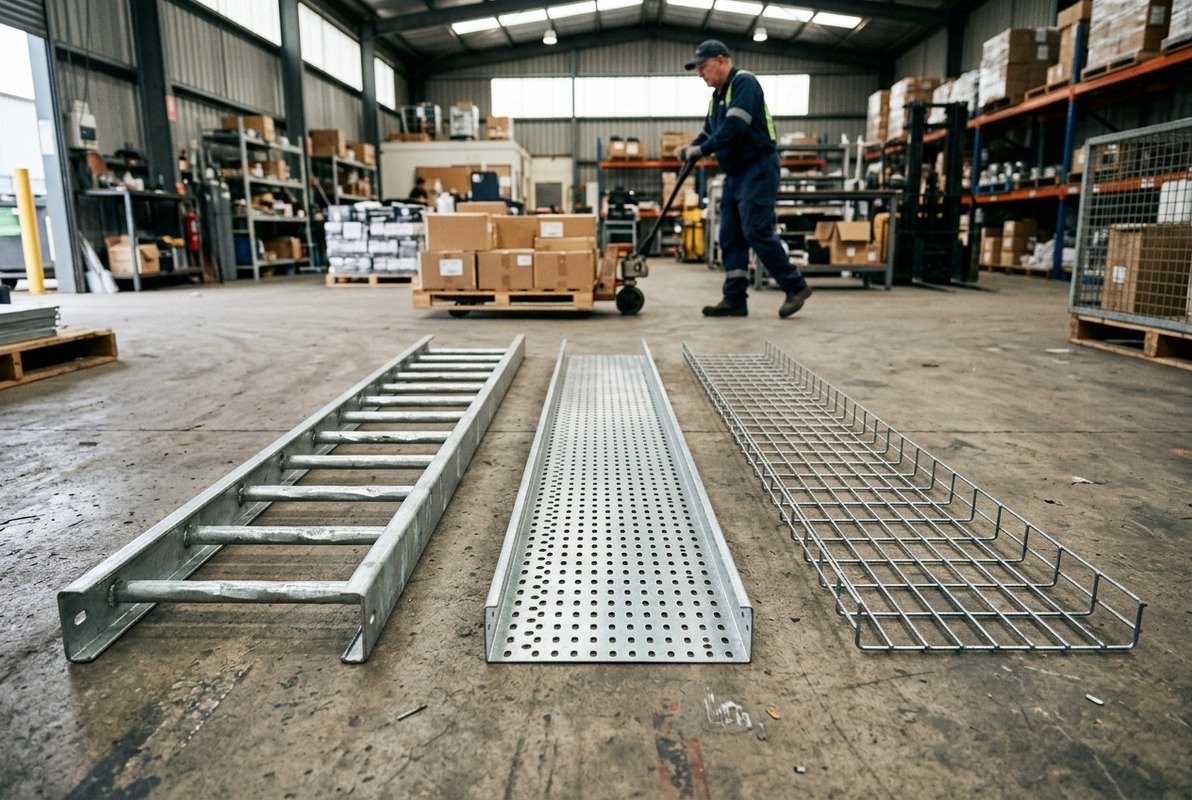
| Heavy-duty power cables, HV/LV main distribution, vertical risers | HDG Cable Ladder | Maximum load capacity, superior airflow minimizes cable derating, easy cable cleating on rungs |
| Sensitive instrumentation, control cables, ELV signals | HDG Solid Bottom Trunking | 360-degree physical protection, dust exclusion, excellent EMI/RFI shielding 1 |
| Medium/small power cables, lighting circuits, secondary distribution | HDG Perforated Cable Tray | Balanced ventilation via perforations plus solid bottom protection, BS-compliant — the “all-rounder” |
| High-density data/telecom, fiber optics, low-voltage sensor wires | HDG Wire Mesh Cable Tray | Extremely lightweight, on-site forming without factory elbows, 100% visual cable inspection |
Load Capacity: The Numbers That Matter
Cable tray installation in Singapore EPC projects demands strict load calculations. You need to account for the weight of cables per meter, add a safety factor (typically 1.5×), then confirm the tray’s rated Uniformly Distributed Load (UDL) 2 exceeds that figure at your planned support span.
Ladder trays handle the heaviest loads. On outdoor pipe racks at petrochemical plants on Jurong Island, I routinely see specifications calling for 150 kg/m or more. A 600 mm wide HDG ladder with 2.0 mm thick side rails and rungs at 300 mm centers handles this comfortably at 2-meter spans.
Perforated trays cover the middle ground. For commercial buildings around Marina Bay or underground cable galleries in LTA MRT stations, loads typically range from 30 to 80 kg/m. A 1.5 mm or 2.0 mm thick perforated tray handles this well.
Wire mesh cable trays suit lighter loads — usually under 30 kg/m. They dominate data center overhead IT cabling and semiconductor fab environments in Tuas. Their strength is routing flexibility, not raw load capacity.
Ventilation and Cable Derating
Heat dissipation directly affects cable ampacity 3. Poor ventilation means cables derate — they carry less current safely. Ladder trays offer the best airflow because cables sit on open rungs with air circulating from all sides. Perforated trays provide moderate ventilation through the hole pattern. Solid trunking offers minimal airflow but maximum physical protection. For sensitive instrumentation where environmental conditions include dust or fluid drip exposure, that trade-off is correct.
Wire mesh trays deliver nearly the same ventilation as ladders. In controlled indoor environments like pharmaceutical plants or data centers, this is a strong advantage for high-density cable bundles.
Matching Tray to Singapore Application Zones
| Singapore Application Zone | Typical Tray Choice | Key Reason |
|---|---|---|
| Jurong Island petrochemical pipe racks | HDG Ladder | Heavy cables, outdoor exposure, maximum ventilation |
| Data Centers (underfloor/overhead) | Wire Mesh | Lightweight, flexible routing, visual inspection |
| Marina Bay commercial buildings | HDG Perforated | BS-compliant all-rounder, moderate loads |
| MRT underground cable galleries | HDG Perforated | Balance of protection and airflow |
| Desalination plants, substations | HDG Ladder | Corrosion resistance, heavy load support |
| Server halls, containment routing | HDG Solid Trunking | Dust prevention, EMI shielding |
One critical note for Singapore: wire mesh cable trays are predominantly used indoors or in controlled environments. For harsh outdoor coastal areas, HDG ladder or perforated trays with proper hot-dip galvanization 4 are the safer choice.
What quality standards should I verify to ensure my galvanized trays won’t corrode in Singapore’s humid tropical environment?
Last year, we shipped a batch of cable management solutions to a water treatment project near the Singapore coast. The client’s QC team rejected a competitor’s pre-galvanized trays 5 after just three months — rust bloom appeared at every cut edge. That phone call reminded me why galvanization type is not a line item to cut corners on.
Verify that hot-dip galvanized trays meet BS EN ISO 1461 with a minimum 85-micron zinc coating, and that electro-galvanized trays carry SS249 Class 1 certification with at least 50-micron epoxy powder coating. Always request mill certificates and salt spray test reports before shipment.
Understanding the Galvanization Options
Singapore sits close to the equator with year-round humidity above 80% and significant salt-laden air in coastal zones. Corrosion resistance is not optional — it is a project survival requirement. Here are the three galvanization methods our production line handles:
Hot-Dip Galvanized (HDG): The entire fabricated tray is dipped into molten zinc at roughly 450 °C. This creates a metallurgically bonded zinc-iron alloy layer. The result is a thick, self-healing coating — if the surface gets scratched, surrounding zinc sacrificially protects the exposed steel. HDG meets BS EN ISO 1461 6:1999 and is the gold standard for outdoor and harsh environmental conditions in Singapore.
Electro-Galvanized (Pre-Galvanized): Zinc is deposited onto flat steel sheets via an electrolytic process before fabrication. The coating is thinner and more uniform, giving a cleaner appearance. However, cut edges and welds remain unprotected unless a secondary coating is applied. For Singapore, the standard requires SS249 7 Class 1 certification with a minimum 50-micron epoxy powder coating on top.
Mill Galvanized: The least expensive option. Zinc coating is applied during steel production. It is typically thinner than both HDG and electro-galvanized finishes. Mill galvanized trays are sometimes used indoors where post-painting is planned, but I would not recommend them for any Singapore project without additional surface treatment.
Which Standard Applies Where?
| Galvanization Type | Applicable Standard | Typical Zinc Thickness | Best Use in Singapore |
|---|---|---|---|
| Hot-Dip Galvanized | BS EN ISO 1461:1999 | 85–120 µm | Outdoor, coastal, petrochemical, water treatment |
| Electro-Galvanized + Epoxy | SS249 Class 1 / TUV SUD | 8–12 µm zinc + 50 µm epoxy | Indoor commercial, MRT stations, controlled environments |
| Mill Galvanized | Varies by mill | 20–40 µm | Indoor only, with additional paint or powder coat |
What to Request From Your Supplier
When our QC team prepares shipments for Singapore, we include mill test certificates for the base steel, zinc coating thickness reports measured by magnetic gauges, and salt spray test documentation (typically per ASTM B117 8). Some EPC specifications also require a Kelvin cross-cut adhesion test for epoxy coatings.
Ask your supplier these questions before placing an order:
- Can you provide BS EN ISO 1461 certification for HDG trays?
- What is the actual measured zinc coating thickness — not just the minimum spec?
- Do you test adhesion of epoxy powder coating, and at what frequency?
- How do you handle cut edges and welds on pre-galvanized trays?
A common debate in Singapore’s market is whether electro-galvanized with powder coating is sufficient for outdoor use. From our experience supplying projects across Southeast Asia, it works well for sheltered outdoor areas. But for direct coastal exposure or chemical plant environments, HDG remains the only reliable choice. Some clients even consider stainless steel cable trays or FRP cable trays 9 for extreme corrosion scenarios such as desalination plants or chemical storage zones, though these come at a significantly higher cost.
Steel Type Matters Too
The base steel affects both structural performance and corrosion behavior. Cold-rolled (CR) steel in the 1.0 mm to 2.0 mm range offers tighter dimensional tolerances and a smoother surface — ideal for electro-galvanizing and powder coating. Hot-rolled (HR) steel at 2.0 mm and above is stronger but has a rougher mill scale surface that is more difficult to coat evenly. For HDG, this matters less because the molten zinc bath handles both surface types well. For pre-galvanized finishes, CR steel is the better substrate.
How can I secure a reliable supply chain to prevent delivery delays from affecting my EPC project timeline?
Three months into a wastewater treatment project in Southeast Asia, the general contractor called me on a Friday evening. Their local supplier had missed the third consecutive delivery milestone. The site was idle. Structural steel was up, but no cable trays meant no electrical rough-in. That delay cascaded into a six-week schedule overrun. It is the kind of situation our logistics team works specifically to prevent.
Secure your supply chain by partnering with a manufacturer that holds buffer stock of standard components, offers phased delivery aligned to your construction sequence, maintains transparent production tracking, and has proven freight forwarding relationships into Singapore’s port.
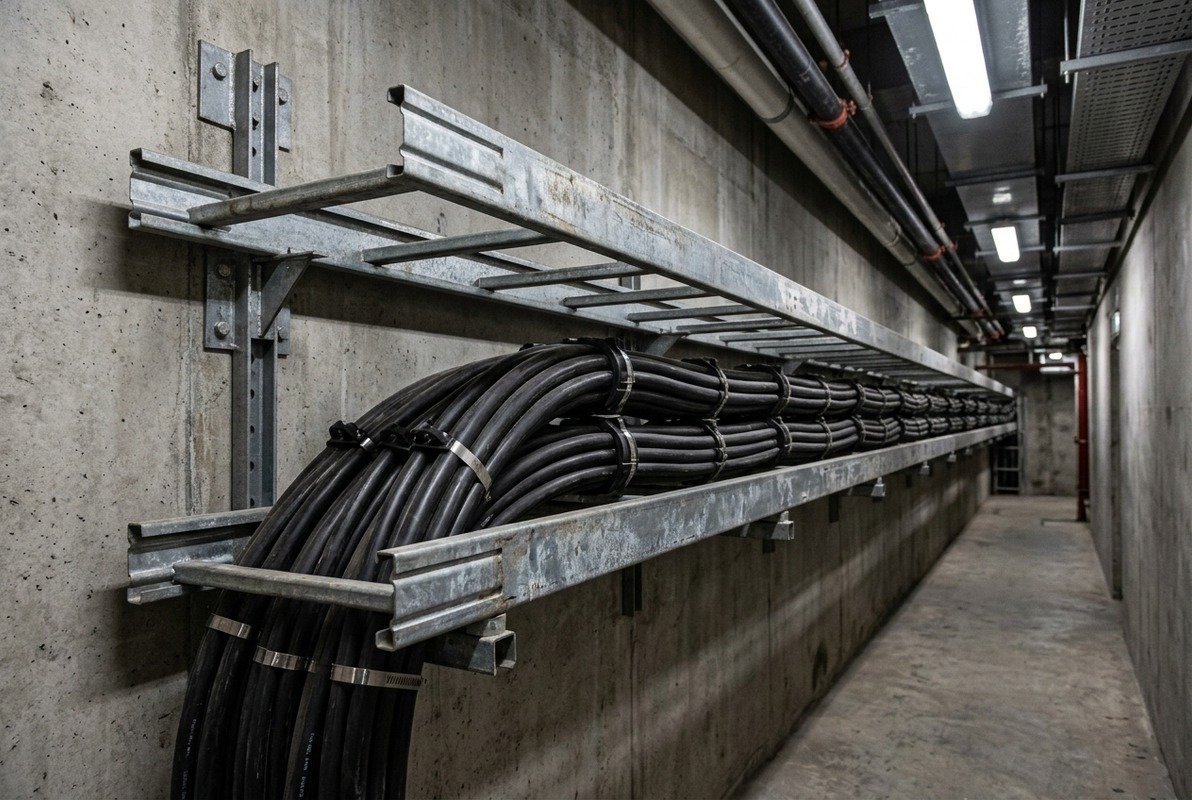
Why Delivery Delays Happen — And How to Prevent Them
Most delivery failures in cable tray procurement trace back to three root causes: unclear project specifications at the order stage, production bottlenecks from poor planning, and shipping complications. Here is what I have learned works best to address each one.
Lock project specifications early. Before we begin production, our engineering team reviews every drawing with the client. We confirm tray types, dimensions, material grades, galvanization requirements, fitting types, and quantities zone by zone. Ambiguity at this stage creates change orders mid-production, and change orders create delays.
Phase the delivery schedule. A typical Singapore EPC project does not need all cable trays on day one. The construction sequence moves zone by zone. We work with project directors to create a phased delivery plan — shipping the first batch for Zone A while producing Zone B trays. This overlapping approach keeps the factory running continuously and the site supplied on time.
Maintain standard-size buffer stock. For the most common tray sizes — 300 mm, 450 mm, and 600 mm widths in HDG perforated and ladder types — our warehouse holds ready stock. If a client’s schedule accelerates unexpectedly, we can dispatch standard items within days rather than weeks.
Communication and Tracking
Transparent communication prevents surprises. Every order gets a production timeline shared via WhatsApp or email, updated weekly with photographs from the shop floor. When trays enter the hot-dip galvanization process, we send coating thickness readings. When goods are packed and loaded, we share container loading photos and Bill of Lading details.
For Singapore-bound shipments, sea freight from our facility in Tai’an typically takes 7 to 12 days depending on the carrier. We work with freight forwarders who handle the Port of Singapore Authority documentation, ensuring customs clearance does not add unnecessary buffer time.
Risk Mitigation Checklist for EPC Procurement Managers
- Confirm lead times in writing before order placement
- Request a phased delivery plan aligned to your construction sequence
- Verify the manufacturer holds buffer stock for standard sizes
- Require weekly production progress reports with photos
- Ensure the supplier has established freight routes into Singapore
- Build a 10–15% quantity buffer for site-measured fittings and field adjustments
- Confirm all IEC 61537 10 standard and local SS249 compliance documentation ships with the goods — not weeks later
This last point is often overlooked. If compliance certificates arrive late, your site inspector cannot approve the installation. The trays may be physically present but unusable until paperwork clears. We always ship test reports and certificates inside the container, packed with the goods.
Can I get customized cable tray dimensions and OEM support that fit my specific technical drawings and site constraints?
One lesson I learned early in this business: no two EPC projects share identical cable tray layouts. Even when two buildings look the same on the outside, the cable routing inside is different. Standard catalog sizes cover maybe 60% of a project’s needs. The remaining 40% requires customization — and that is where the right manufacturing partner makes the difference.
Yes. A capable OEM supplier can produce cable trays in custom widths, heights, thicknesses, perforation patterns, and fitting configurations directly from your technical drawings, with full material traceability and quality documentation matching your project specifications.
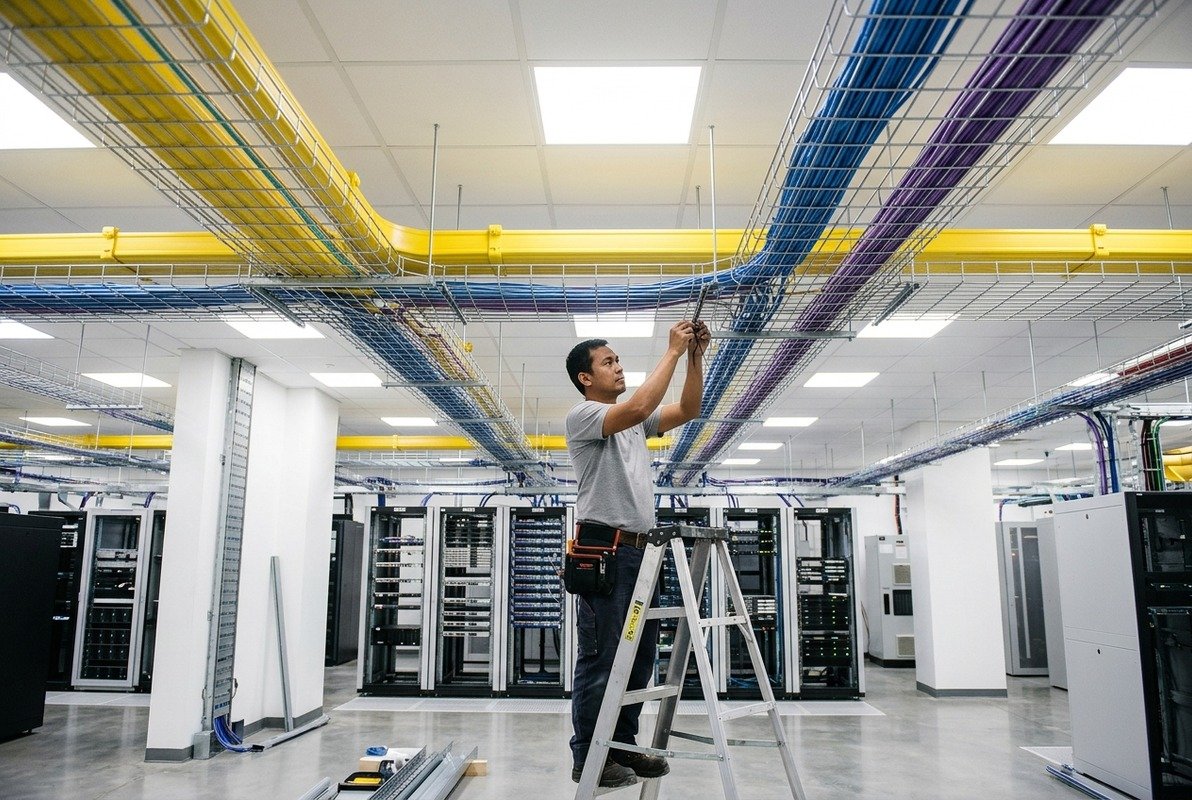
What Can Be Customized?
Almost every physical parameter of a cable tray is adjustable on our production line. Here is what clients most commonly request:
Width: Standard catalog widths run from 50 mm to 1,000 mm. But we regularly produce non-standard widths like 275 mm or 525 mm when project specifications or space constraints demand it.
Height (Side Rail): Typical heights range from 25 mm to 150 mm. Taller side rails increase cable fill capacity and structural rigidity. Some vertical riser applications in high-rise electrical shafts require 200 mm rails — we accommodate those.
Thickness: From 1.0 mm for light indoor wire mesh trays up to 3.0 mm for heavy-duty industrial ladder trays. The thickness directly affects load capacity and support span distances.
Perforation Pattern: The size, shape, and spacing of perforations on perforated cable trays affect both ventilation and structural strength. We can match the exact pattern shown on your engineering drawings.
Fittings and Accessories: Bends (horizontal and vertical), tees, crosses, reducers, risers, wall brackets, trapeze hangers, and splice plates. When a site has unusual angles — say a 37-degree horizontal bend to follow a building’s geometry — we fabricate it to the exact angle.
The OEM Collaboration Process
Our OEM workflow follows a clear sequence:
- Drawing Review: Client sends technical drawings (AutoCAD, PDF, or even hand sketches). Our engineers review dimensions, materials, and galvanization requirements.
- Material Confirmation: We confirm the steel grade, thickness, and galvanization type. For Singapore projects, this is typically Q235B cold-rolled steel with HDG per BS EN ISO 1461 or pre-galvanized with SS249-compliant epoxy.
- Sample Production: For first-time orders or unusual configurations, we produce a sample batch. The client inspects dimensions, coating quality, and fit.
- Bulk Production: Once approved, full production begins with in-process QC checks at cutting, forming, welding, and galvanizing stages.
- Final Inspection and Packing: Dimensional verification, coating thickness measurement, visual inspection, and protective packaging for sea freight.
Customization Limits to Be Aware Of
Not everything can be customized without trade-offs. Here are practical boundaries:
- Extremely thin trays (below 1.0 mm) lose structural integrity after hot-dip galvanization due to thermal distortion.
- Very wide trays (above 1,000 mm) may require intermediate stiffeners to maintain flatness.
- Complex 3D fittings with multiple bends need careful tooling — lead time increases by one to two weeks.
- Non-standard perforation patterns require custom punching dies, adding a modest tooling cost.
When these limits apply, we discuss alternatives with the client. For example, instead of a single 1,200 mm wide tray, we might recommend two 600 mm trays side by side with a divider plate. This achieves the same cable capacity with better structural performance and easier cable tray installation.
OEM Documentation Package
Every OEM order ships with a complete documentation package:
- Material mill certificates
- Galvanization test reports (coating thickness, adhesion)
- Dimensional inspection records
- Packing list with piece marking matching the client’s drawing references
- IEC 61537 compliance statement where applicable
This documentation is essential for Singapore EPC projects where the client, consultant, and main contractor all review material submittals before approving installation. Missing or incomplete documentation stalls the approval chain.
Conclusion
Choosing galvanized cable trays for Singapore EPC projects comes down to matching tray type, galvanization standard, supply chain reliability, and customization capability to your project’s real-world conditions and timeline.
Footnotes
- Explains the process of reducing electromagnetic and radio frequency interference in devices. ↩︎
- Explains the concept of a load spread evenly over a given area or length. ↩︎
- Found a working, authoritative definition of ampacity on the original domain. ↩︎
- Describes the process of coating fabricated steel by immersing it in molten zinc. ↩︎
- Compares pre-galvanized and post-galvanized finishes for cable containment products. ↩︎
- Specifies general properties and test methods for hot-dip galvanized coatings. ↩︎
- Enterprise Singapore oversees national standards like SS249 for quality and safety. ↩︎
- Outlines the standard practice for operating salt spray (fog) apparatus. ↩︎
- Highlights the advantages of Fiberglass Reinforced Plastic (FRP) cable trays. ↩︎
- Specifies requirements and tests for cable tray and ladder systems. ↩︎