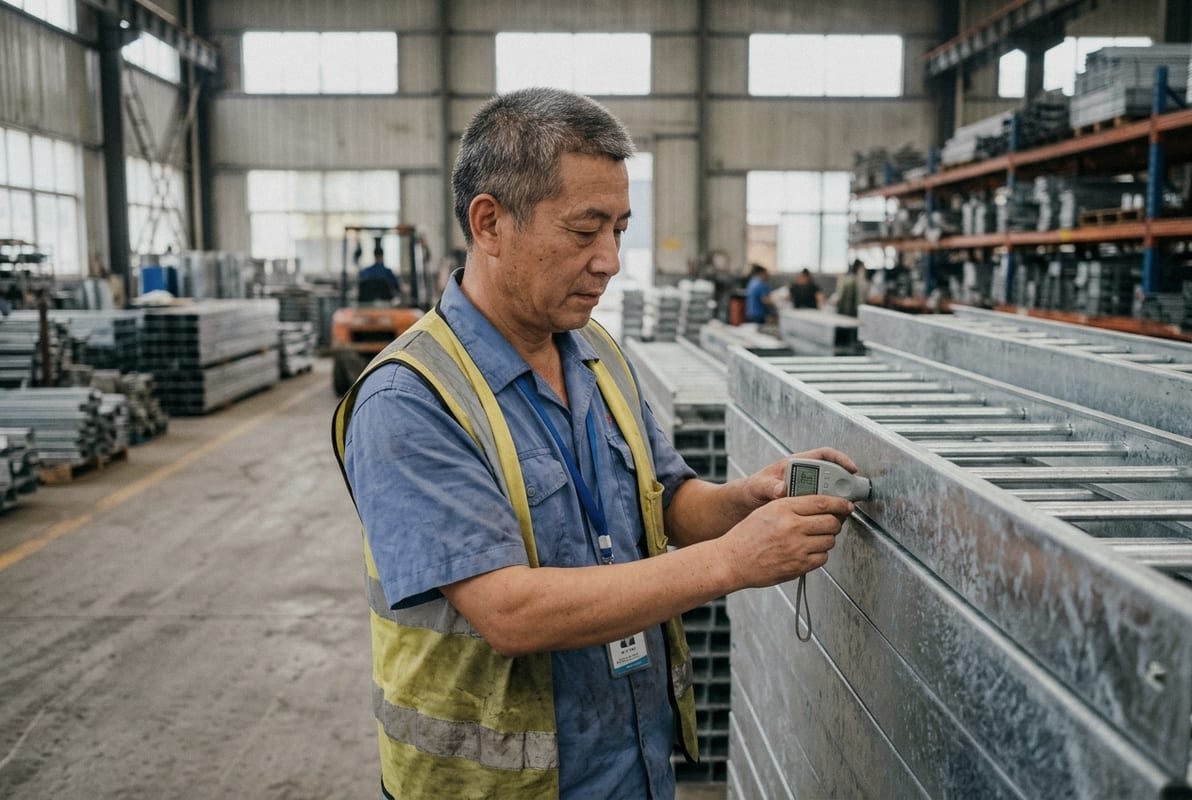
When our team first shipped hot-dip galvanized ladder cable trays to a refinery project in Southeast Asia, the client’s biggest fear was rust eating through cables within five years — a problem that costs thousands in emergency shutdowns and reruns.
To choose the best hot-dip galvanized ladder cable trays from China, verify zinc coating thickness of 70–85 µm, confirm Q235 steel material at 1.0–2.0 mm, demand ASTM A123 or EN ISO 1461 compliance, evaluate the supplier’s customization options, and arrange third-party quality control inspections before shipment.
This guide walks you through every checkpoint — from galvanizing quality to on-time delivery — so you can source with confidence and avoid costly mistakes.
How do I verify the hot-dip galvanizing quality for my industrial project?
A lesson we learned early on: one of our buyers in Africa received pre-galvanized trays from another supplier, and within two rainy seasons the coating peeled right off ISO 9001 quality management certification 1. That experience taught us exactly what separates real hot-dip galvanizing from cheaper alternatives.
Verify hot-dip galvanizing quality by checking zinc coating thickness (minimum 70–85 µm), requesting salt spray test reports exceeding 1,000 hours, confirming compliance with ASTM A123 or EN ISO 1461 standards, and inspecting the visible spangle pattern that indicates a genuine metallurgical zinc-iron bond.
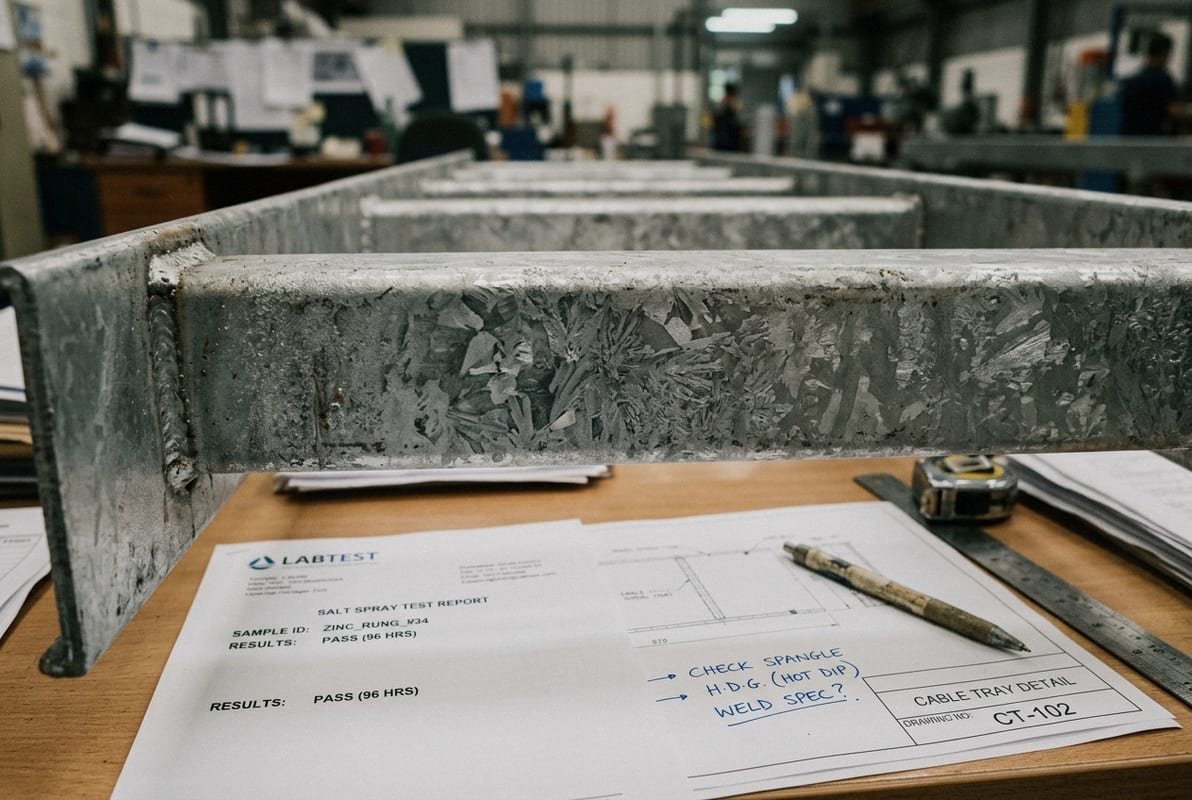
Hot-dip galvanizing is not a simple paint job. The process involves dipping fabricated steel into a bath of molten zinc at roughly 450 °C. This creates a metallurgically bonded zinc-iron alloy layer on the steel surface. metallurgical zinc-iron bond 2 That bond is what gives HDG its superior corrosion resistance — far beyond what pre-galvanized or electro-galvanized finishes can offer.
Understanding the Metallurgical Bond
When steel enters the molten zinc bath, multiple alloy layers form between the base steel and the outer pure zinc layer. These layers are harder than the base steel itself. This means the coating does not simply sit on top; it becomes part of the metal. Scratching the surface will not cause the same peeling you see with painted or electro-plated finishes.
Key Tests and Standards
For industrial projects — especially outdoor ones like crude oil refineries, offshore engineering, and heavy energy infrastructure — you need to insist on specific test results. Here is what to request from your supplier:
| Verification Method | What It Confirms | Minimum Acceptable Value |
|---|---|---|
| Zinc coating thickness 3 (magnetic gauge) | Adequate zinc deposit | 70–85 µm for coastal/industrial use |
| Salt spray test (ASTM B117) 4 | Corrosion resistance duration | >1,000 hours |
| ASTM A123 5 / EN ISO 1461 certificate | Process compliance | Current, valid certificate |
| Visual spangle inspection | Genuine HDG process used | Visible crystalline pattern on surface |
| Adhesion bend test | Coating does not flake or peel | No cracking at bend point |
HDG vs. Pre-Galvanized: A Quick Comparison
Many buyers confuse hot-dip galvanized with pre-galvanized. The difference matters enormously for outdoor applications. To understand how these coating methods stack up in detail, see how hot-dip galvanized, pre-galvanized, and zinc magnesium aluminum compare when sourcing.
| Feature | Hot-Dip Galvanized (HDG) | Pre-Galvanized |
|---|---|---|
| Zinc coating thickness | 65–85 µm | <20 µm |
| Coating bond type | Metallurgical (zinc-iron alloy) | Mechanical adhesion |
| Salt spray resistance | >1,000 hours | 200–400 hours |
| Service life (outdoor) | 20–30+ years | 5–10 years |
| Ideal environment | Coastal, humid, chemical exposure | Dry, indoor, low-corrosion |
| Cost per meter | Higher | Lower |
Our experience shipping to projects across Southeast Asia and Africa has shown that pre-galvanized trays simply cannot survive in tropical humidity or salt-laden coastal air. The upfront savings vanish when you factor in replacement costs within a decade. For any outdoor ladder cable tray, hot-dip galvanizing is not optional — it is essential.
Practical Tips for Buyers
Request a coating thickness report for every production batch. Ask for photographs of the dipping process. If the order is large, arrange a third-party inspector to visit the factory and use a magnetic thickness gauge on random samples. At our facility, we welcome these inspections because they build trust and confirm that every tray leaving the line meets the specified zinc coating thickness.
Can I customize the ladder cable tray dimensions to meet my specific site needs?
Last quarter, a project contractor from Singapore sent us a WhatsApp message with a hand-drawn sketch — he needed 750 mm wide trays with 150 mm side rails and non-standard rung spacing to fit an existing support structure. That kind of request is exactly what we handle daily.
Yes, reputable Chinese manufacturers offer full customization of ladder cable tray dimensions, including widths from 50 to 1,200 mm, side rail heights of 60, 100, or 150 mm, lengths from 2.2 to 9.0 meters, steel thickness from 0.6 to 3.0 mm, and custom rung spacing to match your project's load capacity and routing requirements.
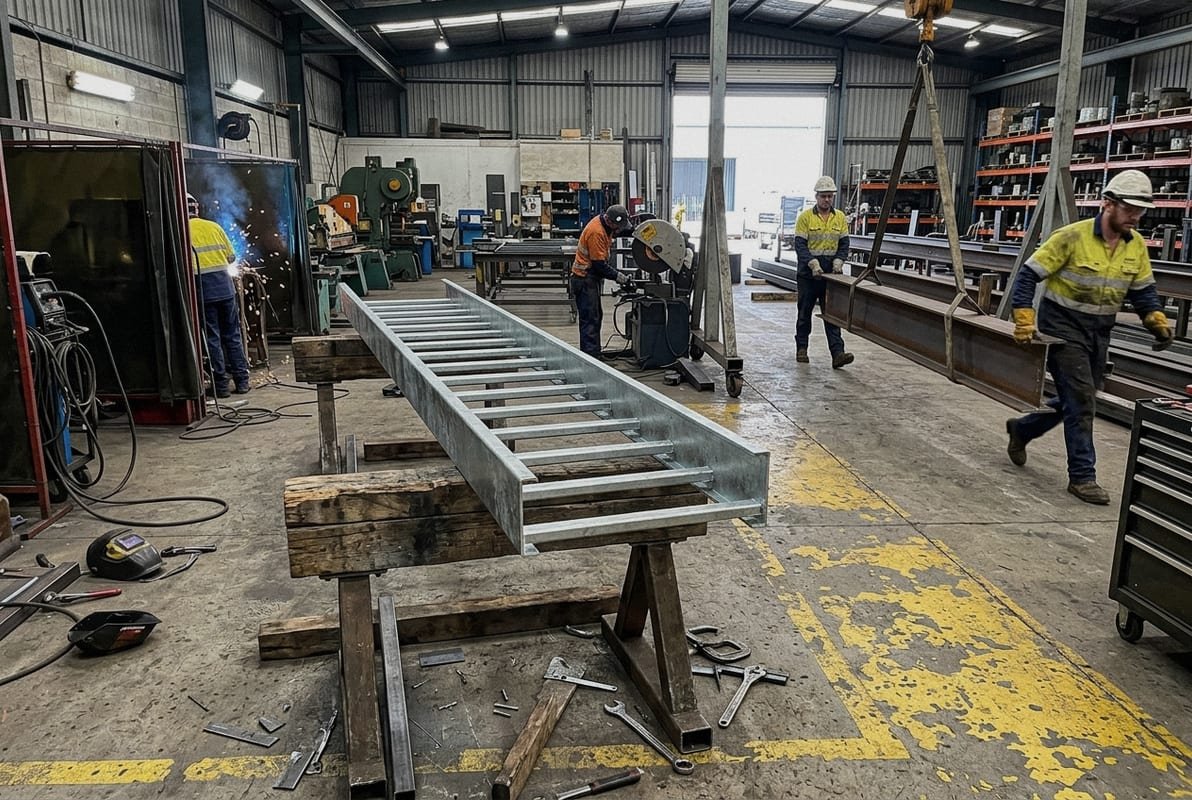
Customization is one of the biggest advantages of sourcing from China. Unlike buying off-the-shelf products from local distributors, working directly with a Chinese manufacturer gives you control over every dimension. But getting it right requires clear communication and precise specifications.
Standard vs. Custom Dimensions
Most manufacturers stock standard sizes. However, real-world projects rarely fit neatly into standard catalogs. Here is a breakdown of typical ranges and what you can customize:
| Dimension | Standard Range | Custom Range Available |
|---|---|---|
| Width | 100–600 mm | 50–1,200 mm |
| Side rail height | 100 mm | 60, 100, or 150 mm |
| Length | 2, 3, or 6 meters | 2.2–9.0 meters |
| Steel thickness | 1.0–1.5 mm | 0.6–3.0 mm |
| Rung spacing | 250 or 300 mm | Custom to project specs |
How to Communicate Your Requirements
The most common source of errors in custom orders is unclear communication. I always recommend buyers prepare a detailed technical drawing with dimensions in millimeters — not inches, not feet. Millimeters are universally understood and reduce the chance of conversion errors.
Include these details in your drawing or specification sheet:
- Overall width, height, and length
- Steel thickness for side rails and rungs separately (they can differ)
- Rung spacing (center to center)
- Surface finish: specify "hot-dip galvanized per ASTM A123" or "per EN ISO 1461 6"
- Required zinc coating thickness in µm
- Load capacity requirements in kg per meter or kN
Material Selection
Most ladder cable trays use Q235 steel material 7, which is a common carbon structural steel in China equivalent to S235JR in European standards. For heavy-duty industrial use — power stations, oil refineries, or offshore platforms — we recommend 1.5 to 2.0 mm thickness. For lighter commercial projects, 1.0 mm may suffice.
The key trade-off is weight versus strength. Thicker steel increases load capacity but also increases shipping costs from China. We help our buyers find the sweet spot by calculating the actual cable weight and span between supports, then recommending the minimum thickness that provides adequate safety margins.
Future Expansion Planning
One piece of advice from years of export experience: always plan for at least 20–30% spare capacity in your tray width. Cables get added over the years. If you size the tray exactly to today's cable bundle, you will run out of space and face expensive retrofits later. A slightly wider tray costs marginally more now but saves a great deal in the long run.
How can I guarantee my order arrives on time without shipping delays?
One of the toughest phone calls I ever had was telling a project director in South America that his container was stuck at port because of a documentation error. That single delay cost him a week and strained the entire project timeline. Since then, we built a shipping protocol to prevent it from ever happening again.
Guarantee on-time delivery by agreeing on a clear production timeline with milestone checkpoints, confirming all export procedures and documentation before production starts, booking freight early, using a reliable freight forwarder experienced with cable tray shipments, and building a 7–10 day buffer into your project schedule for unforeseen customs or port delays.
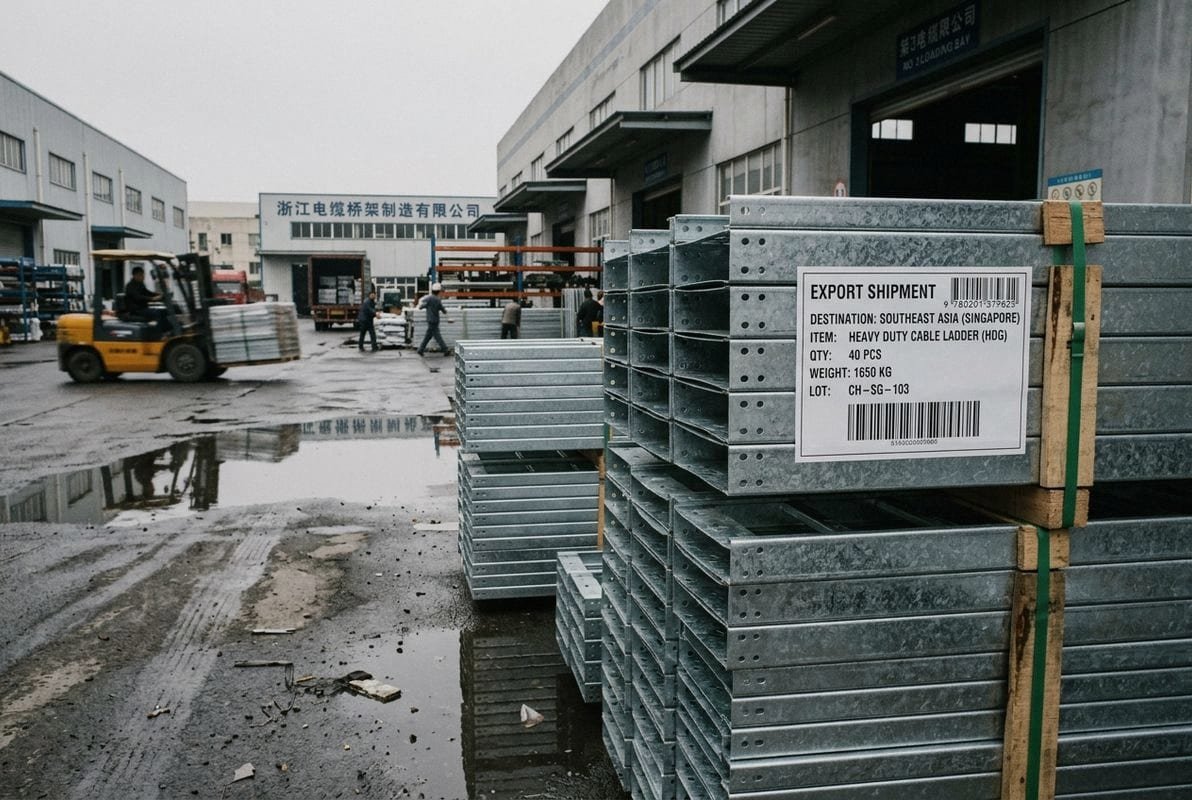
Shipping delays are one of the top pain points for buyers sourcing from China. The good news is that most delays are preventable with proper planning and communication. Here is how we approach it on every order.
The Production-to-Delivery Timeline
A typical order follows this sequence:
- Order confirmation and deposit — Day 0
- Raw material procurement (Q235 steel) — Days 1–5
- Fabrication and welding — Days 5–15
- Hot-dip galvanizing — Days 15–20
- Quality inspection and packing — Days 20–23
- Trucking to port — Days 23–25
- Customs clearance and loading — Days 25–28
- Ocean freight — 15–35 days depending on destination
For standard orders, the factory lead time is roughly 25–28 days. Ocean freight to Southeast Asia takes about 7–15 days. To Africa or South America, expect 25–35 days on the water.
Export Documentation Checklist
Incomplete paperwork is the number one cause of port delays. Before production even starts, confirm the following documents are prepared:
- Commercial invoice and packing list
- Bill of lading
- Certificate of origin
- Mill test certificate for Q235 steel
- Hot-dip galvanizing report with zinc coating thickness data
- Fumigation certificate (if using wooden packing)
- Any destination-country import permits or pre-shipment inspection certificates
Reducing Shipping Costs from China
Shipping costs from China vary significantly depending on volume, destination, and how you pack. Ladder cable trays are bulky but relatively light. This means you often "cube out" a container before you "weigh out." Nesting trays efficiently inside a 40-foot container can fit more product per shipment and lower your per-meter freight cost.
We typically recommend a 40-foot high cube (40HC) container for large orders. For smaller orders under 15 cubic meters, LCL (less than container load) is an option, though it adds a few days for consolidation.
Build a Buffer
No matter how well you plan, external factors — port congestion, weather, customs audits — can add delays. Build a 7–10 day buffer into your project schedule. This simple step removes the pressure and prevents cascade delays across the entire installation timeline.
What should I look for in a Chinese supplier to ensure consistent quality control?
A buyer we work with in Africa once told me he had been burned twice by suppliers who sent perfect samples but delivered inconsistent bulk orders. That conversation shaped how we approach supplier evaluation — and it is the reason we now offer pre-shipment video inspections on every batch.
Look for Chinese suppliers with verified factory capabilities, ISO 9001 quality management certification, in-house hot-dip galvanizing lines, documented quality control procedures at each production stage, willingness to accept third-party inspections, and clear English-language communication with dedicated export teams.
Finding a reliable supplier is the most important decision in your sourcing process. Price matters, but a low price means nothing if the product fails on site. Here is a structured approach to supplier evaluation.
Evaluation Criteria Matrix
Use this framework when comparing potential Chinese cable tray suppliers:
| Evaluation Criteria | What to Check | Red Flag |
|---|---|---|
| Factory verification | Verified plant area, equipment photos, production capacity | Refuses factory visit or video tour |
| Certifications | ISO 9001, CE, NEMA VE 1 standards compliance | Cannot produce original certificates |
| In-house galvanizing | Own galvanizing line vs. outsourced | Outsources galvanizing with no QC oversight |
| Communication | English-speaking export team, responsive on WhatsApp/email | Slow responses, vague technical answers |
| Sample quality | Matches specifications exactly | Sample differs from quoted specifications |
| Third-party inspection | Welcomes independent inspectors | Refuses or discourages inspections |
| References | Can provide past project references or case studies | No verifiable track record |
| Load testing | Provides load capacity test data per NEMA VE 1 standards | No test data available |
The Importance of In-House Galvanizing
Suppliers who operate their own hot-dip galvanizing lines have direct control over the process. They can adjust dipping time, zinc bath temperature, and withdrawal speed to achieve consistent zinc coating thickness across every batch. When galvanizing is outsourced, the supplier loses visibility into these critical process variables.
At our production facility, we monitor every galvanizing batch and record the coating thickness on a batch-level report. This data travels with the shipment so the buyer can verify it against their project specifications.
Third-Party Inspections
For orders above a certain value — and especially for first-time buyers — I strongly recommend hiring a third-party inspection company 8. Companies like SGS, Bureau Veritas, or TÜV have offices throughout China and can visit the factory before shipment. They will check:
- Dimensional accuracy against your drawings
- Zinc coating thickness using calibrated gauges
- Surface quality (no bare spots, drips, or rough patches)
- Packing and labeling per your requirements
- Quantity verification
This one step eliminates most quality surprises. The cost of an inspection — typically a few hundred dollars — is insignificant compared to the cost of receiving defective trays on a remote project site.
Life Cycle Cost Thinking
When evaluating suppliers, do not focus solely on the per-meter price. A comprehensive Life Cycle Cost Analysis 9 should include the initial purchase price, shipping costs from China, installation labor, expected maintenance, and potential replacement costs. A tray priced at $13.60 per meter with 85 µm zinc coating may outlast a $10 per meter tray with 55 µm coating by a decade or more. The cheaper option ends up costing far more when you factor in early replacement and project downtime.
Sustainability and Smart Infrastructure
Some forward-thinking buyers now ask about the environmental footprint of the galvanizing process. Look for manufacturers who manage zinc waste responsibly and can provide environmental compliance documentation. While still emerging in the cable tray industry, compatibility with IoT-based structural health monitoring is another factor that some EPC project managers are beginning to consider for critical infrastructure. For EPC teams evaluating different tray types alongside ladder trays, understanding how to choose galvanized perforated, solid, ladder, or mesh cable trays for Singapore EPC projects can help clarify which configuration best suits each zone of a facility.
Conclusion
Choosing the best hot-dip galvanized ladder cable trays from China comes down to verifying galvanizing quality, specifying exact dimensions, planning logistics carefully, and partnering with a transparent, quality-focused supplier who welcomes inspections.
Footnotes
1. Explains the international standard for quality management systems and its benefits. ↩︎
2. Explains the formation and strength of the metallurgical bond in hot-dip galvanizing. ↩︎
3. Explains how zinc coating thickness impacts corrosion protection and service life. ↩︎
4. Describes the standard practice for operating salt spray (fog) apparatus for corrosion testing. ↩︎
5. Official ASTM standard for hot-dip galvanized coatings on iron and steel products. ↩︎
6. Authoritative source (Galvanizers Association) providing an overview of EN ISO 1461. ↩︎
7. Details the properties, equivalents, and applications of Q235 carbon structural steel. ↩︎
8. Highlights the role and benefits of independent third-party quality control inspections in China. ↩︎
9. Defines LCCA as an economic tool to assess total cost of ownership over a project’s lifespan. ↩︎