Buyers often request a zinc-aluminum-magnesium cable tray 1 by name alone. Months later rust appears at cut edges, and our Tai’an team takes the complaint. A four-step check prevents this.
The right zinc-aluminum-magnesium cable tray matches four checks: confirm the corrosion environment justifies ZAM over galvanized steel, pick the tray structure by cable heat load, lock quality with a coating designation and same-material accessories, then verify expansion joints and grounding at installation.
I use this order on every project we quote. It keeps the conversation on the site, not on the brochure. Below, I walk through each step in plain terms, with the documents and numbers I ask for.
What Makes Zinc-Aluminum-Magnesium Coating Better Than Traditional Galvanizing for My Projects?
Every quote I prepare starts with one trade-off: the ZAM premium versus the site’s real corrosion exposure. For a dry Thai warehouse, pre-galvanized tray often wins.
Zinc-aluminum-magnesium coating adds aluminum and magnesium to zinc, forming dense corrosion products that protect cut edges, holes, and scratches better than plain zinc. It performs best in coastal, humid, and industrial sites, but gains depend on coating mass, exposure, and accessories, not the label alone.

Before I explain the chemistry, here is the hot-dip galvanized comparison I show buyers who ask whether ZAM is worth the extra cost.
| Coating or material | Corrosion resistance rating | Weight | Edge protection | Typical application |
|---|---|---|---|---|
| Pre-galvanized steel | Moderate | Medium | Weak at cut edges | Indoor, dry, controlled rooms |
| Hot-dip galvanized steel | Good | Heavier | Good, but dipping can distort parts | General outdoor, industrial |
| ZAM-coated steel | Good to very good | Medium | Strong at cuts, holes, scratches | Coastal, humid, solar, water treatment |
| Aluminum | Good | Light | Natural oxide | Weight-sensitive, no dissimilar metals |
| Stainless steel 316 | Excellent | Heavy | Excellent | Severe chloride, chemical, washdown |
| FRP | Excellent, nonconductive | Light | Not applicable | Aggressive chemicals, no grounding path |
How the self-healing coating actually works
The coating on our ZAM coils is mostly zinc. One common formulation is about 93.5% zinc, 3.5% aluminum, and 3% magnesium. Zinc gives sacrificial protection. Aluminum builds a stable barrier. Magnesium helps form dense corrosion products that cover exposed steel at a punched hole or a scratch. People call this a self-healing coating. I accept the term, but I tell buyers it is limited. A deep gouge or a field weld still needs an approved repair compound.
When the coating is worth paying for
I rank sites by atmospheric corrosion categories 2 under ISO 12944. For C1 and C2 indoor rooms, pre-galvanized tray is usually enough. From C3 upward, and especially for C5-M coastal environment suitability, ZAM starts to pay back. Our solar farm customers in the Philippines and our water treatment buyers in South America sit squarely in this band. The same coating family is already common on solar mounting structures, so the supply chain is mature.
The objection I hear most
Buyers read that ZAM is ten times better than hot-dip galvanizing. I push back on that. Those multipliers come from specific salt spray test hours, specific coating masses, and specific comparison products. They are not universal. ZAM also performs well in high-pH and ammonia conditions where plain zinc degrades, but acids, solvents, and buried soil are different cases. For continuous immersion, severe chemicals, or nonconductive requirements, I still recommend stainless steel or FRP. I would rather lose an order than oversell a coating.
How Do I Verify the Quality and Corrosion Resistance of My Cable Tray Supplier?
Last year our incoming inspection rejected a coil batch because the mill certificate listed a coating mass lower than the purchase order. That single check saved a Philippines order.
Verify a cable tray supplier by demanding measurable proof: coating designation and mass per square meter, base-steel grade, mill certificates, salt spray test hours with method, load tables for your support span, and IEC 61537 or NEMA VE 1 conformity. Confirm fasteners and fittings share the same coating system.
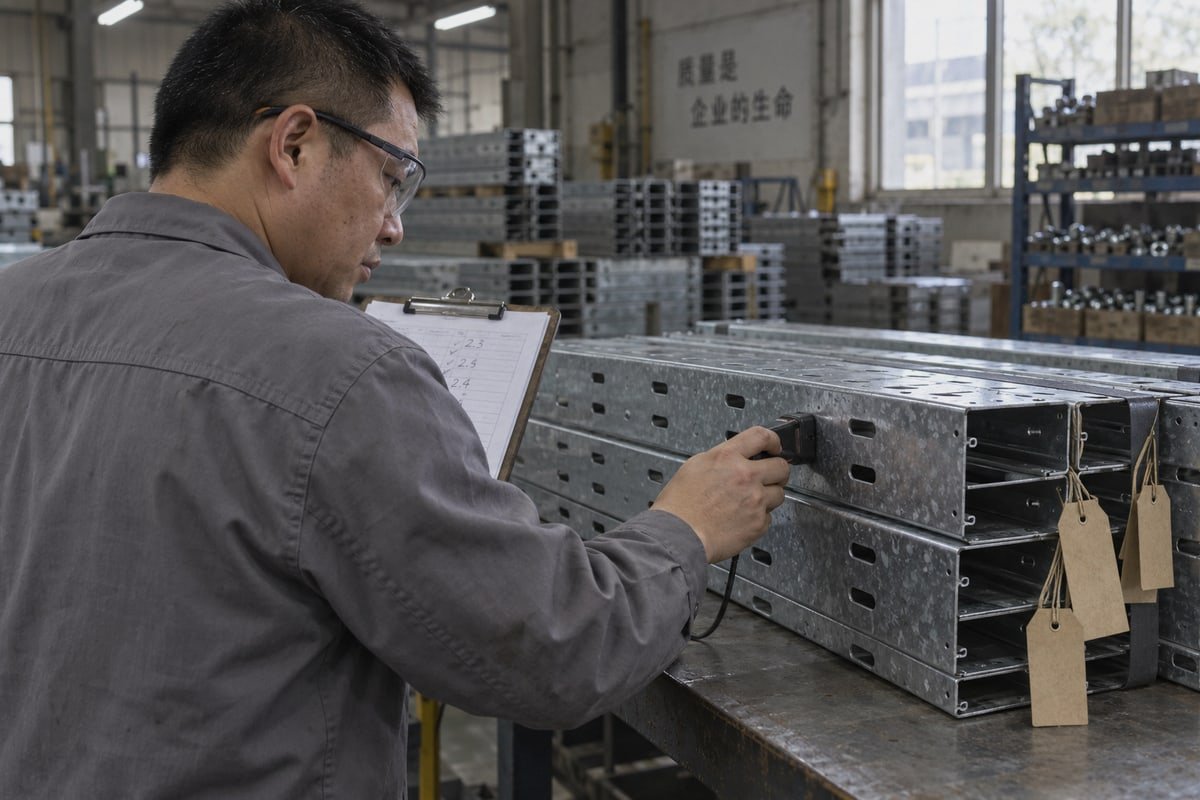
The phrase “ZAM coated” is not a specification. It names a coating family. I learned to write purchase orders the way our own factory reads them: with numbers. Here is the document list I send to every new supplier we benchmark, and the same list I hand to our customers.
The documents that separate real quality from a label
| Document | What it must state | Why it matters |
|---|---|---|
| Coating designation | Mass in g/m² per ASTM A1046 standards or equivalent | Thin ZAM can lose to heavy hot-dip galvanizing |
| Mill certificate | Base-steel grade, yield strength, thickness | Load-bearing capacity comes from steel, not coating |
| Corrosion test report | Salt spray test hours, method, sample thickness | Lets you compare products on equal terms |
| Load test data | Tray width, depth, thickness, support span, deflection | A rating at 1.5 m span means little at 3 m |
| Standard conformity | IEC 61537 or NEMA VE 1 declaration | Project specs usually name one of these |
| Accessory spec | Material of bolts, splice plates, covers, supports | Hardware is often the first corrosion point |
| Continuity test | Joint resistance, bonding jumper locations | Many projects target under 50 milliohms per joint |
Why load-bearing capacity is a system number
Coating type does not change strength. Capacity depends on material thickness specifications, side-rail height, rung spacing, fittings, and the cable tray support span. Our standard ranges run about 1.0 to 3.0 mm wall thickness and 50 to 150 mm rail height, but those are starting points. The same tray carries far less at a longer span. I always ask the buyer for the planned support spacing before I quote a thickness. If a supplier gives you one load number with no span attached, ask again.
Resolving the skeptic’s objection
Some engineers tell me ZAM data is mostly manufacturer marketing. They have a point. Accelerated tests do not reproduce stagnant water, ammonia vapor, or buried soil. My answer is not to argue. I give them the test conditions, the coating mass, and third-party inspection reports where the project requires them. Then they can judge for their own site. That is also why I insist on same-material accessories. A 304 stainless bolt on a ZAM tray in a chloride-rich site 3 can start galvanic corrosion when wet. In those cases I specify 316 with insulating washers, or ZAM hardware from the same coil family.
What Customization Options Should I Consider When Sourcing Cable Trays for My Specific Site Conditions?
A project director in Singapore once sent me a WhatsApp photo of a solid-bottom tray holding rainwater. His site needed drainage slots, not just a better coating.
Customize cable trays around five site factors: tray style chosen by cable heat and fill, width and depth with roughly 20% spare capacity, material thickness and rail height for the support span, drainage and cover details for the exposure, and pre-punched holes with matching fittings.
Our OEM and ODM work with EPC contractors taught me that customization starts with the cables, not the catalog. The personal rule I follow is simple: pick the structure by how much heat the cables produce, then fit the finish to the site.
Match the tray style to the cable load
| Tray style | Best for | Heat and drainage | Watch out for |
|---|---|---|---|
| Ladder | Heavy power cables, long spans | Excellent ventilation | Small cables can sag between rungs |
| Perforated | General power and control mix | Good ventilation, drains well | Confirm hole pattern suits cleats |
| Solid-bottom | Instrumentation, small control cables | Poor ventilation, holds water | Specify drain holes or sloped runs |
| Wire mesh | Data, telecom, light control | Excellent ventilation | Check load and coating match site |
| Channel | Small groups, short drops | Adequate | Low capacity for growth |
The sizing workflow I run with buyers
- List every cable with outside diameter, weight per meter, bend radius, and operating temperature.
- Group by voltage, function, and shielding. Decide where dividers or separate trays are needed.
- Add the widths and weights. Add about 20% spare space as a planning example, or more if expansion is planned.
- Round up to the next standard width. Check fill guidance.
- Confirm fittings, cover clearance, pulling access, and minimum bend radius at elbows.
Options that matter for your exposure
For solar sites, I offer perforated trays with the same ZAM coil used on the solar mounting structures, so the whole run shares one corrosion behavior. For water treatment, I add drain slots, raised covers, and 316 hardware where chlorides or sludge contact is expected. For data centers, buyers ask about zinc whiskers. A smooth, well-controlled coating surface and clean deburred edges reduce that risk and protect cable jackets during fast pulls. We also supply BIM objects with the coating and steel properties so your design team can simulate thermal expansion.
The two installation details I never skip
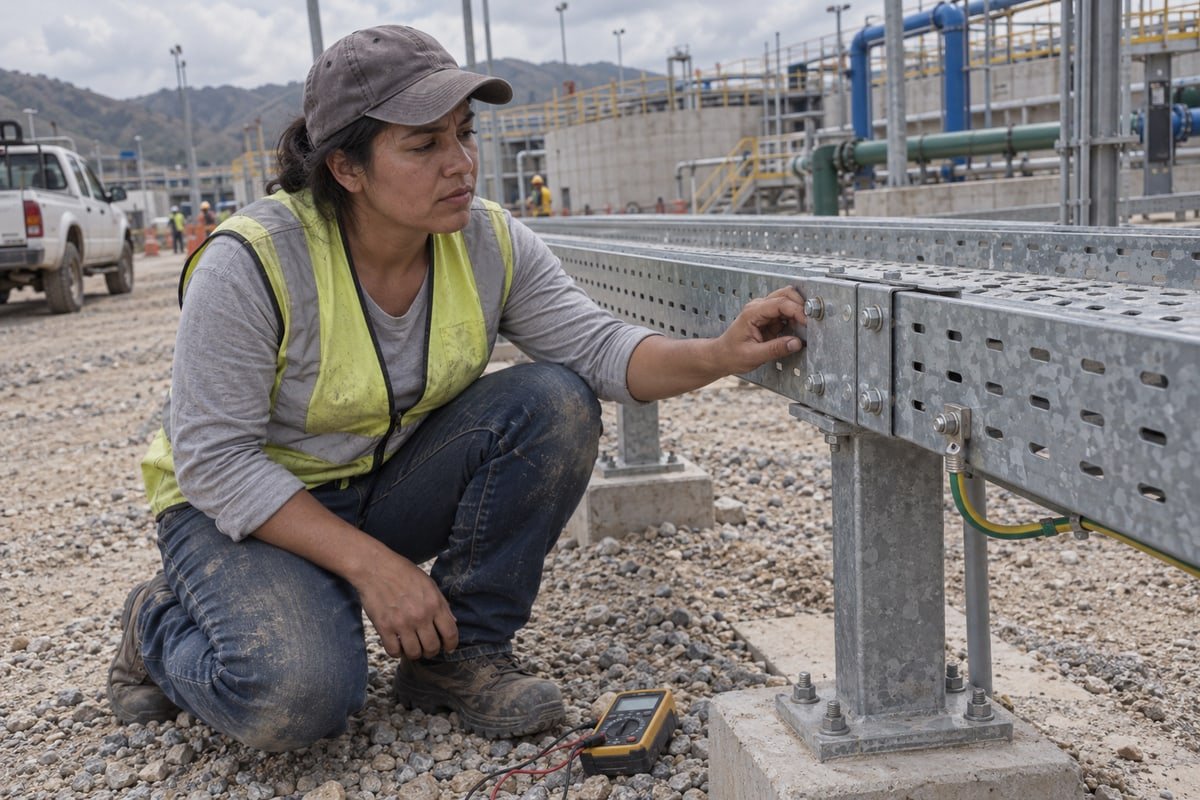
Expansion joints and grounding ruin more installations than coating ever does. Long outdoor runs expand in the sun. We build expansion splice plates 4 with slotted holes and supply bonding jumpers across every expansion joint and discontinuity. Metal tray can be part of the equipotential network, but it should not be your only protective conductor unless the code and the joint design allow it. I ask for continuity to be measured after drilling and field cuts, not just at the factory.
How Can I Avoid Delivery Delays and Logistics Issues When Importing Cable Trays for My Projects?
One hard lesson taught me that lead time is lost before production, not during it. Unconfirmed drawings and late coil bookings cost more weeks than any slow vessel.
Avoid delivery delays by freezing drawings and coating specs before deposit, confirming raw-coil availability, splitting large orders into phased shipments, nesting trays to cut container volume, using pre-shipment inspection with photo reports, and agreeing Incoterms, packing, and documentation in writing with your supplier.

Delivery delays, quality disputes, and returns are the three complaints I hear most from project directors in Singapore and Thailand. They are connected. A rushed drawing leads to a wrong hole pattern, which leads to a return, which leads to a delay. So I treat logistics as a planning problem that begins at the first email.
Where the weeks actually go
| Delay cause | Typical impact | How we prevent it |
|---|---|---|
| Drawings not frozen | Rework of punching tools | Signed drawing set before deposit |
| Coating spec changed mid-order | Wait for new coil | Coating designation written in the PO |
| ZAM coil out of stock | Weeks of waiting | Coil booked at order confirmation |
| Mixed hardware sourcing | Partial shipment | Accessories ordered with the tray |
| Loose packing | Damage, rejected goods | Nested stacks, edge protectors, strapped pallets |
| Document errors | Customs hold | Packing list and certificates checked twice |
A structural advantage of pre-coated ZAM
One point works in the buyer’s favor. ZAM tray is formed from pre-coated coil. There is no separate post-fabrication hot-dip bath. That removes a whole step from the schedule, keeps dimensions accurate, and avoids the warping that sometimes follows dipping. The continuous coating process 5 also uses less energy than batch galvanizing, which matters to buyers tracking green steel credentials. The trade-off is that punched holes and cut ends rely on the edge protection of the coating, so we deburr and, where required, treat cut ends before packing.
Phased shipments and packing
Large EPC orders rarely need every meter on day one. I suggest splitting into phases that follow the site’s installation sequence. The first container carries the main runs and supports. Later containers carry fittings and covers. Trays nest tightly, as you can see in our warehouse stacks, so container loading plans should reflect nested cross-sections, not flat volume. Before each container closes, we send photo reports of coating condition, hole patterns, and strapping. That report becomes the reference if anything is damaged in transit, which keeps returns rare and short.
Conclusion
Choosing by coating name alone invites rust, delays, and returns. Run the four checks, demand documents, and treat ZAM as a project-specific decision. I’m glad to review your drawings.
Interested in sourcing the products mentioned in this article? See details and request a quote here:
Footnotes
- ISO provides international standards for metallic and inorganic coatings used on steel products. ↩︎
- Official ISO standard defining the atmospheric corrosion categories (C1-C5) mentioned in the article. ↩︎
- AMPP is the global authority on corrosion prevention in chloride-rich and industrial environments. ↩︎
- NEMA sets the industry standards for metal cable tray components and installation accessories. ↩︎
- The IEA provides data on energy efficiency and decarbonization in industrial coating and steel processes. ↩︎