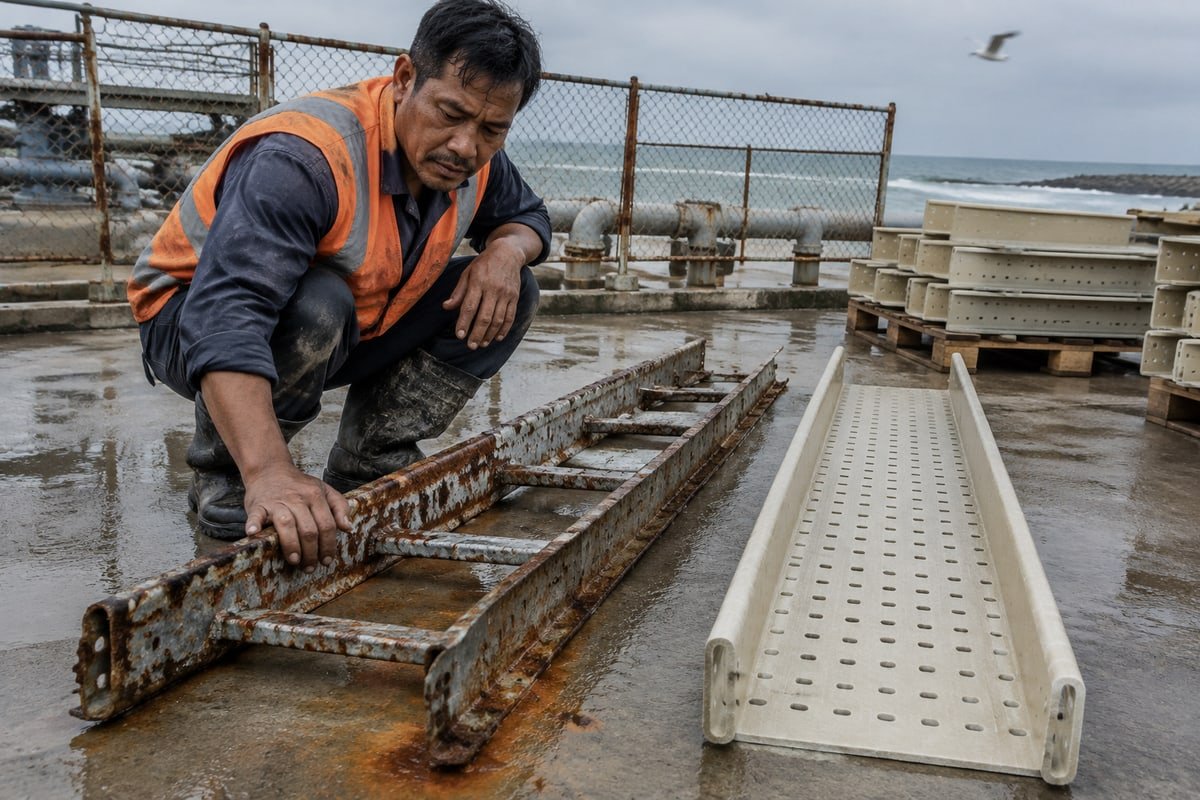
FRP/GRP perforated cable tray enters our quotes for one reason: steel rusts out in coastal plants. Rework follows, then blame. I see this cycle often from our Tai’an floor.
FRP/GRP perforated cable tray is a non-metallic, fiberglass-reinforced cable support made by pultrusion. Its punched or slotted base provides continuous support, partial ventilation, and drainage. It is chosen for corrosive, wet, or electrically sensitive environments where steel corrodes and ladder trays leave cables too exposed.
That is the short definition. The longer story is about when this tray earns its place and when it does not. I will walk through the material, the selection logic, the quality checks, and the customization options. I will also be honest about the limits, because I have seen buyers pick this tray for the wrong reasons.
What makes FRP/GRP perforated cable trays different from steel or aluminum options?
Every quote forces one trade-off in our shop: steel is cheaper per meter, but composite is cheaper over the project’s life. Which side wins depends on the site.
FRP/GRP perforated cable trays differ from steel and aluminum in four ways: they resist chemical and saltwater corrosion without coatings, they are non-conductive so no grounding is needed, they weigh roughly 75% less than steel, and they never need repainting. The trade-off is lower stiffness over long spans.
What the letters mean
FRP stands for fiber-reinforced plastic. GRP stands for glass-reinforced plastic. In cable tray work, both names describe the same thing: a composite of glass fiber reinforcement held in a resin matrix. The resin is usually polyester, vinyl ester, or epoxy. Polyester is the budget option. Vinyl ester handles harsher chemicals. Epoxy is rare in trays because of cost.
The tray body is made from pultruded fiberglass profiles. Pultrusion pulls continuous glass fibers 1 through a resin bath and then through a heated die. The result is a long, straight section with fibers aligned along the length. This is why the side rails are strong in bending but the material is still light.
Side-by-side comparison
| Property | Hot-dip galvanized steel | Aluminum | FRP/GRP perforated |
|---|---|---|---|
| Corrosion resistance | Depends on zinc layer; fails near chlorides | Good in air; weak against alkali and salt spray | Immune to most chemicals and saltwater |
| Electrical behavior | Conductive; grounding required | Conductive; grounding required | Non-conductive; no grounding |
| Weight | Heaviest | About one-third of steel | Roughly 75% lighter than steel |
| Thermal conductivity | High | Very high | Low |
| Long-span stiffness | Best | Good | Lowest; needs closer supports |
| Maintenance | Repainting or replacement over time | Low | Near zero over a 30+ year quoted life |
Where steel and aluminum still win
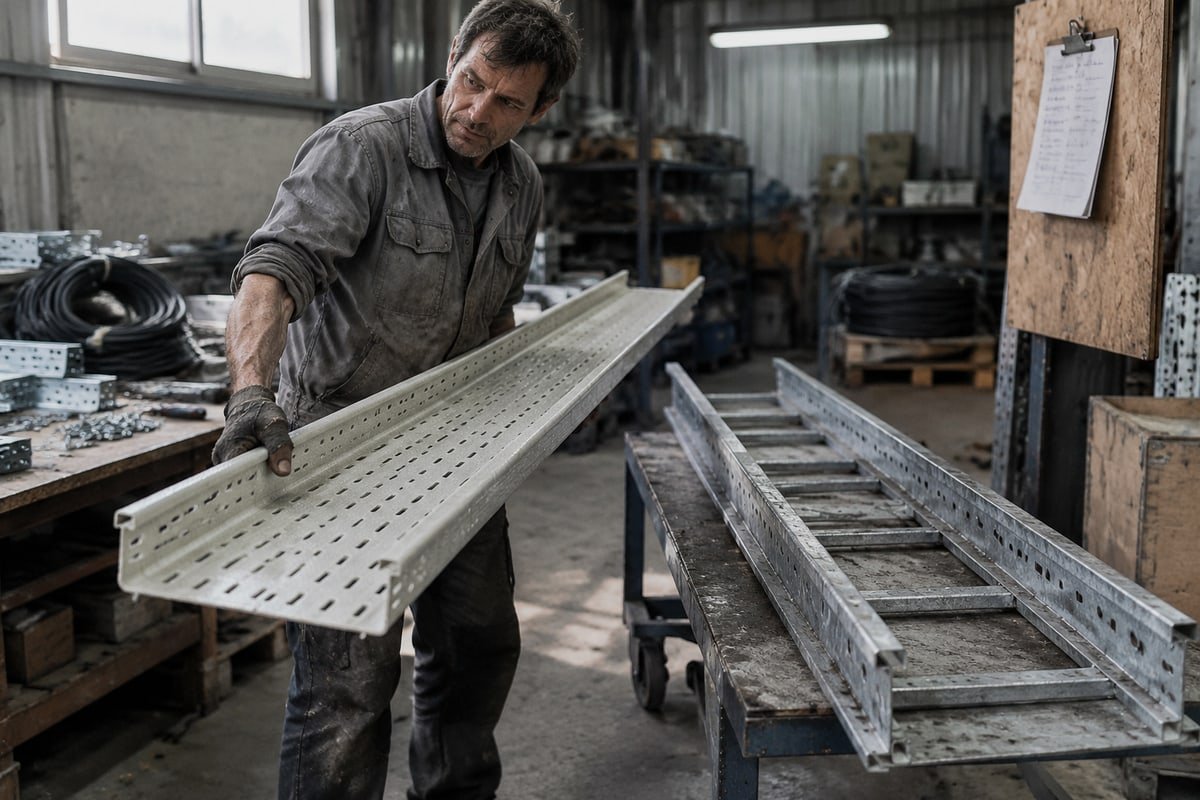
I will not pretend composite beats metal everywhere. We ship galvanized steel trays 2 in far larger volumes than FRP, and for good reason. In a dry indoor switchroom, steel is stiffer, cheaper, and easier to field-modify. Aluminum wins on rooftop solar runs where weight matters but chemical exposure is mild.
FRP/GRP takes over when the site is wet, salty, or chemically aggressive. It also wins where non-conductive electrical safety is a design requirement, such as near live instrumentation. Two further points come from the material itself. The composite damps vibration, which protects fiber-optic and thermocouple cables 3 from micro-fractures near heavy machinery. And its low mass reduces inertial forces during an earthquake, which matters in high-rise and industrial structures in seismic zones.
The honest summary is this. Steel is the default. FRP/GRP is the exception you justify with site data.
How do I choose the right FRP/GRP perforated cable tray for my project environment?
A project director in Singapore once messaged me on WhatsApp asking for perforated FRP across an entire wastewater plant. I asked him three questions before quoting anything.
Choose an FRP/GRP perforated cable tray only when three conditions hold together: the environment corrodes ordinary steel, the cables need continuous support that ladder tray cannot give, and heat or weight limits rule out solid channel tray. If any condition fails, ladder or channel tray is usually the better answer.

Where perforated sits among the three tray types
| Tray type | Openness | Protection for small cables | Heat dissipation | Typical fit |
|---|---|---|---|---|
| Ladder tray | Open rungs | Low; cables can sag or snag between rungs | Best | Heavy power cables, high cable density |
| Perforated tray | 20–40% open area in the base | Medium; continuous support, no snagging | Medium | Instrumentation, control, communication, thermocouple cables |
| Solid channel tray | Closed base | High; blocks dust and debris | Lowest | Containment-first runs, low heat load |
Perforated tray is the middle option. That sounds like a safe choice. In my experience, it is the opposite. It is a narrow-band choice that only makes sense after some calculation.
The three-condition test
Here is the logic I use before I put perforated FRP on a quote.
- Does the environment corrode ordinary steel? Wastewater treatment plants, chemical processing facilities, coastal solar farms, and offshore platforms answer yes. A dry indoor plant answers no. If no, stop here and use galvanized steel.
- Do the cables need continuous support? Small-diameter instrumentation and communication cables sag between ladder rungs. Cable cleats also seat better on a flat base. If the run is mostly large power cables, ladder tray is better and cheaper.
- Does heat or weight rule out solid channel? Power cables that run warm need airflow. Long elevated runs need low mass. If neither is a problem, a solid channel tray gives more protection for similar money.
Only when all three answers are yes does the perforated FRP/GRP tray become the right pick. If one answer is no, I tell the buyer to step back to ladder or channel. Using perforated tray to split the difference usually means paying for protection you do not need or losing airflow you do need.
What I told the Singapore buyer
His plant was corrosive, so condition one held. His runs were mostly 4-core power cables 4 to pumps, so condition two failed. We ended up quoting FRP ladder tray for the power runs and perforated FRP only for the instrumentation racks. His material cost went down, and his heat margin went up.
What quality standards should I verify when sourcing FRP/GRP perforated cable trays?
Last year our QC team rejected a batch of pultruded fiberglass profiles because the flange edges showed exposed glass fibers. The supplier’s datasheet looked perfect. The material did not.
Verify five things when sourcing FRP/GRP perforated cable trays: compliance with NEMA FG1 standards for fiberglass tray, a documented flame retardant resin grade, a UV stabilized coating or surface veil, tested load bearing capacity at your actual span, and a written corrosion resistance statement for your specific chemicals.
Paper versus product
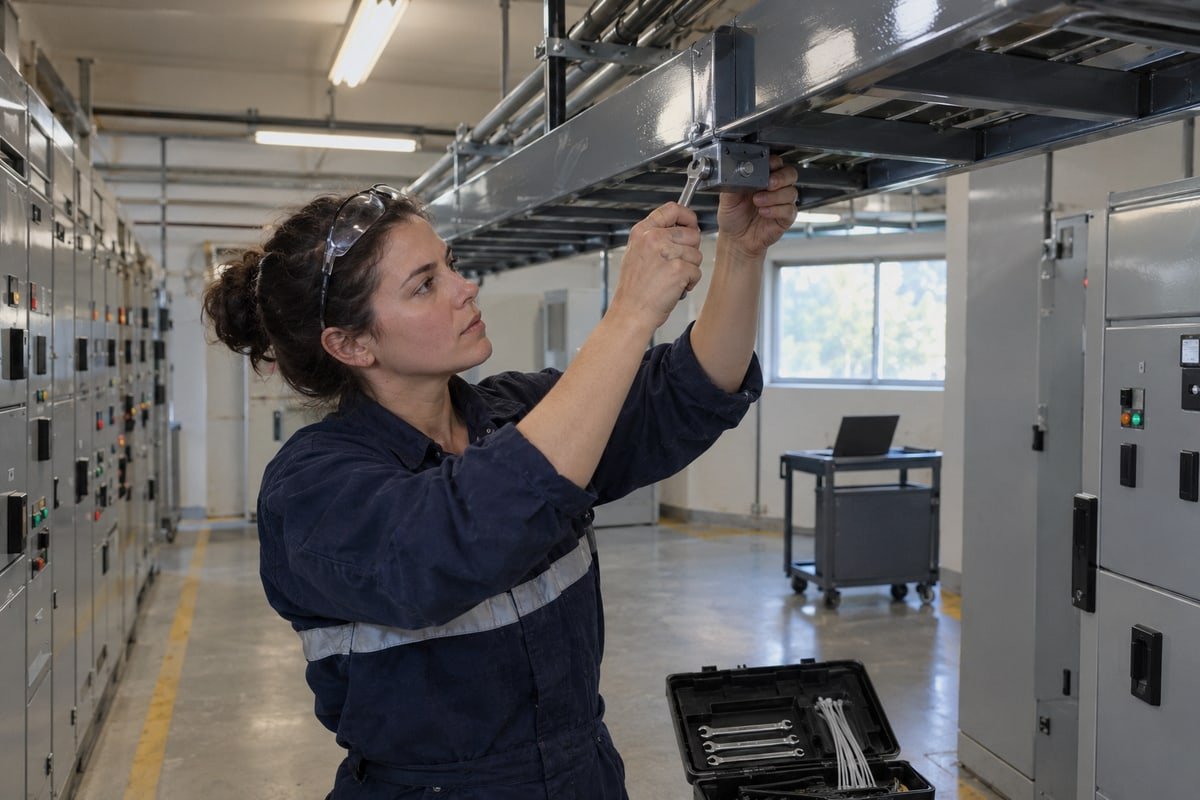
A datasheet can say anything. A tray section cannot hide much. Before we approve any composite tray for export, we look at three physical things. First, the cut ends. Clean pultrusion shows dense, even fiber packing with no dry spots. Second, the surface. A proper UV stabilized coating or surface veil feels smooth and shows no exposed fiber. Third, the perforations. Punched holes should have sealed edges, not frayed glass, because frayed edges wick moisture and become the first point of failure.
The verification checklist
| Item to verify | What to ask for | Red flag |
|---|---|---|
| Standard compliance | Reference to NEMA FG1 standards or your market’s equivalent | Vague words like “meets international standards” |
| Fire performance | Named flame retardant resin grade and test method | “Fire retardant” with no test reference |
| UV protection | Surface veil or UV stabilized coating stated in the spec | Bare pultrusion offered for outdoor runs |
| Load bearing capacity | Load and deflection data at your support span | Data given only at a short, flattering span |
| Corrosion resistance | Resin chemical resistance chart against your actual media | A generic “corrosion resistant” claim |
| Dimensions | Wall thickness of 3 mm to 6 mm confirmed by drawing | Thickness not stated at all |
The naming problem, and how to defeat it
One objection I hear from procurement managers is fair: “Every supplier calls this something different.” They are right. Some call it perforated tray. Others file it under channel tray, or ventilated tray, or solid-bottom tray with slots. The industry has not standardized the name.
The fix is simple. Do not specify by name. Specify by drawing and by number. State the open-area percentage 5, usually between 20% and 40% for this type. State the hole pattern and pitch. State the side height. When the drawing controls, the name stops mattering, and returns caused by “that is not what we meant” almost disappear.
Can FRP/GRP perforated cable trays be customized to meet my project’s specific requirements?
One lesson from OEM work: customization at the drawing stage costs little, while customization after shipment costs a return. We lock drawings before any resin is mixed.
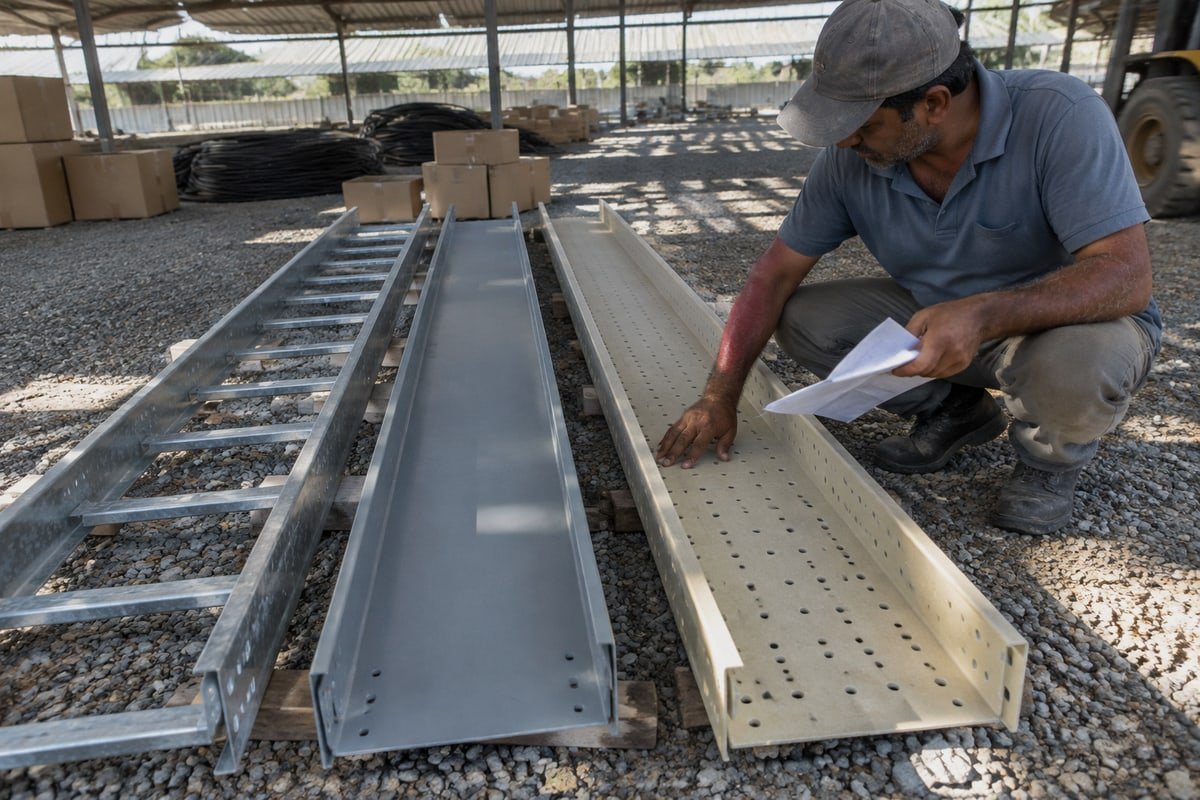
Yes. FRP/GRP perforated cable trays can be customized in width from 50 mm to 1200 mm, wall thickness from 3 mm to 6 mm, side heights such as 50 mm or 80 mm, perforation pattern and open-area percentage, resin type, color, fire rating, and matching fittings and cable tray accessories.
What we customize most often
Most of our EPC and wholesale buyers in Southeast Asia and South America change the same handful of variables. The table below shows the range we work within and the reason each variable moves.
| Variable | Common range | Why a buyer changes it |
|---|---|---|
| Width | 50 mm to 600 mm standard; up to 1200 mm on request | Cable fill and future expansion |
| Side height | 50 mm or 80 mm most common | Stacking depth and cleat clearance |
| Wall thickness | 3 mm to 6 mm | Load bearing capacity at a given span |
| Open area | 20% to 40% | Balance of drainage, airflow, and debris protection |
| Resin | Polyester or vinyl ester | Chemical media at the site |
| Surface | UV stabilized coating or veil, custom color | Outdoor exposure and plant color coding |
| Fittings | Bends, tees, risers, reducers, covers, splice plates | System continuity without site improvisation |
Where customization gets risky
Cutting composite on site is the biggest source of trouble I see. Every field cut exposes raw glass fiber. That edge then needs sealing, or it wicks moisture and starts to degrade. So we push buyers to fix lengths, hole positions, and fitting angles on the drawing, and we ship pre-cut sections with sealed ends. It costs a few days at our end. It saves weeks at the site.
Delivery delays are the pain point I hear most from project directors. Custom tooling for an unusual width or profile adds lead time. I always separate the quote into standard sections, which ship faster, and custom sections, which do not. That way a late custom item does not hold up the whole shipment.
Emerging options worth watching
Two developments are appearing in the composite tray market. The first is adjusting the fiber-to-resin ratio to tune dielectric properties for ultra-high-voltage installations. The second is embedding phase-change materials in tray walls for passive thermal management of high-load power cables. Both are early-stage. I mention them so you can ask about them, not because they should be on your next order.
Conclusion
Corroded steel trays cost projects time and trust. FRP/GRP perforated cable tray fixes that, but only in its narrow band. Check the three conditions, verify the specs, then order.
Footnotes
- Wikipedia entry explaining the pultrusion process used to manufacture continuous lengths of reinforced polymer profiles. ↩︎
- The International Organization for Standardization develops global specifications for materials and industrial processes. ↩︎
- IEEE is the world’s largest technical professional organization dedicated to advancing technology and electrical standards. ↩︎
- The International Electrotechnical Commission is the leading global organization for preparation of standards for electrical technologies. ↩︎
- NEMA publishes the definitive standards for electrical equipment, including nonmetallic cable tray systems. ↩︎