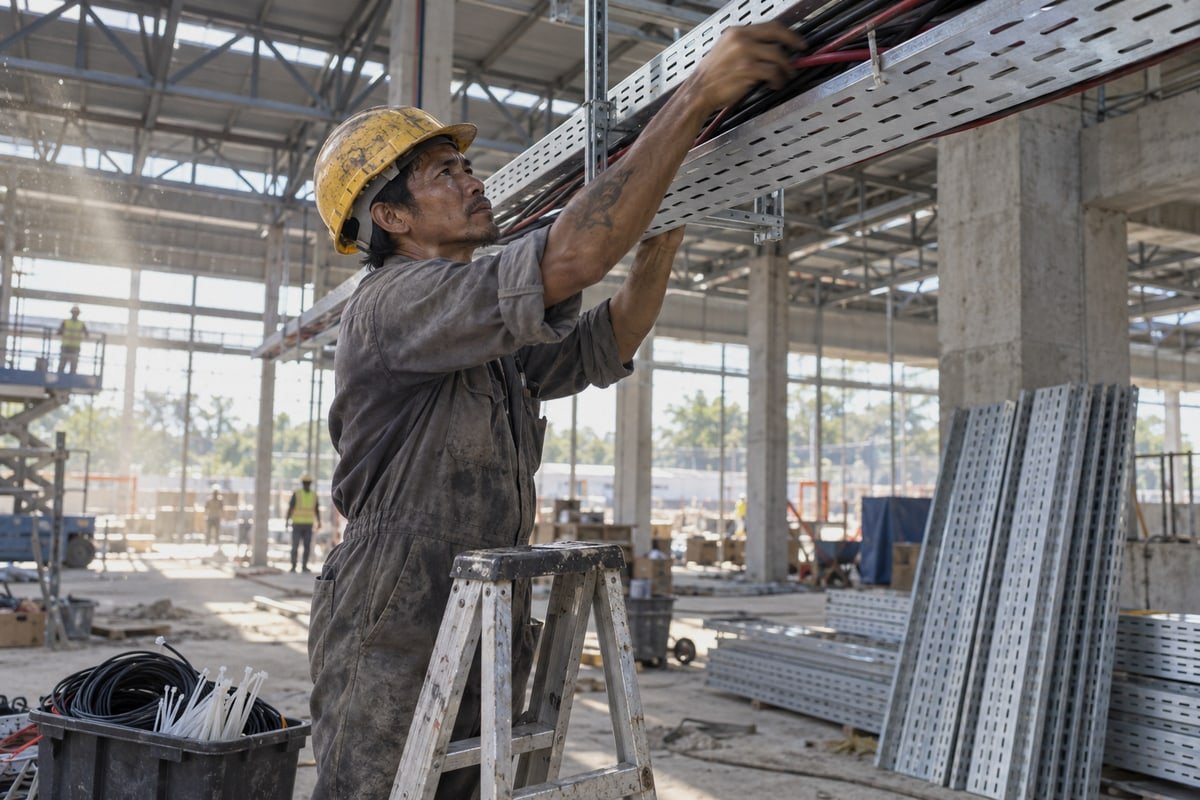
Overheated cables ruin projects. I have watched contractors rip out closed trunking after cables cooked inside. That pain is exactly why our Tai’an factory builds aluminum alloy perforated cable tray.
An aluminum alloy perforated cable tray is a lightweight, corrosion-resistant support channel with slotted holes in its base. It carries power and data cables along a defined route while the perforations allow airflow for heat dissipation, drainage, and easy tie-down points during installation.
That is the short answer. But the details decide whether this tray saves your project or disappoints you. Below, I break down the materials, the trade-offs, the sizing math, and the real applications. Let’s start with what the product actually is.
What Materials and Design Features Make Up My Aluminum Alloy Perforated Cable Tray?
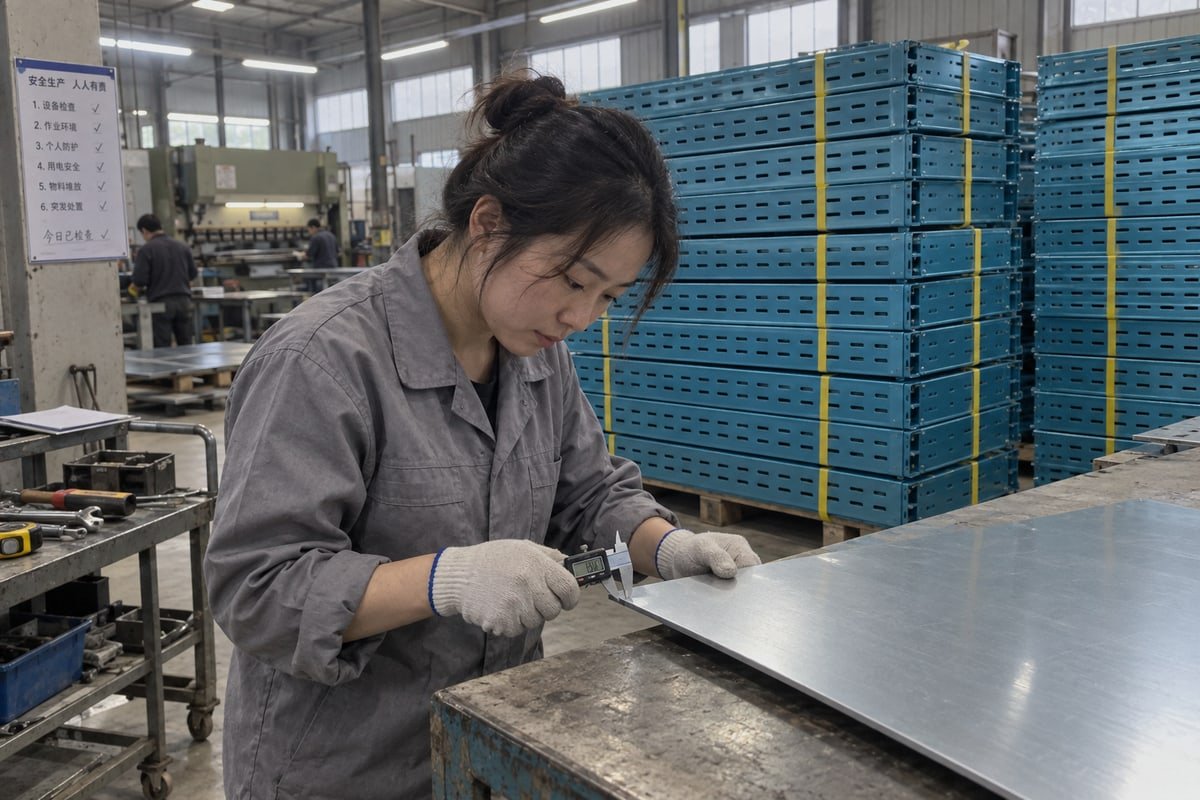
Our QC team once rejected an entire batch of tray blanks over 0.2 mm of missing thickness. On perforated designs, that small gap matters more than most buyers realize.
An aluminum alloy perforated cable tray consists of a slotted base plate, two side rails, and matching cable tray accessories, all formed from grades like 6063-T6 or 5052. The perforations provide ventilation and drainage, while the alloy delivers light weight and natural corrosion resistance.
Think of the product as three things combined: a tray skeleton, ventilation openings, and aluminum’s natural advantages. Each part deserves a closer look.
The Alloy Grades That Matter
Most of our tray production uses 6063-T6 aluminum alloy. It bends cleanly, holds a good surface finish, and balances strength with formability. When a client needs higher structural strength, we quote 6061-T6 instead. For marine or coastal projects 1, 5052 is a strong choice because of its excellent saltwater corrosion resistance. The self-healing oxide layer on all these grades means the tray protects itself without paint.
Anatomy of the Tray
| Component | Function | What to Check Before Ordering |
|---|---|---|
| Base plate | Supports cable weight; slots allow airflow and drainage | Actual sheet thickness, typically 1.5–2.5 mm |
| Side rails | Carry most of the bending load along the span | Rail height and return-flange design |
| Perforations | Heat dissipation, tie-down points, dust and water pass-through | Slot size, spacing, and open-area ratio |
| Couplers, bends, tees | Connect sections and change direction | Fit tolerance and bolt pattern |
| Optional covers | Shield cables from sun or falling debris | Clip type and wind resistance |
| Surface finish | Mill, anodized, or powder-coated | Coating thickness and color consistency |
The Hidden Spec: Sheet Thickness
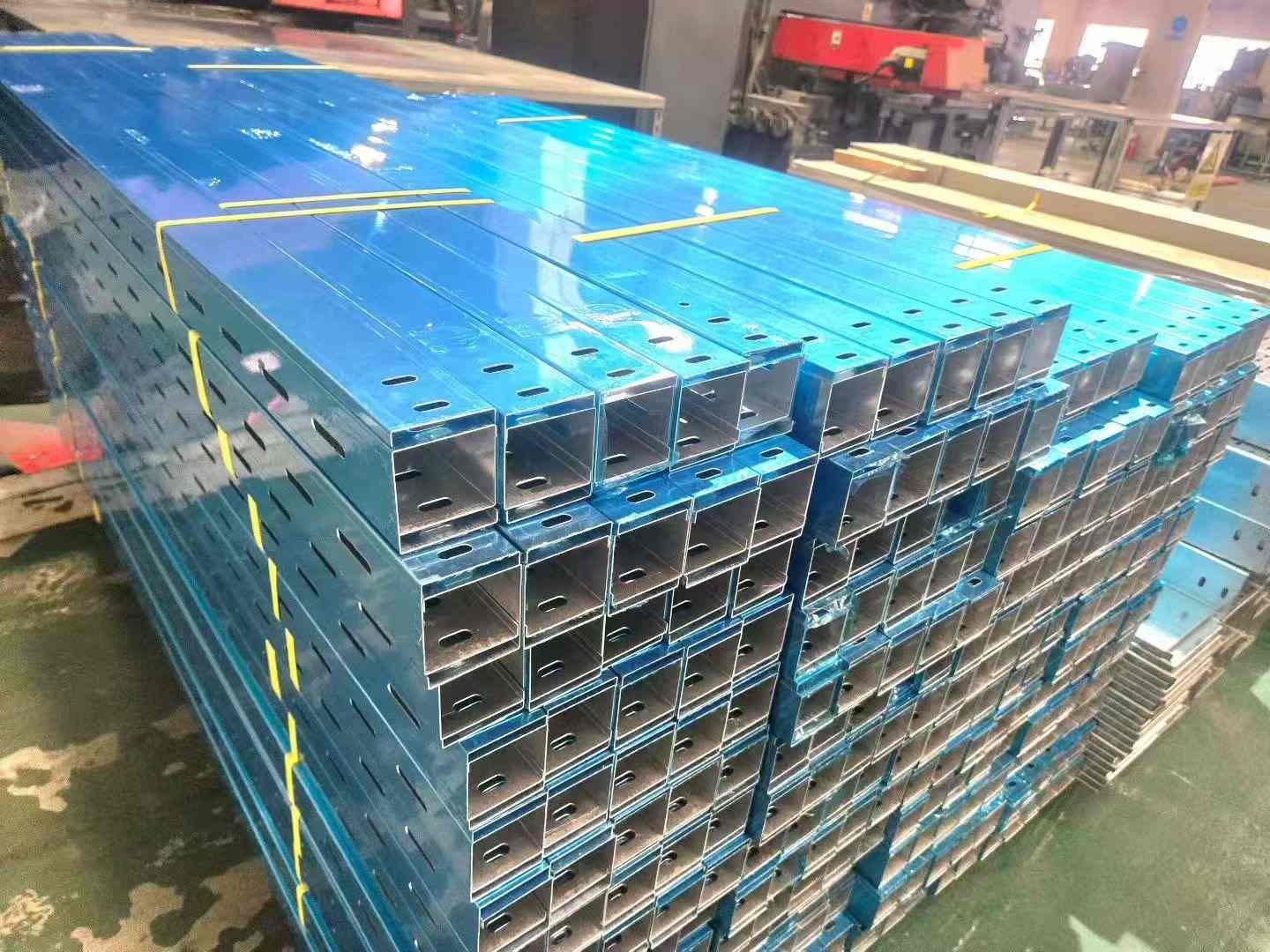
Here is something I stress with every buyer. Punching holes removes material. At the same thickness and span, a perforated base carries less load than a solid one. In practice, we compensate by increasing the sheet thickness. So never judge a tray by its outer dimensions alone. Two trays can look identical in our warehouse, stacked and strapped side by side, yet perform very differently under load. The real plate thickness is the key parameter, and it is the first thing our QC team measures on every batch.
Why Should I Choose Aluminum Alloy Perforated Cable Trays Over Steel or Fiberglass for My Project?
A project director in Singapore messaged me on WhatsApp last year with one blunt question: why pay more for aluminum when galvanized steel is sitting right there?
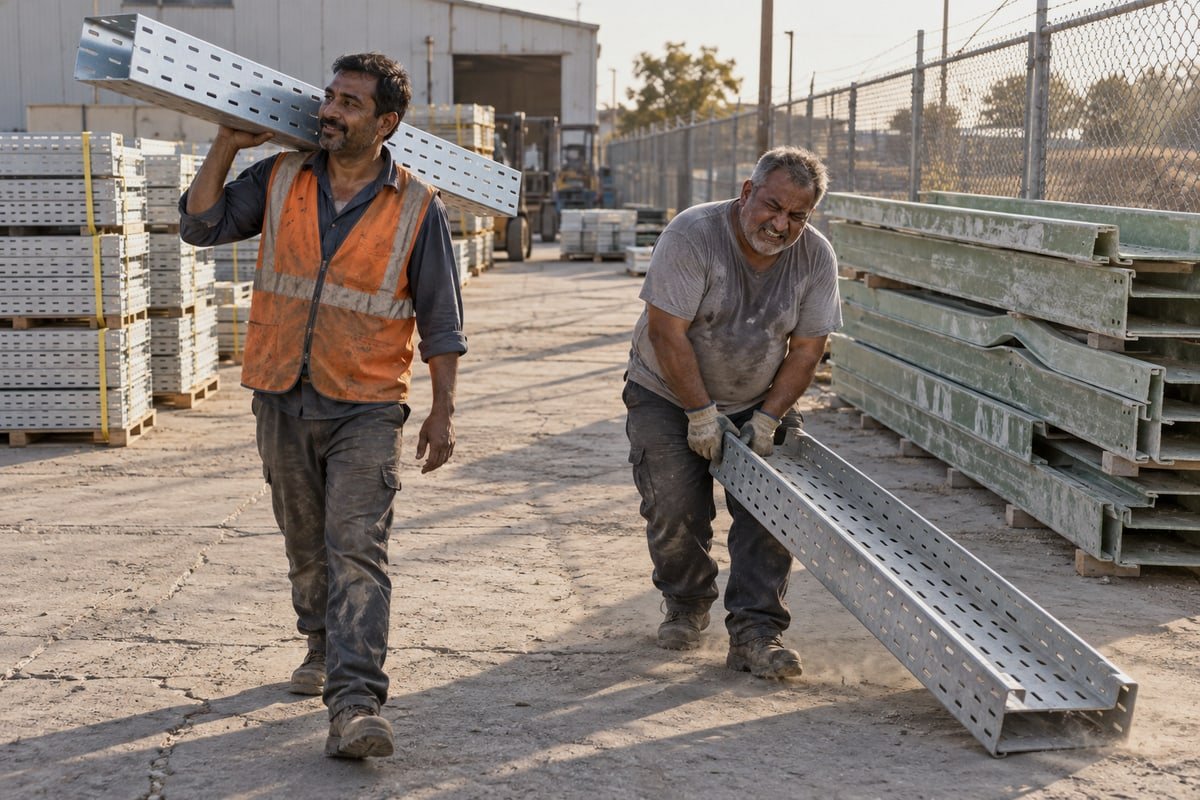
Choose aluminum alloy perforated cable trays when you need low weight, strong corrosion resistance, and fast installation. Aluminum weighs roughly one-third as much as steel, never rusts, can serve as an equipment grounding conductor, and outlasts fiberglass under UV exposure and mechanical stress.
Here is how the three materials stack up on the criteria my clients care about most:
| Criteria | Aluminum Alloy | Galvanized Steel | Fiberglass (FRP) |
|---|---|---|---|
| Weight | Very light, easy ceiling mounting | Heavy, needs stronger supports | Light |
| Corrosion resistance | Excellent, self-healing oxide layer | Good until zinc coating is damaged | Excellent in chemical exposure |
| Rigidity | Good, improves with thicker sheet | Highest for heavy main runs | Lowest, can sag over long spans |
| Grounding | Often UL-classified as an EGC | Requires bonding jumpers at joints | Non-conductive, needs separate ground |
| Installation speed | Fast, light sections and snap-on parts | Slower, heavy lifting required | Fast but fragile edges |
| Material cost | Mid to high | Lowest upfront | Mid to high |
Now let me answer that Singapore director honestly, because his objection is fair. Yes, galvanized steel costs less per meter. And for extremely heavy main runs, a steel ladder cable tray may still be the right call. But upfront price is not installed cost. Lightweight aluminum sections with snap-on, tool-less accessories can cut installation labor time by up to 50% compared with heavy-gauge galvanized steel. Fewer workers, lighter supports, faster ceilings.
There is another saving buyers miss. Aluminum trays 2 are often UL-classified as Equipment Grounding Conductors. That reduces the need for a separate ground wire along the run, which simplifies grounding and bonding and trims material cost. Steel needs jumpers at every joint; fiberglass needs a full separate grounding path.
One caution from our export experience: when aluminum tray meets structural steel or copper grounding components, you must use isolation hardware or bimetallic transition plates. Otherwise galvanic corrosion will attack the joint. We include these fittings in project quotes for exactly this reason.
How Do I Determine the Right Size and Load Capacity for My Aluminum Alloy Perforated Cable Tray?
Every quote we prepare involves the same balancing act: wider tray or thicker sheet, longer support span distance 3 or more brackets. Sizing decides whether a system performs or sags.
Determine tray size by calculating total cable weight per meter, adding a 20–30 percent expansion margin, then matching that load to the manufacturer’s rated capacity at your planned support span distance. Verify the actual sheet thickness, because perforations reduce load bearing capacity versus solid bases.
Sizing is not guesswork. I walk clients through the same five steps on every project, whether it is a solar farm in Thailand or a plant retrofit in the Philippines.
A Five-Step Sizing Process
- Calculate the cable load. Add up the weight per meter of every cable in the run. Your cable supplier’s datasheets give these figures directly.
- Add a growth margin. Reserve 20–30 percent of width and load for future cables. Trays exist so you can add circuits later without rework.
- Select the width by fill. Lay out cable diameters across the tray width. Keep a sensible fill so heat dissipation stays effective and cables remain accessible.
- Check the load chart at your span. A tray rated at a 1.5 m support span distance carries far more than the same tray at 3 m. Always match the chart to your actual bracket spacing, and ask whether the rating was tested to NEMA VE 1 standards.
- Verify the sheet thickness. This is my personal rule. Because perforations weaken the base, we often quote a thicker plate to restore load bearing capacity. Confirm the real thickness in writing, not just the external dimensions.
Common Sizes We Produce
| Tray Width | Typical Sheet Thickness | Typical Use |
|---|---|---|
| 100–200 mm | 1.5–2.0 mm | Branch runs, instrumentation cables |
| 300–400 mm | 2.0–2.5 mm | Main power and mixed-service runs |
| 500–600 mm | 2.5 mm and above | Heavy trunk routes, data center corridors |
One more engineering detail matters for long runs. Aluminum has a high coefficient of thermal expansion. On outdoor or high-temperature routes, plan expansion splice plates at intervals recommended by your supplier. Skipping them invites buckling and joint deformation when temperatures swing. We flag this on every outdoor project drawing we review.
Which Industries and Applications Are Best Suited for My Aluminum Alloy Perforated Cable Tray Installation?
One wastewater project taught our team where perforated tray truly belongs. The chlorine-heavy air destroyed painted steel in two years, while our aluminum runs stayed untouched.
Aluminum alloy perforated cable trays suit solar farms, data centers, water treatment plants, high-temperature workshops, and coastal outdoor installations. They fit anywhere heat dissipation, corrosion resistance, and light weight outrank full enclosure. Avoid them where strict electromagnetic shielding or heavy impact protection is required.
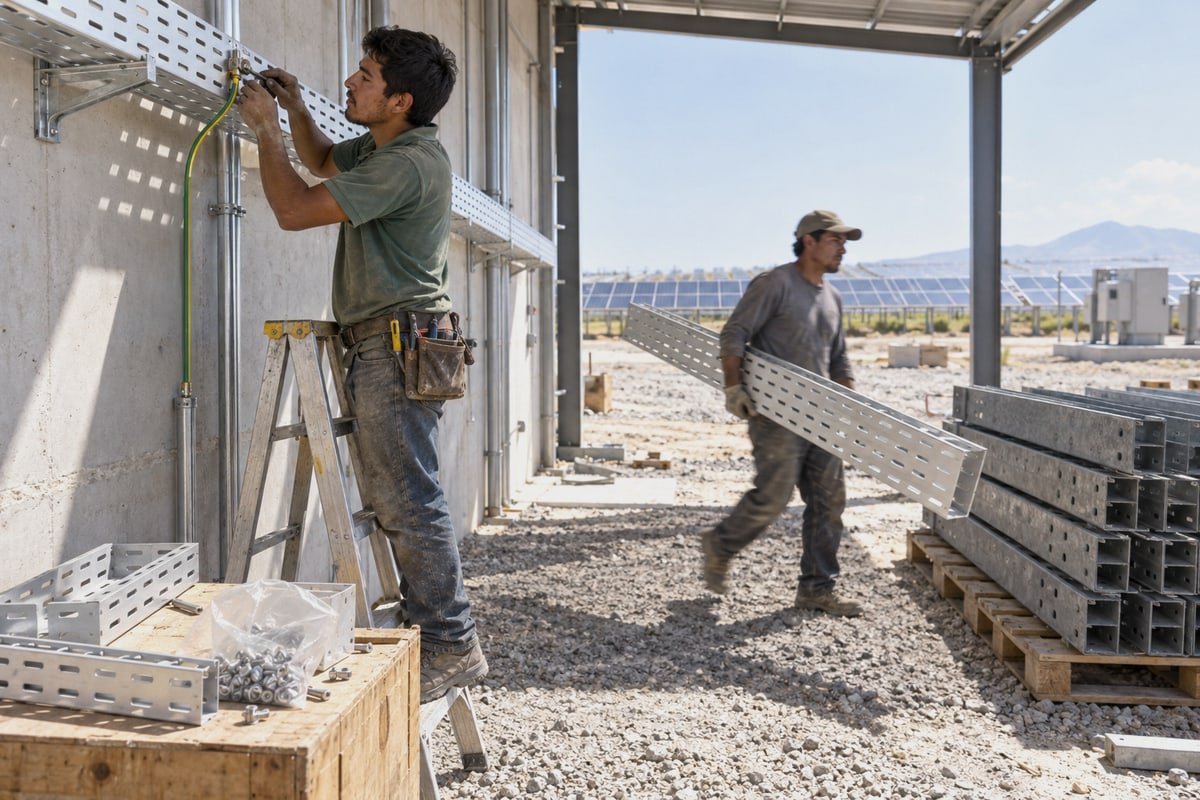
The pattern behind every successful installation is simple. This tray was designed for heat and lightness, not for maximum protection. Match the product to that purpose and it performs brilliantly.
Where Perforated Aluminum Tray Wins
- Solar farms. Our solar EPC clients across Southeast Asia run DC strings through open, ventilated trays. Cables stay cooler, which supports higher current-carrying capacity in hot climates.
- Data centers. Dense cable runs generate real heat. Perforations keep air moving, and the slots double as tie-down points for organized bundles.
- Water and wastewater treatment. Humid, chemically aggressive air punishes coated steel. Aluminum’s oxide layer shrugs it off, and the open base drains splashes instead of pooling them.
- High-temperature workshops. Foundries, kilns, and process lines benefit from any design that sheds heat rather than trapping it.
- Outdoor and coastal routes. Rain and dust fall through the perforations. Add optional covers where sun or debris is a concern.
Where I Tell Buyers to Choose Something Else
Here is a point I insist on, even when it costs us a sale. Perforated does not mean better in every case. If your industrial electrical installations 4 require physical separation between power and signal cables, the open base weakens electromagnetic shielding. A solid aluminum body does block some EMI and RFI, but every slot punches a gap in that barrier. For strict shielding requirements, a solid-bottom trunking or a fully covered tray is the right tool. Perforated tray’s home ground is where cooling beats containment. Know which problem you are solving, and the choice becomes obvious.
Conclusion
An aluminum alloy perforated cable tray is a tray skeleton plus ventilation holes plus aluminum’s light weight. Choose it for heat and corrosion challenges, and verify sheet thickness before ordering.
Footnotes
- NOAA provides data on environmental conditions in marine and coastal areas that affect material corrosion. ↩︎
- ISO develops international standards for the performance and testing of cable tray systems. ↩︎
- NEMA provides industry standards for load ratings and support spans in metal cable tray systems. ↩︎
- The IEC develops international standards for safety and efficiency in industrial electrical installations. ↩︎