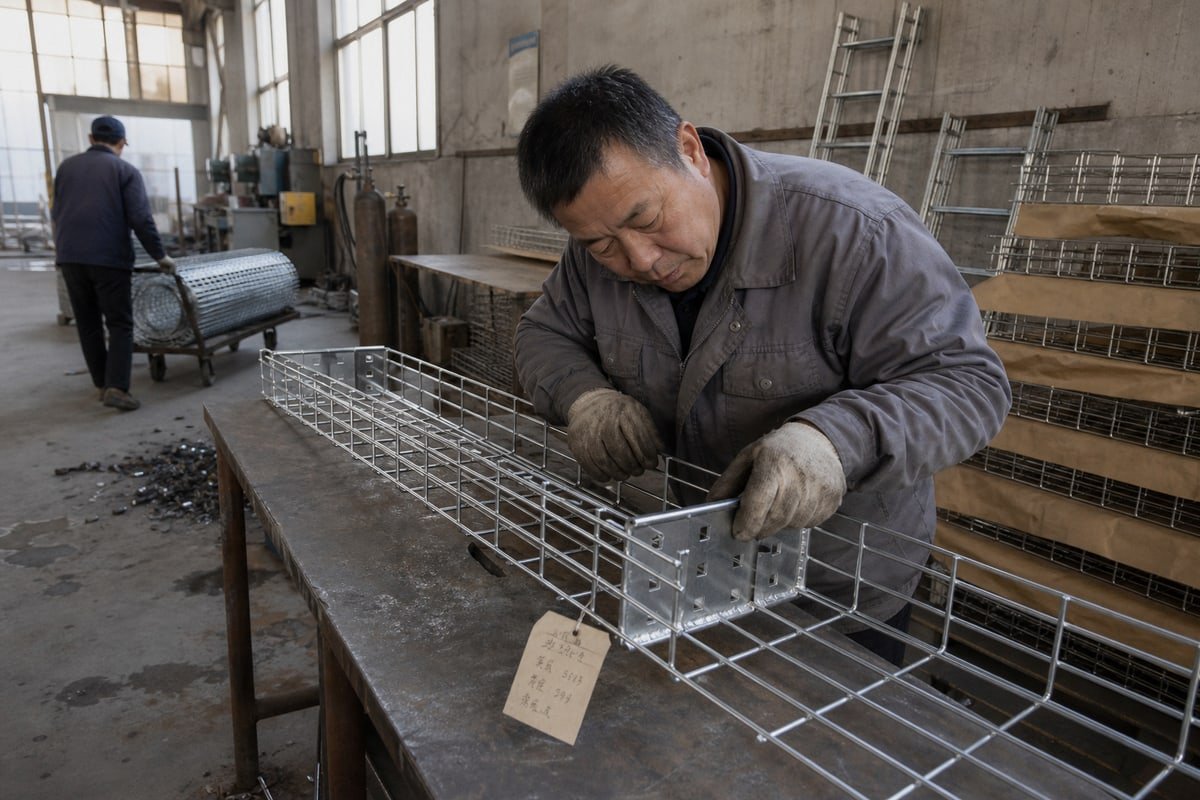
Salt air kills ordinary trays fast. On our Tai’an production line, we build stainless steel 316 wire mesh cable tray systems because coastal projects keep losing galvanized baskets to rust.
A stainless steel 316 wire mesh cable tray is an open, basket-style cable management system made from welded 316 stainless wires. Its 2–3% molybdenum content resists chloride pitting, making it ideal for marine, coastal, food processing, and washdown environments where lighter cables need ventilated, corrosion-proof support.
That is the short answer. But choosing this product wisely takes more context. Below, I walk through the material science, the best-fit industries, sizing rules, and sourcing checks—step by step.
How does 316 stainless steel differ from 304 for wire mesh cable trays?
Last year, a PMI gun on our incoming inspection bench caught a coil labeled 316 that tested as 304. That single check saved a Philippine desalination order.
316 stainless steel contains 2–3% molybdenum, which 304 lacks. That molybdenum content gives 316 far better resistance to chloride pitting and crevice corrosion. For wire mesh cable trays, choose 316 in marine, coastal, or chemical washdown settings; 304 suits milder indoor environments at lower cost.
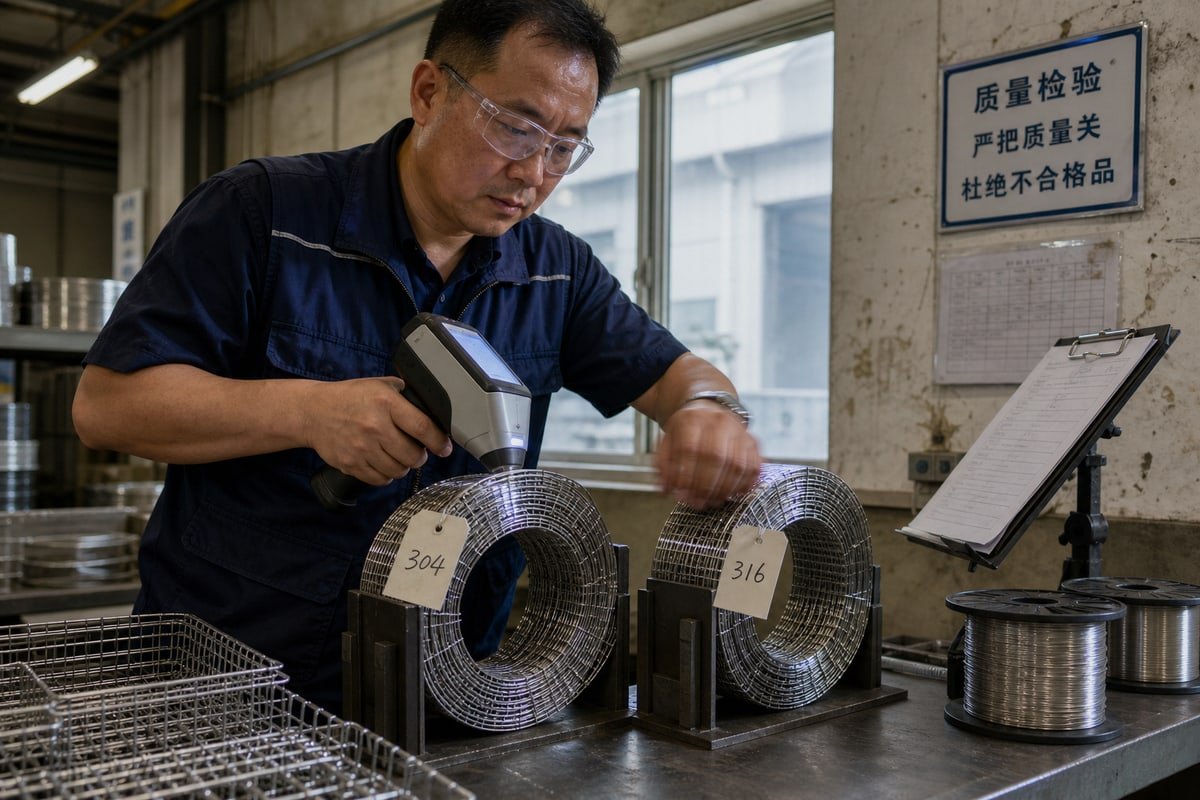
The 304 vs 316 stainless steel debate comes up in almost every inquiry we receive. Both grades look identical. Both weld well. Both resist rust in normal indoor air. The difference only appears when chlorides enter the picture. Salt spray, seawater, de-icing salts, and chlorine-based cleaning agents all attack the passive oxide layer on stainless steel. The molybdenum in 316 stabilizes that layer, so pitting and crevice corrosion start much later, if at all.
The molybdenum difference, in plain terms
Think of molybdenum as insurance against localized attack. A 304 basket cable tray 1 in a coastal plant may look fine for a year, then develop rust pits at weld points. A 316 tray in the same spot keeps its surface intact. That is why 316 earns the label of marine grade stainless steel.
| Property | 304 wire mesh tray | 316 wire mesh tray |
|---|---|---|
| Molybdenum content | None | 2–3% |
| Chloride pitting resistance | Moderate | Excellent |
| Salt spray / marine suitability | Limited | Industry standard |
| Chemical resistance to chlorinated cleaners | Fair | Strong |
| Relative cost | Baseline | 1.5–2x higher |
| Best environments | Dry indoor, mild industrial | Coastal, offshore, washdown |
Beyond corrosion: two hidden advantages
There are two less obvious benefits I always mention to engineers. First, 316 is essentially non-magnetic, so it prevents eddy currents and inductive heating when high-ampere single-conductor cables run through it—a real risk with magnetic carbon steel trays. Second, 316 is zinc-free. That eliminates zinc whiskers 2, the microscopic conductive filaments from galvanized coatings that can short out servers in mission-critical data centers.
The honest trade-off is cost. In our own quotations, a 316 mesh tray runs roughly 1.5 to 2 times the price of the same tray in 304, and several times the price of hot-dip galvanized. Pay that premium only when the environment justifies it.
What industries and environments benefit most from 316 wire mesh cable trays?
A project director in Singapore once messaged me on WhatsApp about tray corrosion on an FPSO retrofit. His galvanized baskets had failed within eighteen months offshore.
Industries that benefit most include offshore oil platforms, FPSO vessels, ships, coastal pharmaceutical and food processing plants, desalination facilities, coastal data centers, and telecom stations. 316 wire mesh cable trays excel wherever chloride exposure combines with dense, lightweight signal, control, or fiber cabling.
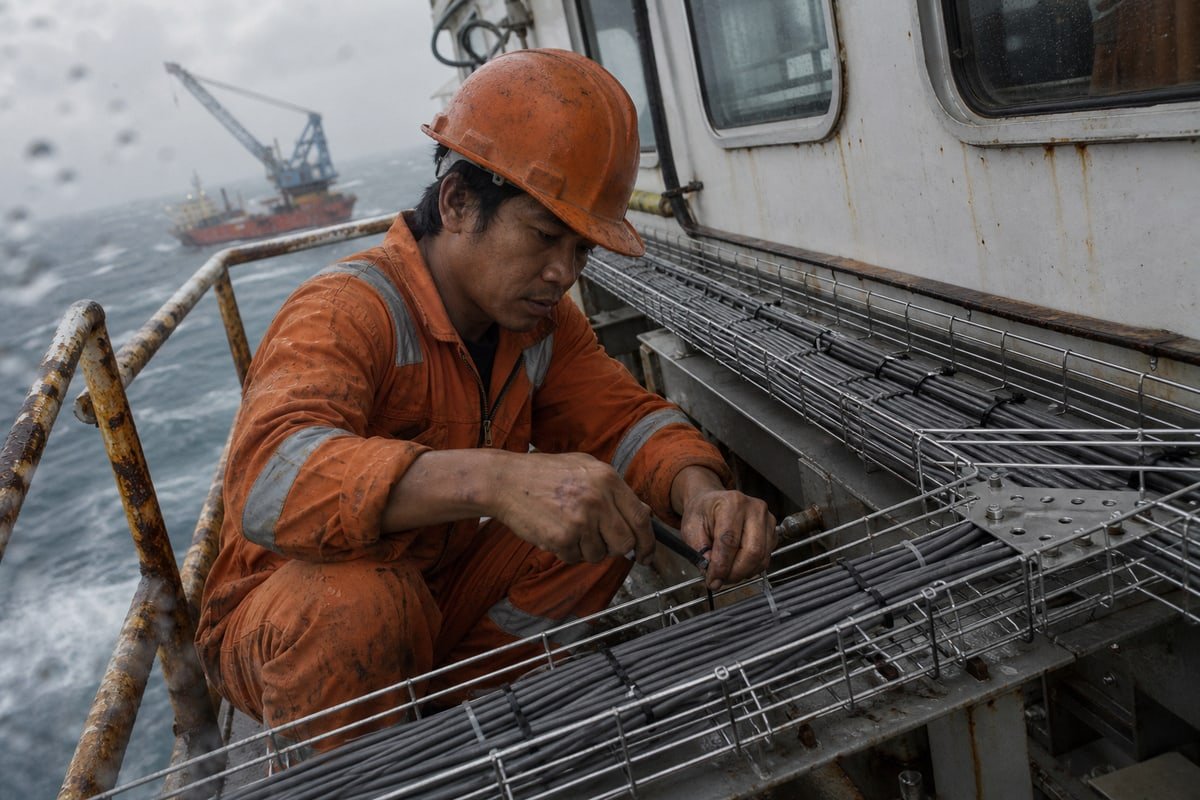
From the export orders that cross my desk, the pattern is very precise. The ideal application almost always pairs two conditions: an extreme chloride environment plus dense, light cabling. When both are present, nothing else performs as well.
Marine and offshore engineering
Offshore platforms, FPSO units, and ship control rooms carry enormous volumes of signal wires and fiber optic cables. The mesh structure lets installers fix cables with ties at any grid node, which is perfect for hundreds of small control and communication lines. Salt spray is constant, so marine grade stainless steel is non-negotiable here.
Coastal hygienic facilities
The food processing industry and coastal pharmaceutical plants wash equipment down with chlorine-based disinfectants, sometimes daily. A 316 mesh tray survives that chemical resistance test where galvanized coatings dissolve. The open basket also refuses to collect dust or standing water, and it rinses clean in seconds. For Grade A sterile zones, electropolished 316 can reach a surface roughness below 0.8 μm, which prevents biofilm adhesion and satisfies the strictest hygiene audits.
Low-voltage systems in harsh locations
Coastal data centers and telecom base stations 3 round out the list. With more than 80% open area, heat dissipation is the best of any tray type, so cable current ratings are barely affected. The zinc-free material also protects sensitive server rooms from zinc whisker contamination.
| Environment | Why 316 mesh fits | Typical cabling |
|---|---|---|
| Offshore platforms / FPSO | Constant salt spray; dense control rooms | Signal, instrumentation, fiber |
| Coastal food and pharma plants | Chlorinated washdowns; hygiene rules | Sensor and instrument wiring |
| Coastal data centers | Zinc-free; superior airflow | Data, network, fiber bundles |
| Desalination and water treatment | Chloride-saturated air and mist | Control and monitoring cables |
One honest caveat from my side: an open industrial wire basket provides almost zero physical protection. It does not block dust, water jets, or rodents. If cables need enclosure, specify trunking or conduit instead.
How do I choose the right size and load rating for my project?
Every quote we prepare forces a trade-off: a deeper, thicker-wire basket carries more, but it also raises cost and weight. Getting the balance right starts with your cable schedule.
List your cables, calculate total fill weight per meter, then pick a tray width and depth that keeps fill below 50%. Match the wire diameter and support span to that load, remembering wire mesh trays suit light control, data, and signal cables—not heavy power feeders.

Sizing a mesh tray is a simple, repeatable process. I walk our EPC clients through it in four steps.
- Build the cable schedule. List every cable with its outer diameter and weight per meter. Group by route.
- Calculate cross-sectional fill. Add up the cable areas and target no more than 40–50% fill. Spare capacity matters, because mesh trays exist precisely so you can add cables later.
- Select width and depth. Common depths run 50 mm to 100 mm; widths run 50 mm to 600 mm. Shallow and wide beats narrow and deep for heat dissipation.
- Confirm load bearing capacity against span. The same tray carries far less at a 2.5 m support span than at 1.5 m. Ask your supplier for load test data referencing NEMA standards or IEC 61537, at your actual span.
| Tray width | Typical depth | Typical use | Support span guidance |
|---|---|---|---|
| 100–200 mm | 50 mm | Branch runs, sensor wiring | 1.5–2.0 m |
| 300–400 mm | 50–100 mm | Main data/control routes | 1.5 m recommended |
| 450–600 mm | 100 mm | Data center trunk pathways | 1.2–1.5 m, extra supports |
Two warnings I repeat on every project. First, never route heavy or oversized power feeders in wire mesh; that is ladder tray 4 territory. Second, a UL classification on a mesh tray relates to load testing, not grounding. Plan a separate grounding conductor per your local electrical code. On the plus side, mesh trays can be field-cut with offset bolt cutters to form bends and drops on site, and the flexible welded grid dissipates seismic energy better than rigid trays.
What should I look for when sourcing a reliable 316 wire mesh cable tray supplier?
Early in my export career, I shipped an order without demanding mill certificates. The lesson cost us a rework, and now every 316 coil gets verified twice before welding.
Look for verified 316 material certificates, PMI spot testing, clean TIG welds, proper surface finishing such as pickling or electropolishing, load test reports referencing NEMA or IEC standards, transparent lead times, and OEM customization support. Reliable suppliers document quality at every production stage.

Material fraud is the single biggest risk when buying a stainless steel 316 wire mesh cable tray from overseas. 304 and 316 are visually identical, and the price gap tempts bad actors. Here is the vetting framework I recommend to procurement managers, based on what our own buyers in Singapore, Thailand, and South America ask us to prove.
Verify the material, not the label
Demand mill test certificates traceable to the wire batch, then ask for PMI (positive material identification) reports on finished trays. A serious factory will run this test on video call if you ask. Price is your second signal: genuine 316 mesh costs roughly 1.5–2 times the 304 equivalent and several times a hot-dip galvanized product. A quote that undercuts that math is telling you something.
Inspect workmanship and finishing
Weld nodes must be full-strength and burr-free, because smooth wires protect cable jackets during pulling. Ask whether the supplier pickles, passivates, or electropolishes after welding—welding heat damages corrosion resistance if left untreated.
| Checkpoint | What to ask for | Red flag |
|---|---|---|
| Material grade | Mill certs + PMI test | “Trust us, it’s 316” |
| Weld quality | Photos, burr-free guarantee | Sharp or skipped welds |
| Surface treatment | Pickling/passivation records | Bare as-welded finish |
| Load data | Test reports per span | Generic catalog numbers |
| Logistics | Firm production schedule | Vague lead-time answers |
Finally, assess collaboration ability. EPC projects change mid-stream, so a supplier offering OEM/ODM development, custom widths, and matching splice plates and brackets saves you weeks. On our side, we lock lead times in the contract because we know delivery delays and quality disputes are the two pain points that end supplier relationships fastest.
Conclusion
Stainless steel 316 wire mesh cable tray solves one problem: dense, light cabling in chloride-heavy environments. Match it to the right job, verify the material, and it outlasts cheaper options.
Footnotes
- World Stainless provides technical resources and corrosion resistance comparisons for common stainless steel grades like 304. ↩︎
- Wikipedia offers a detailed overview of zinc whisker growth and its impact on electronic equipment in data centers. ↩︎
- The ITU is the global authority for telecommunications infrastructure standards and base station deployment guidelines. ↩︎
- NEMA provides standards and technical specifications for various cable management systems, including ladder tray and wire mesh. ↩︎