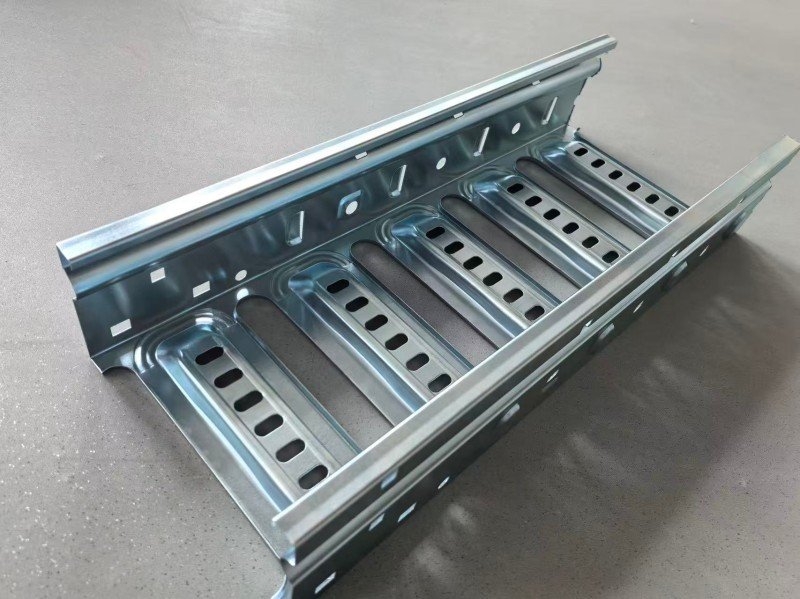
Last year, a water treatment project in the Philippines sent back an entire shipment of cable trays—corroded within eight months polyvinylidene fluoride resin 1. That failure cost everyone time, money, and trust. It forced our team to rethink how we approach coating selection, fire compliance, and structural durability for harsh environments.
To choose energy-efficient, corrosion-resistant PVDF-coated fire-resistant cable trays, verify the PVDF coating thickness and adhesion standards, confirm fire-resistance certifications like UL 2277 or IEC 61084-1, select press-formed structural designs that reduce material weight, and partner with a supplier offering transparent QC and reliable delivery timelines.
This guide breaks down each decision factor so you can specify the right tray system without second-guessing your choice BREEAM 2. Let us walk through coating quality, fire ratings, energy-saving design, and supplier selection one step at a time.
What Should I Look for in PVDF Coating Quality to Ensure Long-Term Corrosion Resistance?
A project contractor in Singapore once told me his previous supplier claimed “PVDF coating” but delivered standard polyester powder coat. He only discovered the difference when rust appeared on trays installed near a coastal cooling tower—barely one monsoon season later.
Look for verified PVDF coating with a minimum 80–120 micron thickness for outdoor use, adhesion tested per ASTM D3363, and salt spray resistance exceeding 1,000 hours per ASTM B117. Confirm the coating uses genuine polyvinylidene fluoride resin, not a polyester substitute marketed under a similar name.

Why PVDF Outperforms Standard Coatings
PVDF is a fluoropolymer. It resists UV radiation, acid rain, salt spray, and chemical splashes far better than epoxy or polyester coatings. On our production line, we see the difference in accelerated aging tests. A polyester-coated sample starts chalking after 500 hours of UV exposure. A genuine PVDF-coated sample stays intact well past 2,000 hours.
The key is that PVDF forms a dense molecular barrier. Moisture and chloride ions cannot penetrate easily. This matters in coastal zones, desalination plants, and chemical processing facilities where standard galvanized trays corrode within a few years.
Coating Thickness and Application Method
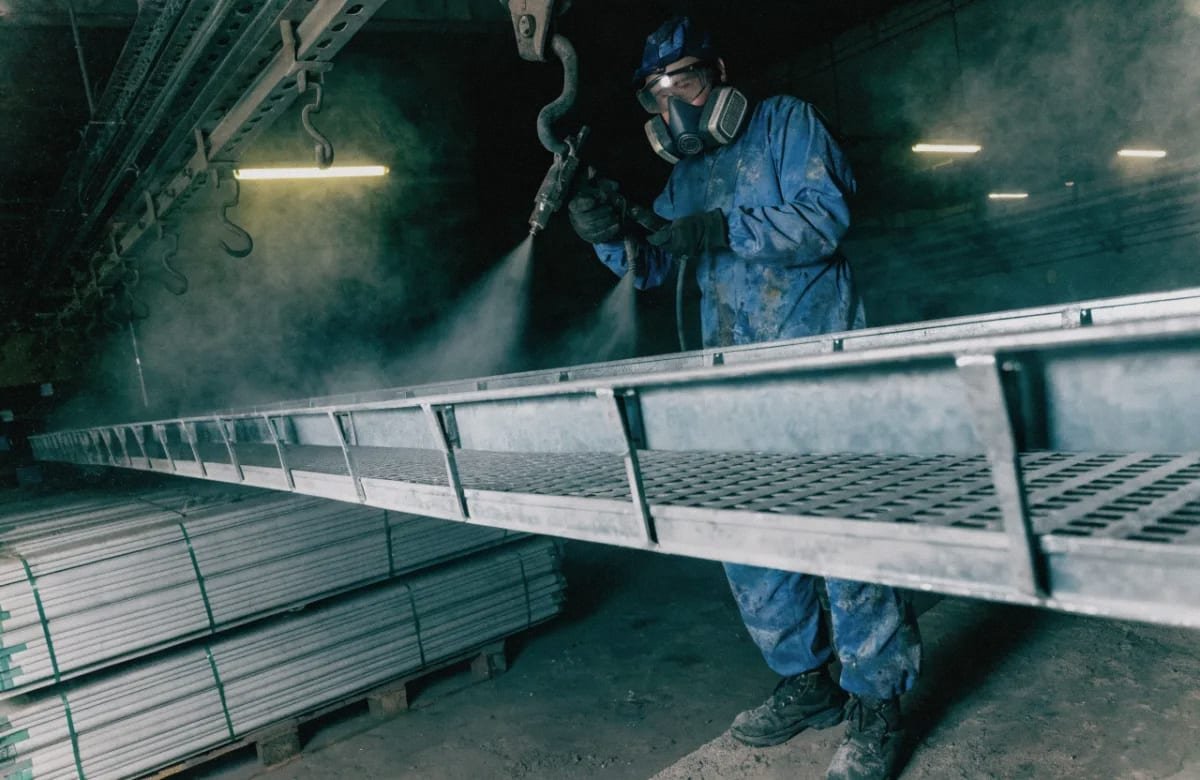
Not all PVDF coatings are equal. Thickness and how the coating is applied make a real difference. Electrostatic spray application produces a more uniform layer with fewer micro-pores compared to dip-coating. Micro-pores are tiny gaps in the coating film. They let moisture reach the base metal. That leads to under-film corrosion, which is invisible until the coating blisters off.
| Coating Parameter | Minimum for Indoor Use | Minimum for Outdoor / Corrosive Use | Our Recommended Specification |
|---|---|---|---|
| PVDF Coating Thickness | 60–80 μm | 80–120 μm | ≥100 μm for tropical/coastal |
| Salt Spray Resistance (ASTM B117 3) | 500 hours | 1,000 hours | ≥1,500 hours for offshore |
| Adhesion (ASTM D3363) | 2H pencil hardness | 3H pencil hardness | 3H minimum |
| UV Resistance | 1,000 hours | 2,000 hours | ≥2,000 hours |
| Application Method | Dip or spray | Electrostatic spray | Electrostatic spray |
Zinc-Aluminum-Magnesium Substrates: A Powerful Combination
One insight from our engineering team is that the substrate under the PVDF coating matters just as much. We often recommend zinc-aluminum-magnesium (ZAM) alloy-coated steel as the base metal. This alloy contains 3%–6% magnesium, and its coating weight should be at least 275 g/m² on both sides, with a thickness no less than 20 μm.
ZAM has a remarkable “self-healing” property. When the coating gets scratched or cut, a dense protective film forms at the damaged spot and stops corrosion from spreading. This is a major advantage over standard hot-dip galvanized steel, where a scratch can become a rust pathway.
When our team combines a ZAM substrate with a PVDF top-coat, the result is a dual-defense system. The ZAM handles any breach in the PVDF layer. The PVDF prevents the broad surface degradation that attacks galvanized finishes in acidic or saline air. Some manufacturers now offer 30-year service life warranties on this combination.
How to Verify Coating Authenticity
Ask your supplier for a mill test certificate showing the resin type. Genuine PVDF resin is typically Kynar-based. Request third-party test reports for salt spray hours and adhesion. If possible, ask for a coating thickness gauge reading on a sample piece before placing a bulk order. These steps take minutes but save months of warranty disputes.
How Do I Verify Fire-Resistance Ratings and Certifications Before Placing a Bulk Order?
During a recent project review for a data center in Southeast Asia, the client asked me a direct question: “Your tray says fire-resistant—does the PVDF coating itself stop fire, or is something else doing the work?” It was a fair question, and the answer is more nuanced than most product brochures admit.
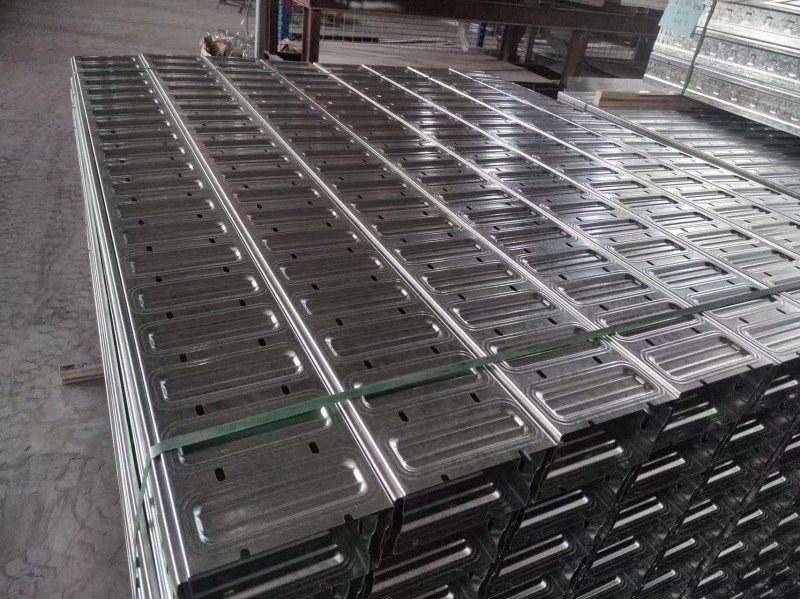
Verify fire-resistance ratings by requesting UL 2277 listing for the specific coating system, checking IEC 61084-1 or BS 476 Part 20–23 compliance for the required duration (E30, E60, E90), and confirming whether an intumescent sub-layer provides the actual fire barrier beneath the PVDF corrosion-resistant top-coat.
The Critical Distinction: Flame-Retardant vs. Fire-Resistant
This is where many specifiers make costly mistakes. PVDF is a flame-retardant material. It self-extinguishes. It produces very little smoke—well below NFPA-262 4 limits. Its oxygen index reaches up to 46%, earning UL 94 V-0 5 classification.
But flame-retardant is not the same as fire-resistant.
A fire-resistant cable tray must maintain structural integrity for a defined period—30, 60, 90, or even 120 minutes—while exposed to fire temperatures. The tray must keep cables functional so fire pumps, emergency lighting, and elevator systems keep running. PVDF alone does not provide this level of protection.
True fire resistance typically comes from an intumescent coating layer 6 applied beneath the PVDF top-coat. This intumescent layer is usually over 500 μm thick. When exposed to fire, it expands and forms a carbonized insulating shield that blocks heat transfer to the steel and cables.
What Certifications to Demand
| Certification / Standard | What It Covers | Why It Matters |
|---|---|---|
| UL 2277 7 | Cable tray systems with specific coating | The listing must name your exact coating system; a galvanized listing does NOT cover PVDF |
| IEC 61084-1 | Cable trunking and ducting fire performance | Defines E-ratings (E30, E60, E90) for circuit integrity |
| BS 476 Part 20–23 | Fire resistance of building elements | Common in Commonwealth countries; specifies fire endurance periods |
| UL 94 V-0 | Flammability of plastic materials | Confirms PVDF self-extinguishes; does NOT confirm structural fire endurance |
| NFPA-262 | Smoke and flame for cables/raceways in plenums | Relevant for data centers and high-rise buildings |
A Practical Verification Process
Here is what I recommend to every procurement manager before signing a bulk purchase order:
- Request the UL 2277 listing number. Search it on UL’s online database. Confirm the listed coating type matches what you are buying.
- Ask for the fire test report. It should show the actual fire duration achieved, not just a marketing claim.
- Clarify the coating stack. Ask the supplier: “Is the fire rating achieved by the PVDF layer alone, or by an intumescent sub-layer plus PVDF top-coat?” If they cannot answer clearly, that is a red flag.
- Match the rating to your project code. A solar farm may only need E30. A hospital or high-rise elevator shaft may require E90 or E120. Over-specifying wastes money. Under-specifying risks lives.
When we prepare shipments for EPC contractors, we include the full certification package in the documentation. That way, the project engineer can present it during site inspections without chasing paperwork.
Smoke Performance Matters Too
In enclosed environments like data centers, tunnels, and underground substations, smoke is often more dangerous than flames. PVDF produces virtually no smoke when it burns. This is a genuine advantage. But again, confirm this with test data—specifically NFPA-262 results—rather than relying on a general material claim.
Which Material and Design Factors Help Me Maximize Energy Efficiency in My Cable Tray System?
One trade-off I weigh constantly is this: heavier trays carry more load but cost more to ship, install, and support. Lighter trays save material but must not flex under full cable weight. The sweet spot is where structural engineering meets lifecycle thinking—and that is where “energy efficiency” in cable trays actually lives.
Maximize energy efficiency by selecting press-formed (stamped reinforcement) tray designs that reduce steel usage by 20% or more while maintaining load capacity, choosing ventilated tray styles to prevent cable ampacity derating, and prioritizing durable coatings that eliminate replacement cycles and their associated embodied energy costs.
Defining “Energy Efficiency” for a Passive Product
Cable trays do not consume electricity. So what does “energy efficient” mean here? It means three things:
- Reduced embodied energy. Less steel per meter means less energy consumed during manufacturing, galvanizing, and coating.
- Longer service life. A tray that lasts 25 years instead of 10 eliminates two full cycles of manufacturing, shipping, and installing replacements.
- Better thermal performance. Ventilated tray designs allow heat to dissipate from cables. This prevents ampacity derating 8—the forced reduction of current-carrying capacity when cables overheat. When cables derate, engineers must use larger (more expensive, more copper-intensive) conductors to carry the same load.
Press-Formed (Stamped Reinforcement) Design
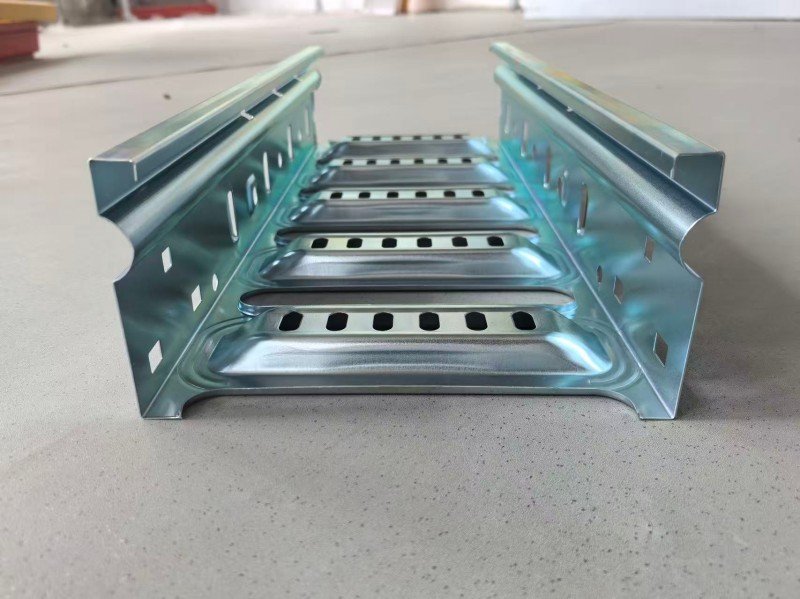
The “press-formed” or “molded reinforcement bottom” is a design approach where stamped ribs are pressed into the tray bottom. This creates structural stiffness without adding material thickness. On our stamping line, we produce trays where the reinforcement pattern increases rigidity enough to reduce steel gauge by one step.
The result: material savings of 20% or more with no loss in load-bearing capacity. For a large solar farm needing thousands of meters of tray, that 20% translates directly into lower shipping weight, fewer support brackets, and faster installation.
Tray Ventilation and Cable Performance
| Tray Type | Ventilation Level | Best Use Case | Impact on Cable Ampacity |
|---|---|---|---|
| Solid Bottom | None | Indoor, clean environments | Highest derating risk; cables run hotter |
| Perforated Bottom | Moderate | General industrial, moderate heat | Reduced derating; good airflow |
| Ladder Type | Maximum | Heavy cable bundles, outdoor | Minimal derating; excellent heat dissipation |
| Wire Mesh | High | Data centers, light cable loads | Low derating; easy cable access |
Choosing a perforated or ladder-type tray is not just about convenience. It directly affects the electrical efficiency of the cables inside. Overheated cables waste energy as heat. They also degrade insulation faster, shortening cable life and requiring earlier replacement.
Thickness and Span: Getting the Balance Right
For press-formed trays with zinc-aluminum-magnesium coating, minimum thickness depends on width:
- Width under 300 mm: slot body thickness ≥ 1.2 mm
- Width 300–500 mm: slot body thickness ≥ 1.5 mm
- Width 500–800 mm: slot body thickness ≥ 1.5 mm (with heavier reinforcement)
When support brackets are spaced at 2 meters, the tray must carry its full rated cable load without deflecting more than 1/200 of the span distance. That means a 2-meter span allows no more than 10 mm of sag at full load. Our engineering team runs deflection calculations for every custom order to make sure the tray meets this limit.
Lifecycle Cost Comparison
Think about it this way. A standard galvanized tray installed in a coastal chemical plant might last 8–10 years before corrosion forces replacement. A PVDF-coated tray on a ZAM substrate can last 25–30 years. Over a 30-year project life, you buy the galvanized system three times. You buy the PVDF system once. The energy consumed in manufacturing, transporting, and installing those two extra rounds of galvanized trays is real—and it adds up across a large facility.
This lifecycle lens also aligns with green building certifications like LEED 9 and BREEAM, where material durability and reduced replacement cycles earn credits.
How Can I Choose a Supplier Who Delivers Consistent QC and On-Time Lead Times for My Project?
A lesson I learned early in our export business came from a delayed shipment to a solar project in Thailand. The contractor had booked crane time and labor crews for a specific installation window. When our trays arrived ten days late, the entire installation schedule shifted, and the contractor faced penalty clauses. That experience reshaped how we manage production scheduling and quality checkpoints.
Choose a supplier who provides documented QC inspection at each production stage, shares real-time production updates, offers third-party inspection access before shipment, and has a proven track record of meeting agreed lead times—verified through references from similar EPC or industrial projects.
What QC Checkpoints Matter Most
Quality control for PVDF-coated fire-resistant cable trays is not a single final inspection. It is a chain of checks from raw material to packed container. Here is how we structure it:
- Incoming material inspection. Verify the steel coil’s mill certificate: zinc-aluminum-magnesium composition, coating weight, and base metal grade.
- Press-forming check. Measure dimensions, reinforcement rib depth, and hole alignment after stamping.
- Coating application. Confirm PVDF thickness with a calibrated gauge at multiple points. Check for drips, bare spots, and orange peel texture.
- Fire-resistance layer verification. If intumescent coating is specified, measure its thickness (must exceed 500 μm).
- Final inspection. Check overall dimensions, straightness, labeling, and packing.
- Pre-shipment inspection. Ideally performed by a third-party agency (SGS, Bureau Veritas 10, or the buyer’s own inspector).
Red Flags When Evaluating Suppliers
Watch for these warning signs during your supplier selection process:
- The supplier cannot provide a specific UL 2277 or IEC test report for the coated tray system.
- Coating thickness data is “typical” rather than measured per batch.
- Lead time commitments are vague (“about 4–6 weeks”) with no production schedule shared.
- The supplier resists third-party inspection or charges extra for factory access.
- No references from similar project types (EPC, solar, water treatment).
Delivery Reliability: How to Protect Your Schedule
| Supplier Evaluation Factor | What to Ask | Green Flag | Red Flag |
|---|---|---|---|
| Production Capacity | Monthly output in meters or tons | Shares specific numbers with evidence | Vague or evasive |
| Lead Time Commitment | Fixed weeks from order confirmation | Written in the contract with penalties | “We’ll try our best” |
| Progress Updates | How often and through which channel | Weekly photo/video updates via WhatsApp | Updates only when you ask |
| Third-Party Inspection | Allowed before shipment? | Yes, at no extra charge | Refused or expensive |
| Packaging Quality | How trays are protected for sea freight | Custom wooden crates, edge protectors | Bare bundles with plastic wrap only |
| After-Sales Support | Handling of quality claims | Clear return/replacement policy | No written policy |
Building a Collaborative Relationship
The best supplier relationships I have seen work like partnerships, not transactions. When a project director in Singapore sends us a drawing, our team reviews it within 24 hours and comes back with suggestions—maybe a lighter gauge is possible with deeper press-forming, or a different tray width reduces waste from cutting.
This collaborative development approach catches problems before production starts. It also builds trust. When both sides invest in getting the specification right, there are fewer surprises at the jobsite.
For large orders, we recommend splitting production into two or three batches. The first batch ships early so installation can begin on schedule. Subsequent batches follow the project timeline. This approach reduces warehouse costs at the project site and gives both parties a chance to catch any issues before the full quantity is produced.
Conclusion
Choosing PVDF-coated fire-resistant cable trays requires careful attention to coating authenticity, fire certification specifics, structural design efficiency, and supplier reliability. Verify every claim with test data, match specifications to your project environment, and build a supplier relationship grounded in transparency and collaboration.
Footnotes
- Background on PVDF fluoropolymer chemistry supports the coating authenticity discussion. ↩︎
- BREEAM is the other sustainability certification framework mentioned alongside LEED. ↩︎
- ASTM standard referenced for salt spray corrosion testing methodology. ↩︎
- NFPA publishes the smoke and flame standard cited for enclosed environments. ↩︎
- UL 94 is the flammability classification standard directly referenced. ↩︎
- Intumescent coatings are the material technology providing the actual fire barrier. ↩︎
- UL is the certification body issuing the fire-resistance listing referenced. ↩︎
- Ampacity is the electrical engineering concept explaining cable heat and current capacity. ↩︎
- LEED is the green building certification referenced for lifecycle material credits. ↩︎
- Bureau Veritas is a named third-party inspection agency for pre-shipment QC. ↩︎