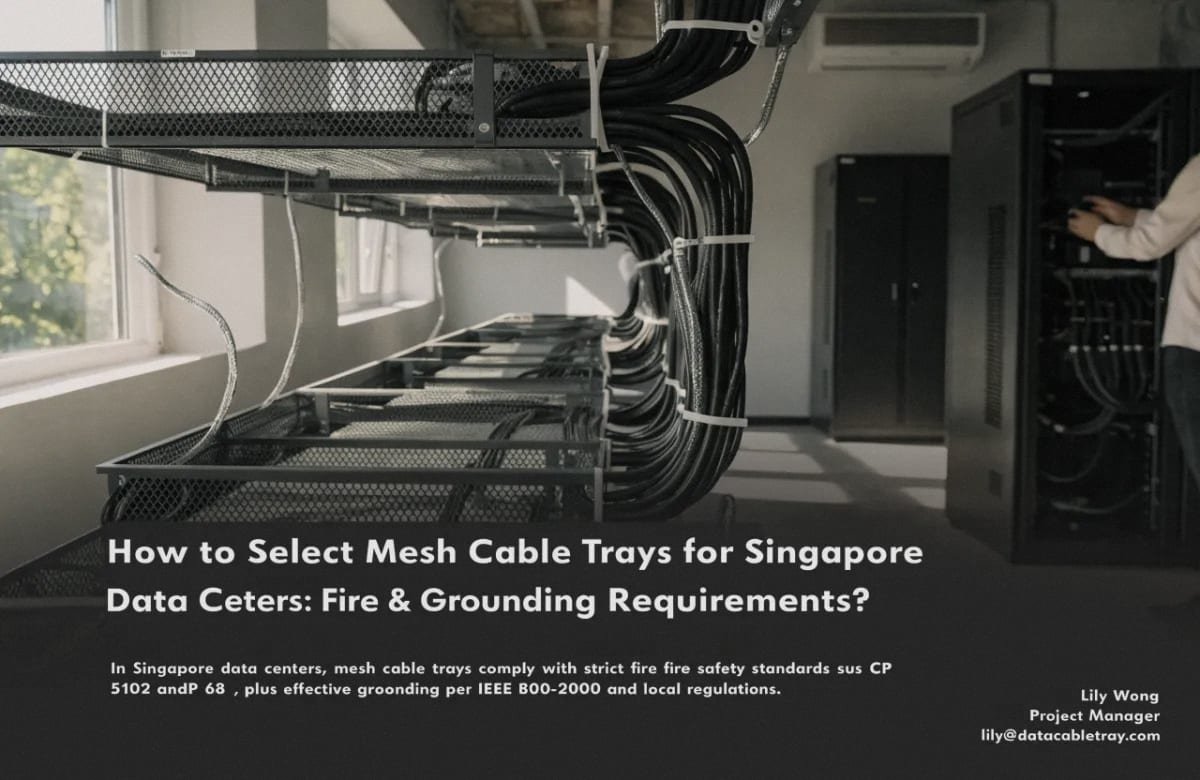
When our team shipped the first batch of mesh cable trays to a Singapore hyperscale project last year, the project director’s first question wasn’t about price — it was about fire integrity ratings and grounding continuity documentation. That moment confirmed what I had been sensing across our Southeast Asian orders: Singapore’s data center boom has raised the compliance bar far above what most suppliers prepare for.
To select mesh cable trays for Singapore data centers, verify E30–E90 fire integrity as a complete tested system per DIN 4102-12, ensure continuous grounding paths compliant with SS 638 and NEC 392.7 equivalents, and choose hot-dip galvanized or stainless steel materials that resist Singapore’s tropical humidity while meeting SCDF and IMDA requirements.
This guide breaks down every critical decision — fire ratings, grounding methods, material choices, and certifications — so you can specify mesh cable trays with confidence. Let’s walk through each requirement step by step.
What fire safety standards should I check before choosing mesh cable trays for a Singapore data center?
One lesson I learned early when working with EPC contractors in Singapore is that fire safety for cable trays is not just about the tray itself. A project director once rejected a shipment because the splice kits came from a different manufacturer, which technically voided the fire rating of the entire assembly.
Before choosing mesh cable trays, check compliance with DIN 4102-12 for E30–E90 fire integrity as a complete tested system, align with SCDF Fire Code requirements, and ensure fire stops are installed at every penetration through fire-rated walls and floors per NEC 300.21 or equivalent local standards.
Understanding E30 vs. E90 Fire Ratings
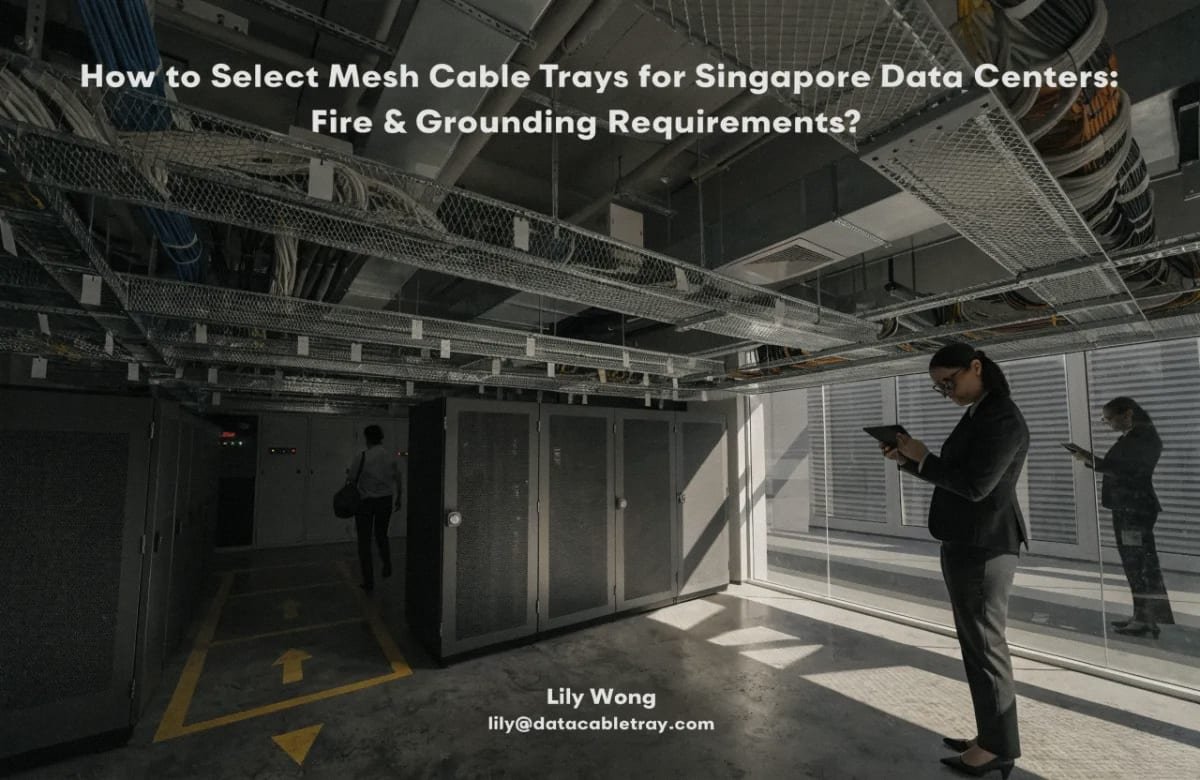
Fire ratings for cable trays measure how long the system maintains circuit integrity under extreme heat. E30 means 30 minutes. E90 means 90 minutes at temperatures up to 1000°C. For Singapore data centers, E90 is the gold standard — especially in critical corridors where fire could spread through high thermal-load areas.
But here is the part many buyers miss: the fire rating applies to the complete system, not just the tray. Under DIN 4102-12, the tray, supports, fixings, and fasteners must all be tested together. If you buy a certified tray but use generic third-party bolts or brackets, the rating is void. Our production team stamps matching batch codes on every component in a system order precisely because of this rule.
| Fire Rating | Duration | Max Temperature | Typical Application |
|---|---|---|---|
| E30 | 30 minutes | ~840°C | Secondary corridors, low-risk zones |
| E60 | 60 minutes | ~950°C | Intermediate zones, general routing |
| E90 | 90 minutes | ~1000°C | Critical corridors, emergency circuits, battery rooms |
The Singapore Regulatory Landscape
Singapore does not use DIN standards as its primary code. The Singapore Civil Defence Force 1 (SCDF) enforces the Singapore Fire Code, while electrical installations follow SS 638. However, global hyperscale operators like AWS and Google often mandate DIN 4102-12 for E90 certification as a best practice on top of local requirements.
This creates a dual-compliance challenge. You must confirm whether SCDF accepts DIN test reports or requires a separate local fire test. In our experience shipping to Singapore projects, most Tier 1 data center operators accept DIN 4102-12 reports, but always verify with the local authority having jurisdiction before procurement.
Fire Stops at Penetrations
Mesh cable trays are not inherently fire-rated barriers. Wherever trays pass through fire-rated walls or floors, you need fire-stop collars or wraps that match the compartment’s rating — typically a 2-hour rating. This is required under NEC 300.21 and its Singapore equivalents. Neglecting fire stops is a common audit failure point. NFPA electrical safety 2
Lithium-Ion Battery Considerations
Modern data centers increasingly use lithium-ion batteries 3. These fires burn hotter and longer than traditional fires. Fire suppression systems using nitrogen gas now require extended holding times of 30 minutes or more. This reinforces the need for E90-rated tray systems that maintain integrity during prolonged thermal exposure.
How do I ensure proper grounding and bonding for mesh cable trays in high-density server environments?
A Singapore-based project director I work with once shared a frustrating scenario: intermittent ground faults kept triggering in a newly commissioned server hall. The root cause turned out to be corroded splice joints on the mesh cable trays, which had broken the grounding continuity path. That single issue caused weeks of delay.
To ensure proper grounding, specify mesh cable trays with integrated grounding paths or certified continuous joints, install bonding jumpers at every splice point, use hot-dip galvanized or stainless steel to prevent corrosion-induced grounding failure, and comply with SS 638 earthing requirements and NEC 392.7 equivalents.
Why Mesh Trays Present a Grounding Challenge
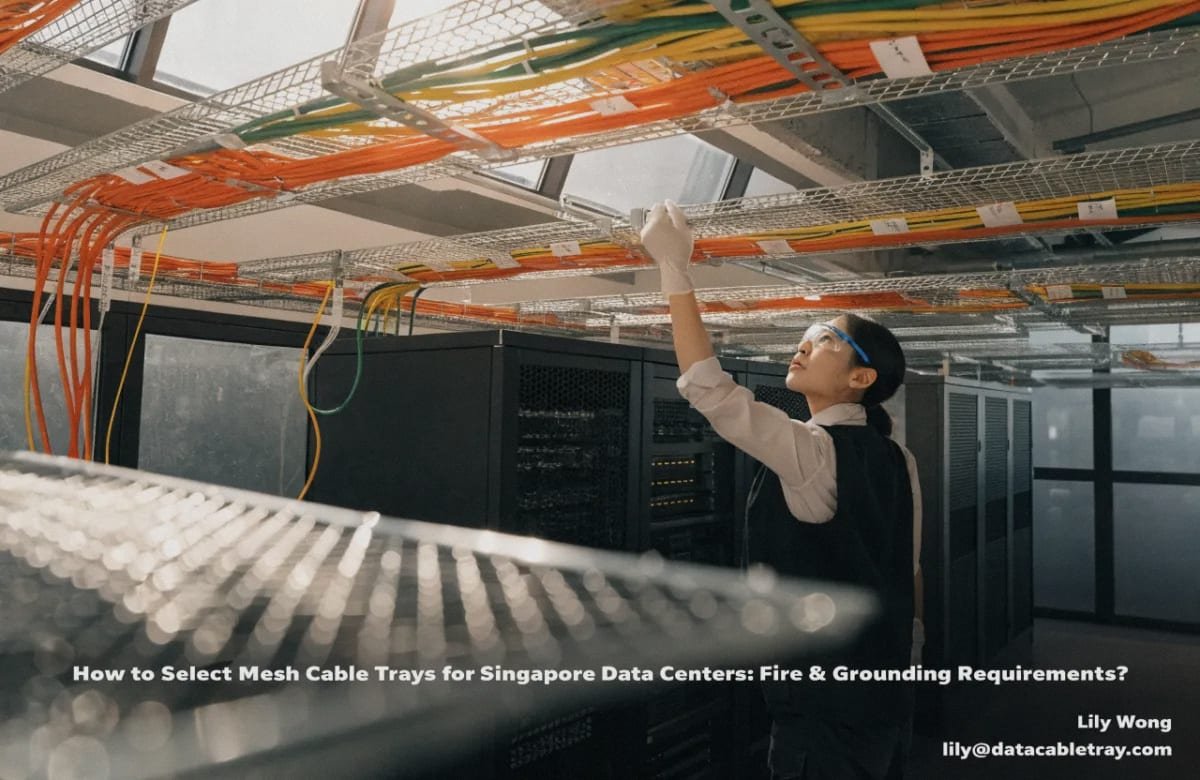
Mesh cable trays can serve as equipment grounding conductors under NEC 392.7 — but only if specific conditions are met. The tray must have a continuous electrical path. Qualified personnel must maintain it. And the tray must be clearly marked for this purpose.
The inherent challenge with mesh geometry is the gaps. Unlike solid-bottom trays, mesh trays rely on welded wire intersections and splice joints for electrical continuity. Any break — from loose hardware, corrosion, or vibration — disrupts the grounding path. In Singapore’s 80–90% average relative humidity 4, corrosion is not a theoretical risk. It is an operational certainty if the wrong material or coating is selected.
Integrated Grounding Paths vs. External Bonding
Modern mesh tray manufacturers now offer two approaches. The first is integrated grounding paths — a continuous conductor built into the tray rail that bypasses the mesh wire intersections entirely. The second is the traditional method: external bonding jumpers at every splice plate and joint.
| Grounding Method | Pros | Cons |
|---|---|---|
| Integrated grounding path | Continuous conductor, lower installation labor, reliable long-term | Higher upfront tray cost |
| External bonding jumpers | Lower tray cost, widely available | Requires discipline during install, more failure points |
| Dedicated ground wire alongside tray | Independent of tray integrity | Additional material and labor cost |
When we manufacture trays for data center projects, we recommend integrated grounding paths for any installation where the tray will also serve as the equipment grounding conductor. For projects that run a separate ground wire, external bonding jumpers at splice points are usually sufficient.
Corrosion and Grounding Integrity
Corrosion is the silent killer of grounding continuity. In Singapore’s tropical climate, even zinc-plated (electro-galvanized) trays can develop surface corrosion within a few years if the zinc layer is too thin. Hot-dip galvanized coatings are thicker and more durable. Stainless steel (304 or 316 grade) eliminates the corrosion variable entirely but costs significantly more.
The critical rule: use galvanically compatible metals for trays, splice kits, and support hardware. Mixing steel trays with aluminum brackets, for example, accelerates galvanic corrosion 6 in humid environments and breaks both structural and electrical integrity.
Cable Fill and Grounding Contact
Overfilling mesh trays creates two problems. First, excessive cable weight can deform the mesh and loosen joints. Second, tightly packed cables generate heat, which accelerates corrosion. NEC guidelines recommend single-layer installation up to approximately 50% cross-sectional area fill. This also ensures proper grounding contact between the tray and cables.
Which mesh cable tray materials offer the best fire resistance and corrosion protection for my project?
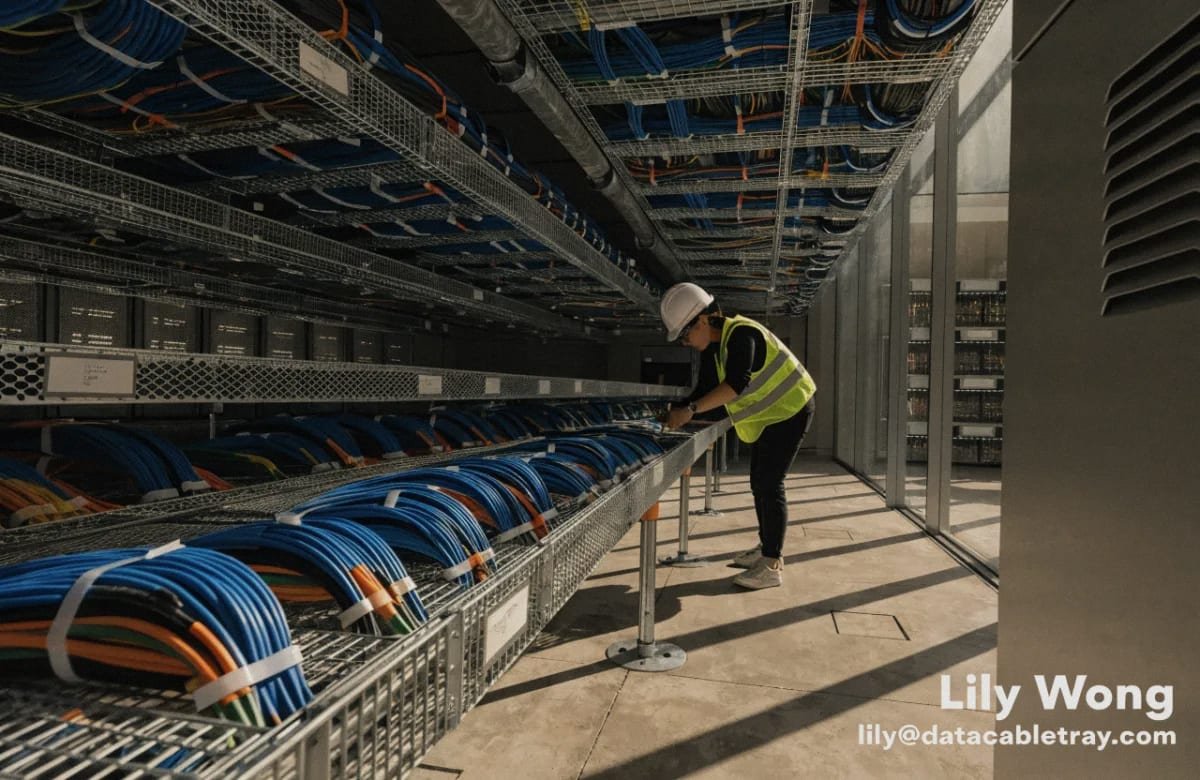
Electro-galvanized mesh cable trays and powder-coated mesh cable trays are the workhorses of data center cable management. They cost less, look clean and minimal, and make cable management extremely convenient. That is why most EPC companies I work with choose them as their default option. But for Singapore’s specific climate and fire requirements, the material decision deserves a closer look.
Hot-dip galvanized steel offers the best balance of fire resistance, corrosion protection, and cost for Singapore data centers. Stainless steel (304/316) provides superior longevity in harsh or coastal environments. Electro-galvanized and powder-coated trays suit budget-sensitive indoor installations with controlled humidity.
Material Comparison for Singapore Conditions
Choosing between material options requires weighing fire performance, corrosion resistance, cost, and compliance with Singapore’s regulatory framework. The IMDA Fibre Ready Scheme mandates galvanized perforated materials for cable trays, which sets a baseline that both hot-dip galvanized steel and stainless steel can meet.
| Material / Finish | Zinc Thickness | Corrosion Resistance (Singapore Climate) | Fire Behavior | Relative Cost | IMDA FRS Compliance |
|---|---|---|---|---|---|
| Electro-galvanized (EG) | 5–12 µm | Moderate; may corrode in 3–5 years in high humidity | Steel core resists fire; thin zinc layer offers limited protection | Low | May meet baseline; verify coating durability |
| Hot-dip galvanized (HDG) | 45–85 µm | High; 15–25 year service life in tropical indoor environments | Steel core resists fire; thick zinc layer provides additional protection | Medium | Yes — standard specification |
| Stainless steel 304 | N/A | Very high; resists most indoor corrosion sources | Excellent fire resistance | High | Yes |
| Stainless steel 316 7 | N/A | Highest; resists chloride and coastal salt air | Excellent fire resistance | Highest | Yes |
| Powder-coated steel | Varies (base + coating) | Good for indoor; coating can chip, exposing base metal | Coating may produce fumes under fire; check for halogen-free formulation | Medium-Low | Verify halogen-free and galvanized base |
Why Hot-Dip Galvanized Is the Default Choice
For most Singapore data center projects, hot-dip galvanized (HDG) steel hits the sweet spot. The zinc coating is 4–8 times thicker than electro-galvanized finishes. This means HDG trays maintain both structural and grounding integrity far longer in Singapore’s 80–90% relative humidity. The thicker zinc layer also serves as a sacrificial anode — it corrodes before the steel underneath, extending service life significantly.
On our production line, we offer both pre-galvanized wire (galvanized before welding) and post-galvanized trays (welded first, then hot-dip galvanized as a complete unit). Post-galvanized trays cost more but protect the weld joints — the most vulnerable corrosion points — much better. For data centers, I always recommend post-galvanized when the budget allows.
When to Specify Stainless Steel
Stainless steel becomes necessary in two scenarios. First, when the data center is located near Singapore’s coast and salt-laden air can infiltrate the facility. Grade 316 with molybdenum content resists chloride attack. Second, when EMI shielding is a secondary concern — stainless steel provides better electromagnetic shielding 8 than open mesh in galvanized steel, though supplemental EMI bonding straps are still recommended for sensitive low-voltage cabling.
Halogen-Free Coatings: An Emerging Trend
A growing number of Singapore data center specifications now require halogen-free materials. During a fire, halogen-containing coatings release toxic and corrosive gases that damage sensitive electronics even in adjacent rooms. Pairing mesh trays with low smoke zero halogen 9 (LSZH) cables and halogen-free powder coatings reduces this risk. When we receive RFQs specifying halogen-free, we switch to a dedicated coating line that uses polyester-based powder with zero halogen content.
Sustainability Angle: BCA Green Mark
Singapore’s BCA Green Mark for Data Centres awards points for recyclable material content and reduced material mass. Steel mesh trays — which use less raw material than solid-bottom trays — and recyclable galvanized steel score well in this framework. This is an increasingly important factor in tender evaluations.
What certifications should I request from my supplier to meet Singapore’s data center compliance requirements?
During a recent pre-qualification review, a procurement manager in Singapore sent me a checklist of twelve certifications and test reports. Half of them were irrelevant to cable trays. The other half were critical — but two were missing. This experience taught me that knowing exactly which certifications matter saves weeks of back-and-forth.
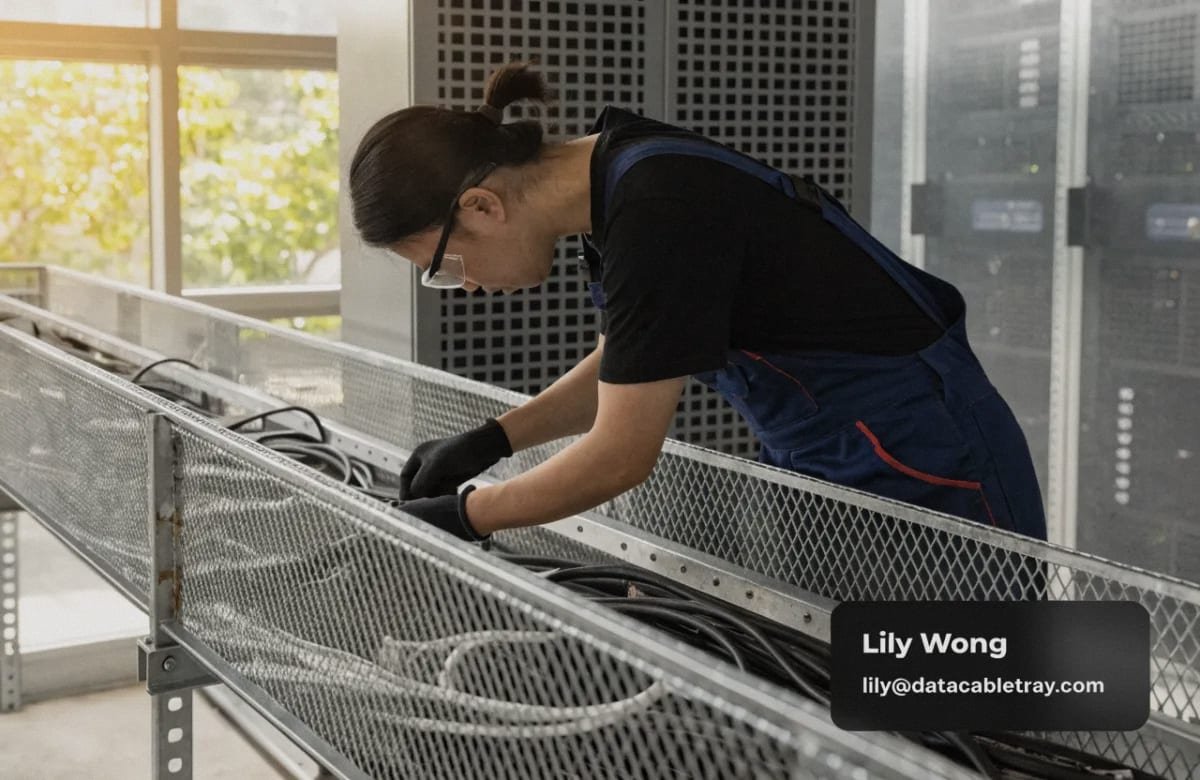
Request DIN 4102-12 fire test reports for the complete tray system, DIN EN 61537 (IEC 61537) mechanical performance certificates, material test certificates for galvanization thickness, SS 638 alignment documentation for electrical installations, and IMDA Fibre Ready Scheme compliance confirmation from your supplier.
The Certification Checklist Explained
Not all certifications carry equal weight. Some are mandatory by regulation. Others are best-practice requirements imposed by end clients (the hyperscale operators). Understanding the difference helps you prioritize during procurement.
| Certification / Document | Standard | What It Proves | Who Requires It |
|---|---|---|---|
| Fire integrity test report | DIN 4102-12 | Complete system maintains circuit integrity for E30/E60/E90 duration | Hyperscale operators, SCDF (verify acceptance) |
| Cable tray system standard | DIN EN 61537 / IEC 61537 10 | Mechanical strength, load classification, dimensional accuracy | BCA, SS 638 alignment, project specifications |
| Material test certificate | EN 10346 or ASTM A653 | Zinc coating thickness, steel grade, tensile strength | Quality assurance, corrosion compliance |
| Galvanization thickness report | ISO 1461 (HDG) or ISO 2081 (EG) | Minimum zinc layer in µm | IMDA FRS, long-term durability verification |
| Grounding continuity test | NEC 392.7 equivalent or manufacturer test | Tray maintains continuous electrical path across joints | Electrical engineer, SS 638 |
| Halogen-free declaration | EN 50267 / IEC 60754 | Coating releases no halogen gases during fire | LSZH project specifications |
| BCA Green Mark documentation | BCA criteria | Recyclable content, material efficiency | Sustainability-rated projects |
How to Verify Fire Test Reports
When a supplier provides a DIN 4102-12 fire test report, check three things. First, verify that the report covers the exact tray model, width, and finish you are ordering — not just a similar product. Second, confirm that the tested assembly includes the supports and fixings you will use. Third, check that the testing laboratory is accredited (look for DAkkS accreditation for German labs or equivalent national accreditation).
I have seen cases where suppliers provide a fire test report for a ladder-type tray and claim it covers their mesh tray. These are different products with different thermal behaviors. Do not accept cross-references without written confirmation from the testing body.
IMDA and SCDF: The Local Gatekeepers
For Singapore specifically, two authorities matter most. The IMDA administers the Fibre Ready Scheme, which mandates galvanized perforated materials for cable trays in qualifying buildings. The SCDF approves fire safety measures. While SCDF may accept international fire test reports, they retain the authority to require additional local testing. Always submit your documentation to the relevant authority early in the project timeline to avoid delays during commissioning.
What We Include in Our Export Documentation
When we prepare shipments for Singapore data center projects, our standard documentation package includes the material test certificate with zinc thickness values, IEC 61537 compliance documentation, a declaration of halogen-free coating (when applicable), and detailed packing lists with batch traceability. For E90-rated system orders, we include the complete DIN 4102-12 test report with photographic evidence of the tested assembly. This level of documentation prevents the back-and-forth that causes delivery delays — which is the number one pain point our Singapore clients report.
Practical Tips for Procurement Managers
Request all certifications before placing the order, not after. Build the certification requirements into your purchase order terms. Specify that non-compliant documentation is grounds for rejection. And keep a master compliance matrix for the project that maps each tray zone to its required fire rating, material specification, and grounding method. This matrix becomes your audit defense document during commissioning.
Conclusion
Selecting mesh cable trays for Singapore data centers demands attention to fire integrity, grounding continuity, material durability, and proper certification. Specify complete tested systems, choose corrosion-resistant materials, and verify all documentation before procurement to avoid costly project delays.
Footnotes
- SCDF is the primary fire safety authority referenced throughout the article. ↩︎
- NFPA provides authoritative fire and electrical safety codes referenced by NEC standards mentioned in article. ↩︎
- Background reference on lithium-ion battery technology mentioned in fire safety context. ↩︎
- Background concept explaining the humidity metric central to Singapore corrosion risk discussion. ↩︎
- ISO 1461 standard defines hot-dip galvanizing requirements referenced for zinc coating thickness. ↩︎
- Explains the corrosion phenomenon referenced when mixing incompatible metals in trays. ↩︎
- ISO standards define stainless steel grades referenced for coastal corrosion resistance. ↩︎
- Background concept for EMI shielding property discussed regarding stainless steel trays. ↩︎
- Background definition of LSZH cable technology referenced for halogen-free fire safety. ↩︎
- Links to ISO/IEC standards body governing cable tray mechanical performance certification. ↩︎