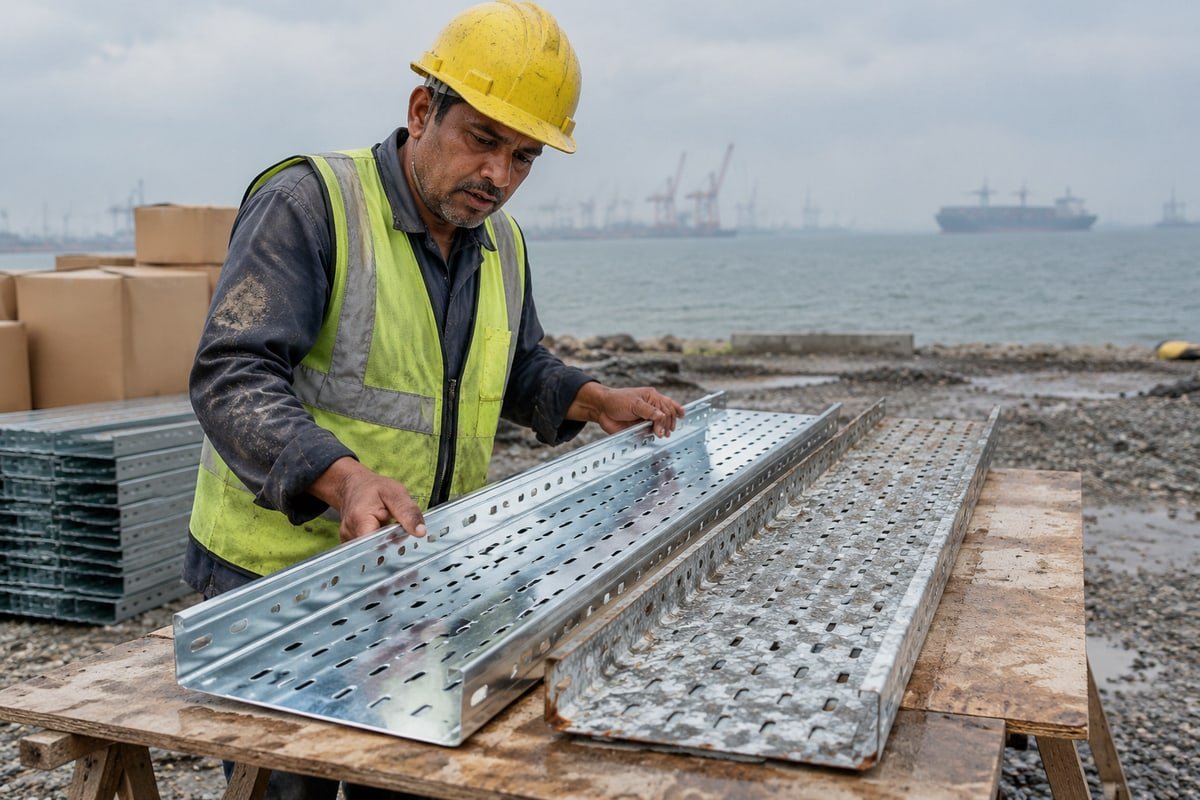
Choosing a zinc-magnesium-aluminum vs hot-dip galvanized cable tray seems simple until a coastal site rusts early salt spray testing 1. That call-back lands on our Tai’an desk, so here is the honest answer.
A zinc-magnesium-aluminum vs hot-dip galvanized cable tray choice depends on environment. Hot-dip galvanized is economical for C1–C3 sites and shorter project lives. Zinc-magnesium-aluminum wins in C4 and harsher corrosion classes, coastal or chemical plants, and long-life projects where self-healing cut edges and lower maintenance justify its premium.
That is the short version. The long version matters more, because the wrong coating does not fail on day one. It fails in year six, when the cable is live and the crane is gone. Below I walk through corrosion science, budget math, coastal reality, and a decision framework we use with EPC buyers.
How Does the Corrosion Resistance of Zinc-Magnesium-Aluminum Compare to Hot-Dip Galvanized Coatings?
Last year one batch of hot-dip galvanized ladder tray returned from the galvanizer with zinc tears on rung ends. Our QC team filed them smooth before the Thailand shipment.
Zinc-magnesium-aluminum coating typically delivers three to ten times the corrosion resistance of hot-dip galvanized zinc in salt spray testing, despite being thinner. Hot-dip galvanized relies on a thick sacrificial zinc layer, while ZMA forms stable alloy corrosion products that also protect scratches and cut edges.
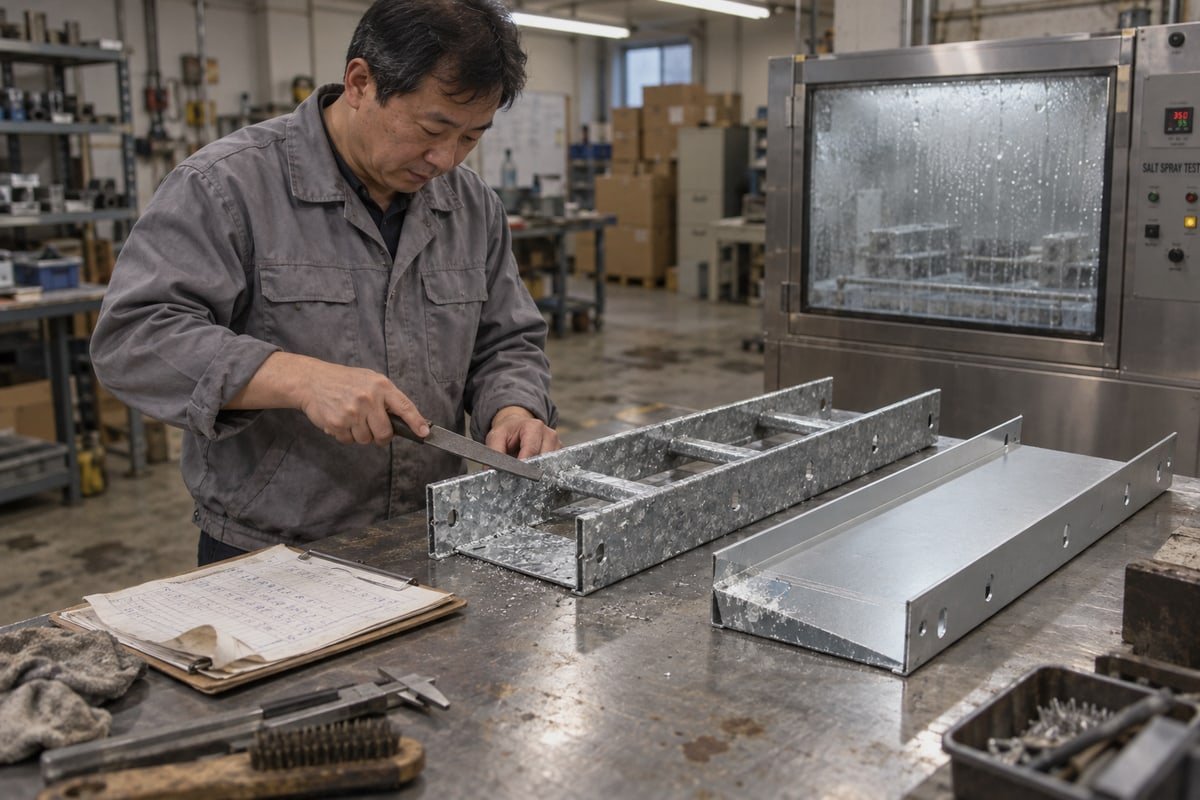
That rung-end story is the whole comparison in miniature. Hot-dip galvanizing is a batch process. The finished tray goes into molten zinc 2 after fabrication. It comes out thick, rugged, and slightly messy. ZMA is a continuous coil process. The steel sheet is coated first, then punched and folded into tray. It comes out thinner, smoother, and more consistent. Here is how the two stack up.
| Factor | Hot-Dip Galvanized (HDG) | Zinc-Magnesium-Aluminum (ZMA) |
|---|---|---|
| Process | Batch dipping after fabrication | Pre-coated coil, formed after coating |
| Typical chemistry | Zinc plus zinc-iron alloy layers | Approx. 93.5% Zn, 3% Mg, 2–3% Al (varies by mill) |
| Coating thickness | Thick; governed by ISO 1461 standard minimums | Thinner; measured as coating mass per square meter |
| Protection mechanism | Barrier plus sacrificial cathodic protection | Stable Mg/Al-rich corrosion products plus sacrificial action |
| Cut edges | Bare steel; needs zinc-rich touch-up | Self-healing cut edges on small cuts and scratches |
| Surface | Spangle, possible zinc tears and burrs | Smooth, uniform, low friction for cable pulling |
| Reported corrosion resistance | Baseline | Roughly 3× to 10× HDG in accelerated tests |
How each coating stops red rust
HDG works by brute thickness. Zinc corrodes slowly, and when steel is exposed, zinc corrodes first. That is sacrificial red rust protection 3, and it is well understood. The ISO 1461 standard sets minimum coating thickness microns by steel thickness, so engineers can specify and inspect it with confidence.
ZMA works differently. When magnesium and aluminum corrode alongside zinc, they form a dense, stable layer of corrosion products. That layer slows further attack far more than plain zinc oxide does. This is why a thinner ZMA coating can outlast a thicker zinc one in chloride exposure.
What self-healing really means
The phrase gets abused in marketing. On ZMA, corrosion products migrate across a small scratch, a drilled hole, or a shear-cut edge and seal it. That is real, and it is a genuine edge over HDG. It does not mean a deep gouge or a torch-cut section becomes factory-fresh. Damage size, salt load, humidity, and time all set the limit.
Reading salt spray test hours honestly
Suppliers love quoting salt spray test hours. Treat them as comparative evidence, not a field-life forecast. When we send data to a project engineer, we always say which coating mass was tested, whether the sample was flat sheet or formed tray, and whether edges were included. The number without that context is just a number.
Which Coating Option Gives Me Better Long-Term Value for My Project Budget?
Every quote we price forces one trade-off: a lower per-meter figure today, or fewer rust complaints in year eight. Our mid-range pricing lets buyers see both options side by side.
Hot-dip galvanized gives better value for budget-sensitive, short-cycle projects in mild environments because its upfront price is lower and supply is plentiful. Zinc-magnesium-aluminum gives better long-term value when design life exceeds twenty years, access is difficult, or corrosion would drive repairs, shutdowns, and early replacement.

Price per meter is the number every procurement manager asks for first. I understand why. It is easy to compare and easy to defend in a meeting. But for a zinc-magnesium-aluminum vs hot-dip galvanized cable tray decision, it is the least useful number on the sheet. The honest comparison is total installed lifecycle cost. Here is the cost model we walk buyers through.
| Cost Item | Hot-Dip Galvanized | Zinc-Magnesium-Aluminum |
|---|---|---|
| Tray and cover purchase | Usually lower | Usually higher per unit |
| Post-fabrication galvanizing | Required; adds transport, energy, lead time | Not required |
| Freight and lifting | Heavier assemblies | Often lighter, depending on gauge |
| Field-cut repair | Zinc-rich paint and labor at every cut | Minimal on small cuts |
| Inspection and maintenance | Periodic touch-up in aggressive sites | Lower in C4+ sites |
| Expected replacement interval | 15–20 years severe coastal; 20–40 years moderate | Often beyond 20 years severe coastal |
| Access equipment and shutdowns | Risk rises with corrosion | Risk falls with lower corrosion |
Where hot-dip galvanized saves real money
For an ordinary factory, an underground car park, or a leased logistics yard, HDG is the right call. The environment is C1 to C3. The project may not even exist in fifteen years. Paying a premium for corrosion capacity you will never use is not material cost efficiency. It is waste. HDG is also standardized and available from many galvanizers, so delivery risk is lower.
Where zinc-magnesium-aluminum saves real money
ZMA skips the whole post-fabrication dipping stage. That removes a trucking leg to the galvanizer, acid pickling waste, energy use, and often a week of lead time. For solar PV mounting structures and cable runs, charging stations, water treatment plants 4, and municipal utility tunnels, the asset is expected to run for twenty-five years. In those cases the premium buys certainty. You are paying so that nobody has to think about the cable tray again.
Compare apples to apples
One warning. Do not compare a premium ZMA quote against a thin “galvanized” tray. Many sellers use “galvanized” to describe pre-galvanized sheet with a fraction of the coating mass of batch HDG. The fair fight is ZMA versus batch HDG with the same load rating, dimensions, accessories, and documented coating mass. On our LANYE CABLETRAY quotes we label the coating type and mass explicitly for that reason.
Modeling and carbon
Two smaller points help the business case. ZMA corrodes at a more predictable, linear rate than variable-thickness HDG, so lifecycle modeling in BIM is tighter. And because it avoids the energy-heavy dipping stage and pickling waste, its carbon footprint is lower. For EPC clients with sustainability reporting, that line item is starting to matter.
Can I Rely on Zinc-Magnesium-Aluminum Cable Trays for Coastal or High-Humidity Environments?
A project director in Singapore messaged us on WhatsApp asking whether ZMA tray would survive a reclaimed-land substation near the shore. His real worry was returns, not chemistry.
Yes, zinc-magnesium-aluminum cable tray is a reliable choice for coastal and high-humidity sites classed C4 and C5, where chloride attack depletes ordinary zinc quickly. For continuously wet or C5-M marine splash zones, verify supplier cyclic-corrosion data first, and consider stainless steel or FRP if exposure is extreme.
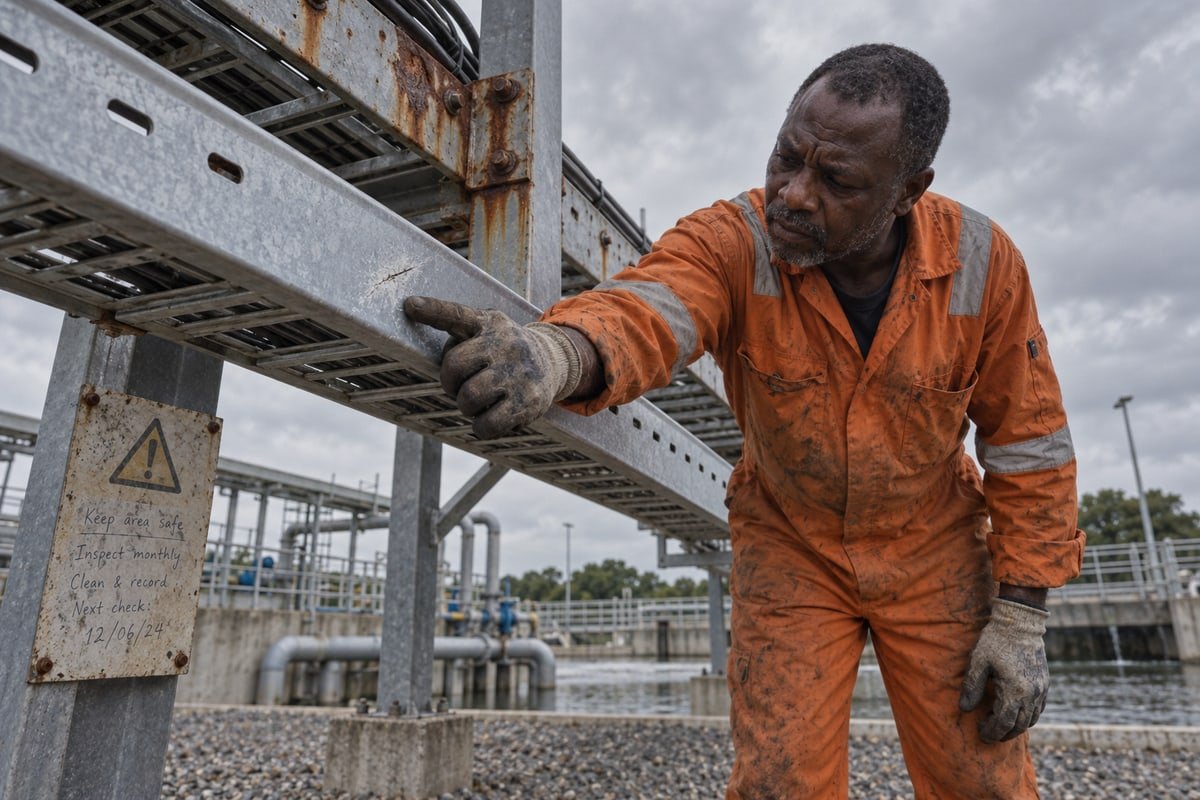
That Singapore question is the one we get most from Southeast Asia. Humid, salty air is the default there, not the exception. The useful way to answer it is to stop talking about “coastal” as one thing and start using atmospheric corrosivity 5 categories. The corrosion resistance class of the site decides the coating, not the postcode.
| Category | Typical Environment | Hot-Dip Galvanized | Zinc-Magnesium-Aluminum |
|---|---|---|---|
| C1–C2 | Dry interiors, rural outdoor | Fully adequate, often over-spec | Adequate, usually unnecessary |
| C3 | Urban, light industrial, moderate humidity | Strong default | Good, premium rarely justified |
| C4 | Coastal with moderate salt, industrial, high humidity | Workable with heavy coating and maintenance | Recommended |
| C5 | Harsh industrial environments, aggressive coastal | Zinc depletes faster than expected | Recommended with supplier data |
| C5-M marine environment | Splash zone, continuous salt wetting | Not recommended alone | Verify data; consider stainless or FRP |
Why chloride hurts hot-dip galvanized
Salt does not attack zinc evenly. It concentrates at cut edges, splice plates, bolt holes, and anywhere water sits. Those are exactly the spots where HDG is thinnest or already bare. Once the zinc there is gone, red rust starts and spreads. In a C4 or C5 site that can happen inside the warranty period. ZMA’s self-healing cut edges change that math, which is why the SERP consensus and our own export experience both point to ZMA for high-chloride work.
Ammonia, alkaline, and wastewater sites
Our water treatment customers face a different attack. Ammonia and alkaline moisture eat plain zinc at a surprising rate. ZMA holds up noticeably better in those conditions, which is why it is now the preferred choice in intensive livestock farming 6 and chemical processing plants too. The same logic applies to fertilizer plants and sewage pumping stations.
When neither steel option is enough
I will not sell steel tray into a continuously wet marine splash zone and call it fine. In a true C5-M marine environment, or inside a chemical plant with acid mist, stainless steel, aluminum, or FRP may be the right answer. Aluminum has its own chloride pitting issues, so it still needs review. The honest move is a site-specific corrosion assessment before anyone signs the purchase order.
Details that decide service life
Coating is only one variable in service life durability. Drainage matters. A tray that holds a puddle will rust whatever it is coated with. Fasteners matter. A ZMA tray bolted with plain zinc-plated hardware will see the bolts fail first. Galvanic contact matters. Dissimilar metals in a wet environment create their own corrosion cell. We supply matched fasteners and splice plates for that reason, and we ask buyers how the tray will be supported before we quote.
What Should I Consider When Choosing Between These Two Coatings for My EPC Project?
One lesson cost us a reshipment: a site crew cut hot-dip galvanized tray on-site and skipped the zinc-rich touch-up. Red rust showed at every cut within months.
Match the coating to your site’s corrosion class, design life, and field-cutting volume. Choose hot-dip galvanized for C1–C3 sites, tight budgets, and short cycles. Choose zinc-magnesium-aluminum for C4-plus exposure, 25-year assets like solar and utility tunnels, heavy on-site cutting, or costly maintenance access.
That reshipment taught us to ask about site practice, not just site chemistry. EPC projects involve many hands. Tray gets cut, drilled, dragged, and modified by crews who never read the coating spec. So the zinc-magnesium-aluminum vs hot-dip galvanized cable tray decision has to account for people as well as weather. Here is the framework we use.
| Choose Hot-Dip Galvanized When | Choose Zinc-Magnesium-Aluminum When |
|---|---|
| Site is C1–C3: ordinary plant, car park, general outdoor | Site is C4 or above: coastal, chemical, high-humidity industrial, wastewater |
| Budget is tight and per-meter price dominates | Design life is long: solar, charging stations, municipal tunnels |
| Project cycle is short: temporary works, leased yards | Replacement is costly or access is difficult |
| Heavy mechanical handling is expected | Large volumes of field cutting and drilling are planned |
| Spec demands familiar ISO 1461 batch galvanizing | Supplier provides matching ZMA fittings and corrosion data |
Field cutting is the hidden deciding factor
This is the detail most comparison articles skip. Every HDG cut is bare steel until someone paints it. On a big site, that is hundreds of cuts, each one a rust seed if missed. ZMA’s self-healing cut edges give the crew a much higher margin for error on small cuts. If your drawings show a lot of site modification, this single point can outweigh the price difference.
Load capacity is not a coating property
Buyers sometimes assume ZMA tray is weaker because the coating is thinner. That is wrong. Load capacity comes from steel grade, sheet thickness, tray width, rung spacing, span, and support design. A ZMA tray may be lighter only because the supplier chose a lighter gauge. Compare load tables and kilograms per meter at the same rating, not coating type.
The purchasing checklist we hand to EPC buyers
- Identify the actual coating: batch HDG, pre-galvanized, or ZMA. Do not accept “galvanized” alone.
- Require coating thickness microns or mass per square meter in writing.
- Confirm the standard, such as ISO 1461 for HDG or the relevant coil standard for ZMA.
- Request corrosion data that matches your corrosion resistance class, not a generic salt spray figure.
- Verify load ratings at your real span and support spacing.
- Check that fittings, covers, splice plates, and fasteners come in the matching coating.
- Define the cut-edge repair procedure and put it in the method statement.
- Confirm bonding and grounding continuity across joints.
- Compare total installed lifecycle cost, not price per meter.
- Lock the delivery schedule and QC inspection plan before deposit.
Delivery and QC are part of the decision
Our typical buyer resells into live projects, so a late container or a rejected batch hurts more than a slightly higher unit price. ZMA removes the galvanizer from the schedule, which removes one common source of delay. HDG has the benefit of many suppliers, which protects against capacity shortages. Either way, insist on pre-shipment inspection photos of edges, holes, and welds. That habit has saved us and our clients more than any coating choice.
Conclusion
Rusting tray is a slow, expensive failure. Hot-dip galvanized is the proven baseline for mild sites; zinc-magnesium-aluminum buys long-term certainty where corrosion bites. Pick by class and lifetime.
Interested in sourcing the products mentioned in this article? See details and request a quote here:
Footnotes
- Detailed overview of the standardized test method for checking corrosion resistance of coatings. ↩︎
- ISO standards define the composition and temperature requirements for molten zinc baths in galvanizing. ↩︎
- Explains the electrochemical process where zinc acts as a sacrificial anode to protect steel. ↩︎
- UN-Water coordinates global efforts to manage water treatment plants and sustainable infrastructure. ↩︎
- AMPP provides technical resources for evaluating atmospheric corrosivity and its impact on infrastructure materials. ↩︎
- The EPA regulates environmental conditions and waste management in intensive livestock farming operations. ↩︎