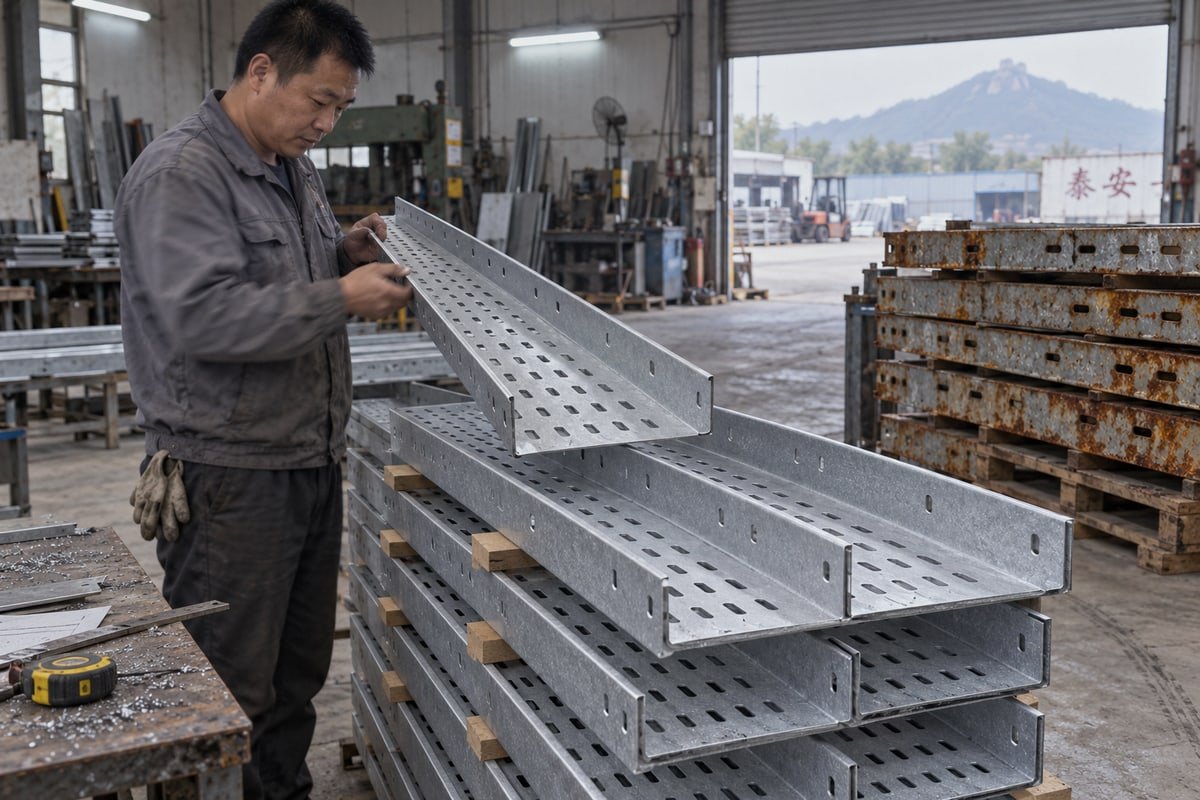
Rusted slot edges on three-year-old galvanized trays keep showing up in photos from our Southeast Asian customers salt spray test reports 1. That problem pushed our Tai’an workshop toward the zinc-magnesium-aluminum tray-type cable tray.
A zinc-magnesium-aluminum tray-type cable tray is a ventilated, perforated-bottom steel cable support with raised side rails, coated in a zinc-aluminum-magnesium alloy. The coating resists atmospheric corrosion far better than ordinary galvanizing, while the slotted base keeps airflow and drainage open for cables.
Two separate choices hide inside that name. One is the coating. The other is the tray shape. I will take them one at a time, then show you where they belong together and where they do not.
How Does Zinc-Magnesium-Aluminum Coating Improve My Cable Tray’s Corrosion Resistance?
Every tray that leaves our Tai’an workshop gets cut, punched and bent, so cut-edge behavior is the first thing we check on a new coil.
The zinc-aluminum-magnesium coating protects steel three ways: zinc corrodes sacrificially instead of the base metal, aluminum forms a barrier layer, and magnesium turns corrosion products into a dense film that spreads over cut edges and scratches. Suppliers report three to ten times the corrosion resistance of hot-dip galvanized steel.
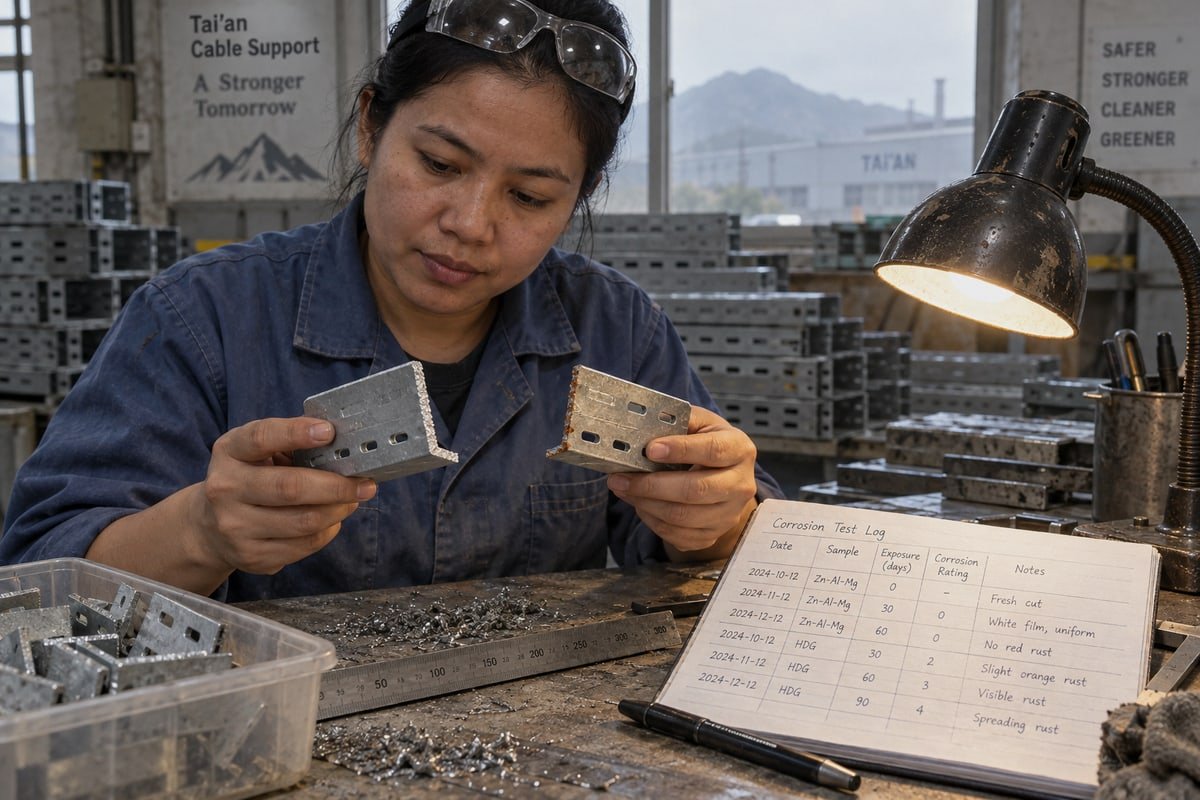
What is actually in the coating?
The tray is not a solid alloy. It is a steel sheet with a thin Zn-Al-Mg layer 2 on both faces. You will see the names ZAM, Zn-Al-Mg, ZM, and zinc-aluminum-magnesium. They all describe the same coating family. The order of the metals just changes by supplier and region.
One recipe that coil mills quote often is about 93.5% zinc, 3.5% aluminum and 3% magnesium. Other grades push aluminum anywhere from 1.5% up to 11%, with magnesium held between 1.5% and 3%. The chemistry changes both the look and the performance. So the grade matters, not just the label.
| Element | Typical share | Job in the coating |
|---|---|---|
| Zinc | About 93% | Sacrificial protection; corrodes before the steel does |
| Aluminum | 1.5% to 11% | Stable, adherent barrier against moisture and oxygen |
| Magnesium | 1.5% to 3% | Makes corrosion products dense and lets them cover bare spots |
Do the self-healing properties really work?
Buyers often tell me “self-healing sounds like marketing.” They are half right. The coating does not grow back. What happens is simpler. When a slot edge is cut, zinc and magnesium corrode first. Their corrosion products form a tight, alkaline film that creeps across the exposed steel. That slows rust at drill holes, punched slots and small scratches.
It does not fix deep gouges, crushed rails or missing material. In our experience it also does not forgive repeated disassembly. Each time a section is unbolted and re-drilled on site, a bit more of the protective layer is spent. For trays that will be rewired often, I say so before the order, not after.
How much better than hot-dip galvanized is it?
Supplier data usually claims more than three times the corrosion resistance of hot-dip galvanized steel in standard air, and up to ten times in chloride, soil, high-moisture or ammonia conditions. Salt spray test results of five to ten times are common in brochures. Treat these as manufacturer-reported figures. A salt spray test does not predict service life in every field. Coating thickness, drainage, pollutant levels and installation quality all shift the result. Still, the direction is consistent: ZAM is a credible hot-dip galvanized alternative for C4 and C5-M environments.
| Material | Cut-edge protection | Weight | Relative cost | Best fit |
|---|---|---|---|---|
| Pre-galvanized steel | Weak | Medium | Low | Dry indoor |
| Hot-dip galvanized | Fair, thick barrier | Heavy | Medium | General outdoor |
| ZAM-coated steel | Good | Medium-light | Medium-high | Coastal, humid, solar, industrial |
| Aluminum | Not needed | Light | High | Nonmagnetic, light duty |
| Stainless steel | Not needed | Heavy | Very high | Severe chemical or marine |
What Makes Tray-Type Cable Trays Different From Ladder or Mesh Designs?
The trade-off I weigh most often is ventilation against protection, because that single choice decides whether a tray, ladder, mesh or trough goes on the drawing.
A tray-type cable tray has a continuous perforated base between two side rails, so it supports small control and instrumentation cables that ladder rungs would let sag, while still ventilating better than a solid trough. Mesh is lighter but offers less load capacity and fewer cover options.
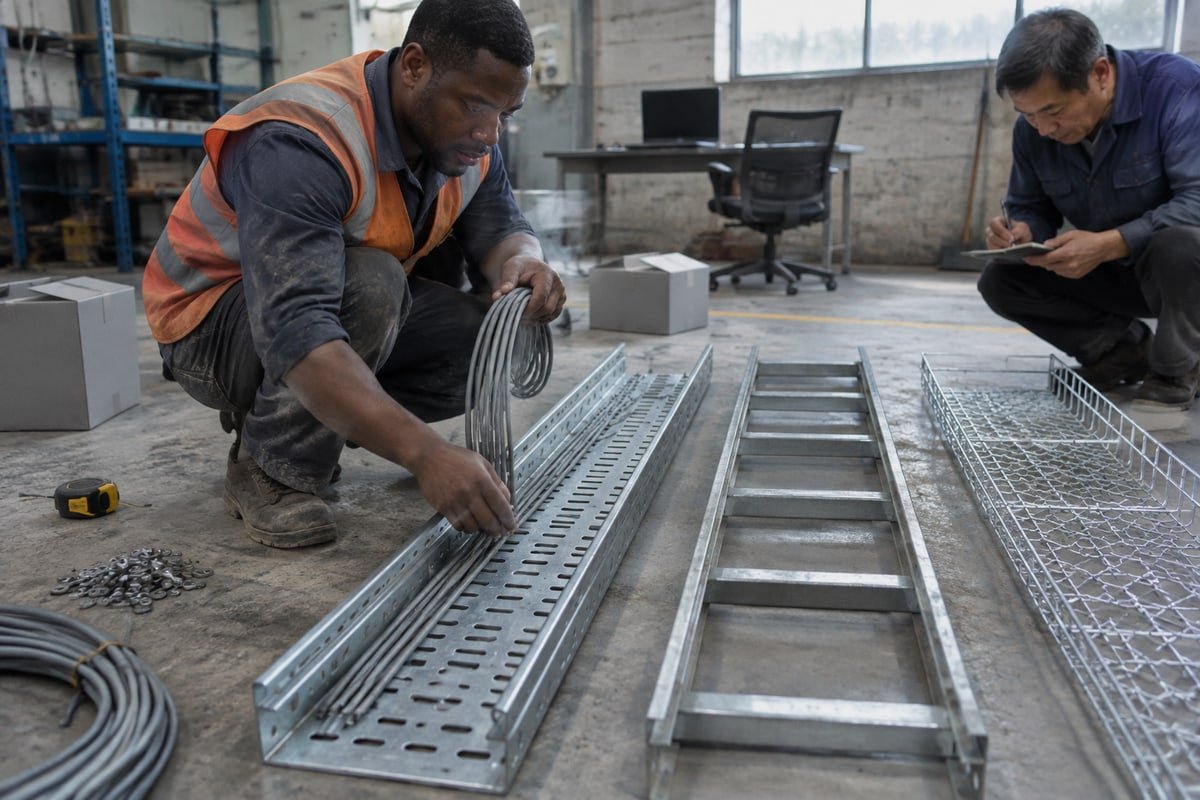
| Design | Base | Ventilation | Small-cable support | Dust and drip protection | Typical use |
|---|---|---|---|---|---|
| Ladder | Rungs only | Excellent | Poor without cleats | Poor | Large power cables |
| Tray-type (perforated) | Slotted sheet | Good | Good | Fair | Mixed power, control, instrumentation |
| Wire mesh | Welded wires | Excellent | Fair | Poor | Data and low-voltage |
| Trough (solid bottom) | Closed sheet | Poor | Good | Excellent | Dusty, dripping, EMI-sensitive areas |
Where the tray-type sits
Think of the perforated tray 3 as the middle option. The slotted base carries cable weight across its full width. That is why control cables and smaller power cables do not need extra cleats. The slots still let air move and let rainwater fall through instead of pooling. On the product we build, the base and sides carry rows of elongated oval slots, and the side flanges have smaller round holes for brackets and splice plates. The rolled edges stiffen the rails and reduce sharp contact points during cable pulling.
Where it is weaker than a trough
This is the part I insist on saying out loud. An open base means the tray cannot keep out dust, oil mist, dripping chemicals or small animals. If your plant has heavy powder, corrosive liquid above the route, or a need to shield electromagnetic interference, the tray-type is the wrong shape. A ZAM trough does that job. The coating does not change the shape, and the shape decides the protection.
Perforation pattern choices
The slot pattern is a design decision, not decoration. Larger openings cut weight and improve airflow. Smaller openings give more bearing area for thin cables and reduce abrasion at bends. When we quote an OEM run, we ask for cable sizes first, then propose the pattern. The goal is no sagging, no point loading and no loss of support at tees and crosses.
Why Should I Choose Zinc-Magnesium-Aluminum Trays for My Solar or Water Treatment Project?
A project director in Singapore once sent me a WhatsApp photo of a galvanized tray rusting from its slot edges after only a few years outdoors.
Choose zinc-magnesium-aluminum trays when the site is both corrosive and heat-sensitive: solar DC-side cable runs, coastal plants, and humid water treatment areas. The alloy coating stops rust at slot edges, while the open base keeps cables cool, which plain galvanized or closed trough designs cannot do together.

That photo sums up the real use case. The buyer feared rust, so a plain pre-galvanized tray was out. He also feared heat, so a closed trough made him nervous. The zinc-magnesium-aluminum tray-type cable tray fits exactly between those two fears. It upgrades the material to fix corrosion anxiety, and it keeps the slots to preserve the cooling path.
Solar DC-side cable routes
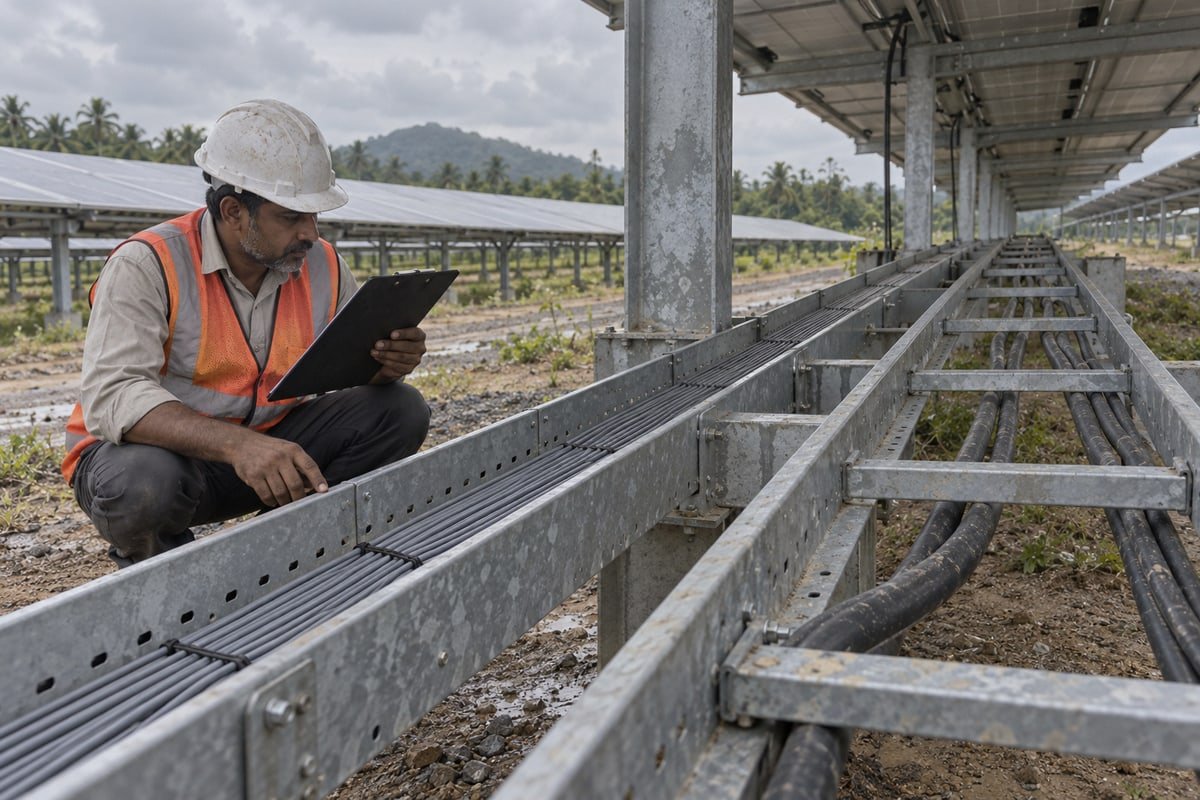
On a photovoltaic support system 4 the DC cables run outdoors for the life of the plant. They see rain, dew, ultraviolet light and daily heat cycles. The slotted base lets heat escape and lets water drain. The bright, reflective surface also absorbs less solar heat than a dark, dull tray, which helps limit cable temperature rise. One caution from our engineers: ventilation does not raise the cable rating by itself. Your electrical designer still applies the code, grouping factors and ambient temperature. The tray simply avoids making the heat worse.
Water treatment and coastal plants
Wastewater areas combine humidity, chlorides and ammonia. These are exactly the conditions where suppliers report the largest gap over hot-dip galvanized steel, up to ten times in some tests. Coastal C5-M environment sites add salt mist. Here the cut-edge behavior pays off, because every bracket hole and every field cut is a potential rust start point.
When I tell buyers not to choose it
I sell mid-range products, so I am careful with premiums. Here is my decision list:
- Dry indoor plant or office ceiling: use ordinary galvanized tray. The ZAM premium will not show value in the short term.
- Heavy dust, oil mist, or liquids dripping from above: use a ZAM trough with cover, not a perforated tray.
- Lines that will be rewired and re-drilled often: either accept touch-up work or choose hot-dip galvanized with its thicker barrier.
- Severe acid or solvent exposure: ask for documented chemical compatibility, or move to stainless steel.
- Corrosive plus heat-sensitive, semi-open acceptable: this is where the ZAM tray-type earns its price.
| Project condition | Pre-galvanized tray | ZAM tray-type | ZAM trough |
|---|---|---|---|
| Dry indoor | Best value | Over-specified | Over-specified |
| Solar DC-side outdoor | Rusts at slot edges | Best fit | Heat concern |
| Humid water treatment | Short service life | Good fit | Good if drips present |
| Dusty or oily process area | Poor | Poor | Best fit |
| Frequent rewiring | Fair | Needs touch-up | Needs touch-up |
The life-cycle argument is strongest when access is hard, such as trays on roofs, behind panels, or above process tanks. Replacement there means downtime. That is when a longer service life, even if the exact years are site-dependent, justifies the higher purchase price.
How Can I Ensure Quality Control When Sourcing Zinc-Magnesium-Aluminum Cable Trays From China?
One lesson from years of shipping trays to the Philippines and Thailand: two coils labelled ZAM can behave very differently once the trays are punched and bent.
Ensure quality by specifying the coating designation and mass, steel thickness, load class and corrosion category in writing, then requesting mill certificates, salt spray test reports and pre-shipment photos. Check cut-edge deburring, perforation consistency and packing before the container closes, not after the trays reach site.
Shimkien, the Singapore director I mentioned earlier, lists three pain points in every call: late delivery, quality surprises, and returns. All three trace back to one weak link, a vague specification. Here is the process we follow with EPC buyers and wholesalers to close that gap.
Step by step from spec to container
- Write the material line fully. State the steel grade, sheet thickness, the Zn-Al-Mg coating designation and coating mass per square meter. “ZAM” alone is not a spec.
- State the geometry. Tray width, side-rail height, perforation pattern, fitting radius, splice plate type and cover requirement.
- State the performance class. Load class, support span, allowable deflection and the corrosion category 5, such as C4 or C5-M.
- Ask for coil-level documents. We request mill certificates for every coil before it enters our line, and we pass copies to the buyer on request.
- Review a first-article sample. Photos or a physical sample of one straight section and one bend, with cut edges visible.
- Pre-shipment check with photos. Count, stacking, bubble wrap and pallet strapping, because trays that arrive bent get returned no matter how good the coating is.
What we look at on the shop floor
| Check point | What we look for | Why it matters |
|---|---|---|
| Coating thickness | Consistent reading on flat and bent areas | Thin spots on bends corrode first |
| Cut edges | Deburred, no rough burrs | Burrs cut cable insulation and start rust |
| Perforation | Even slot spacing, no tearing | Torn slots lose support and expose steel |
| Side-rail squareness | Rails at a clean right angle | Keeps splice plates aligned on site |
| Surface | Bright, uniform, light spangle | Mottling is normal; flaking is not |
| Packing | Layered stacks, wrapped, strapped | Prevents transit damage and returns |
Protecting lead time
Delivery delays usually start with a spec change after the coil is ordered. So I lock the drawing before material purchase. With a small team, we keep communication direct, often on WhatsApp, and share production photos at cutting, punching and packing. That way a customer in Singapore or Bangkok sees the trays before the ship does.
Conclusion
Rust at slot edges, or cables cooking in a closed trough? A zinc-magnesium-aluminum tray-type cable tray solves both, provided your site truly needs it and your specification is precise.
Interested in sourcing the products mentioned in this article? See details and request a quote here:
Footnotes
- Standardized testing method for evaluating the corrosion resistance of coated materials. ↩︎
- Official ISO standard for zinc-aluminum-magnesium alloy-coated steel sheets. ↩︎
- Global authority for electrotechnical standards, including cable tray system requirements. ↩︎
- Leading international resource for photovoltaic power system data and technical guidelines. ↩︎
- ISO standard for classifying environmental corrosivity to determine material suitability. ↩︎