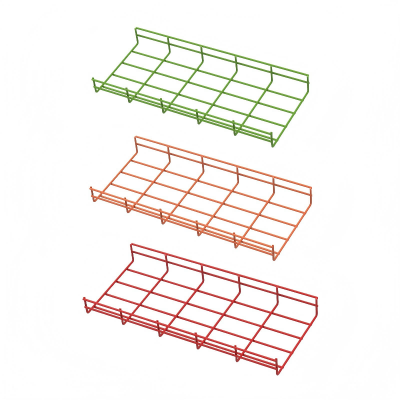
A buyer once showed me rusty trays he had sourced cheap. That pain pushed our Tai’an team to refine the [powder-coated wire mesh cable tray](https://lanyecabletray.com/?p=4100) we build today.
A powder-coated wire mesh cable tray is a welded steel wire basket tray finished with an electrostatically applied, heat-cured polymer coating. It supports and organizes cables in dry indoor spaces, offering good airflow, light-duty corrosion resistance, color-coding options, and a clean appearance at an economical price.
That definition covers the basics. But the real questions come next. How does it compare with galvanized trays? How thick should the coating be? What should you check before ordering? And how does it affect shipping? Let me walk you through each one.
What makes powder-coated wire mesh cable tray different from standard galvanized options?
Last spring, our QC lead lined up a raw galvanized sample beside a yellow powder-coated one on the workshop bench. Visiting buyers picked the coated tray every single time.
Powder-coated wire mesh trays add an electrostatically applied, oven-cured polymer layer over steel, giving color options, a smoother touch, and zinc-whisker-free surfaces for indoor use. Galvanized trays rely on a zinc layer instead, trading appearance for stronger outdoor and humid-environment corrosion protection.
Both products start the same way. We weld steel wire rods into a rigid grid, forming basket tray systems 1 with a flat base and raised side walls. The open lattice gives excellent ventilation and heat dissipation, which matters a lot in data center cable management where high-density cables generate heat. After welding, the paths split. Galvanized trays get a zinc layer. Powder-coated trays get a dry resin powder, usually epoxy, polyester, or a hybrid, applied with an electrostatic gun and then cured in an oven so it melts into one uniform film.
Three practical differences buyers notice
First, appearance and identification. Powder coating comes in almost any RAL shade. That enables color-coded wiring, so a data center can run power in red trays, data in green, and security lines in orange. Zinc offers one gray tone.
Second, cable safety. The cured powder flows over every weld intersection, leaving a smooth, rounded finish that reduces cable jacket abrasion during pulls.
Third, the zinc whisker issue. Electro-zinc surfaces can grow tiny conductive filaments over time. In server rooms, these whiskers can shed and short out equipment. A powder film encapsulates the steel and prevents that risk entirely.
Some buyers tell me powder coat is “just decorative paint.” I push back on that. It is thicker and harder than ordinary paint, and it protects and decorates at the same time. Here is how the zinc-plated vs powder-coated choice breaks down:
| Aspect | Powder-coated mesh tray | Galvanized mesh tray |
|---|---|---|
| Appearance | Full color range, smooth matte or gloss finish | Utilitarian silver-gray |
| Corrosion resistance | Good for indoor, ISO C1–C3 conditions | Better for humid or outdoor exposure (hot-dip) |
| Zinc whisker risk | None, steel is fully encapsulated | Possible on electro-zinc surfaces |
| Color coding | Easy, any RAL shade | Not practical |
| Typical use | Data centers, offices, control rooms | Industrial, outdoor, heavy-duty runs |
How do I choose the right powder coating thickness for my project environment?
Every quotation forces a choice on my desk: a thicker coating costs more powder and oven time, while a thin one risks early rust claims. Thickness deserves careful thought.
For most indoor projects, specify a dry film thickness of 60–80 microns and write it into your purchase contract. Thinner films suit only sheltered ISO C1 spaces, while anything approaching C3 humidity or outdoor exposure calls for hot-dip galvanized or stainless steel instead.

Coating thickness is the single biggest driver of corrosion performance on these trays. Yet it is also where suppliers cut corners most often. You will see wildly different numbers in the market. Some product sheets claim “above 50 microns.” Others promise 60–80 microns. A few list only 6–10 microns, which usually describes a thin vinyl or PVC-style indoor finish, not a true structural powder coat. These systems are not equal, so never accept the vague phrase “powder coated” in a spec sheet.
My advice is simple. State the dry film thickness, in microns, as a hard requirement in your purchase order. On our line, we check films with a digital DFT gauge at multiple points on each batch, because electrostatic application can leave thin spots at wire intersections.
Matching thickness to your environment
| Environment (ISO category) | Example location | Recommended finish |
|---|---|---|
| C1 (very low) | Heated offices, clean server rooms | Powder coat, 60 μm minimum |
| C2 (low) | Ventilated warehouses, retail interiors | Powder coat, 60–80 μm |
| C3 (medium) | Humid production halls, urban interiors | Powder coat 80 μm+, or consider galvanized |
| Outdoor / basements / wet areas | Rooftops, plant rooms, coastal sites | Hot-dip galvanized or stainless steel |
Choosing the powder chemistry
Epoxy powders bond hard and resist chemicals, but they chalk under UV light. A polyester powder finish 2 handles light better, so we suggest it when trays sit near windows or skylights. Hybrids sit in between. Remember the honest limit here: this product is built for indoor, dry environments. If your project runs outdoors, underground, or through damp zones, no thickness of powder alone will save it. Switch materials instead.
What quality control standards should I verify before placing a bulk order?
A Singapore project director once messaged me on WhatsApp at midnight: a rival supplier’s trays had failed site inspection. His story shaped the QC checklist we use today.
Before a bulk order, verify weld shear strength, wire diameter tolerance, mesh opening accuracy, measured dry film thickness, coating adhesion, RAL color consistency, and tested load-bearing capacity against NEMA VE 1 or IEC 61537. Demand documented pre-shipment inspection reports with photos for every batch.

Bulk orders fail for small reasons. A weld that pops. A film that flakes. A color that shifts between production runs. In our export work to Singapore, Thailand, and the Philippines, we learned that EPC contractors cannot afford site rejections, because a returned container kills the project schedule. So build your QC plan around checkpoints, not promises.
The seven-point checklist I recommend
- Wire diameter. Common tray wires run from 3.5 to 8 mm. Measure samples with calipers and compare against the drawing tolerance.
- Dimensions. Standard widths span 50 to 600 mm, with depths of 50 to 150 mm and mesh openings around 50 x 100 mm. Confirm each SKU.
- Weld integrity. Ask for weld shear test 3 results. Weak welds fail under cable load, not in the showroom.
- Dry film thickness. Require gauge readings at flat wires and at intersections, where films run thin.
- Adhesion. A cross-hatch test shows whether the coating grips the steel or flakes off at the first scratch.
- Load performance. Request load-bearing capacity data at your actual support span, referencing NEMA standards such as NEMA VE 1 4 or the IEC 61537 test method. Spacing of cable tray supports changes real capacity, so match the test span to your site design.
- Color and finish. Check RAL codes under daylight, and inspect for runs, pinholes, and bare spots.
| Checkpoint | Method | Failure signal |
|---|---|---|
| Film thickness | Digital DFT gauge, multi-point | Readings below the contracted 60–80 μm |
| Adhesion | Cross-hatch tape test | Coating lifts in grid squares |
| Weld strength | Shear test on sample joints | Welds separate below rated force |
| Load rating | Span test per NEMA VE 1 / IEC 61537 | Deflection beyond allowable limit |
One more point. Remember that this is a lightweight product positioned for indoor, economical cable runs. Do not test it against heavy-duty ladder tray expectations, and do not let a supplier upsell it into a heavy-load role it was never designed for.
How does powder-coated wire mesh cable tray impact my delivery lead time and logistics costs?
I learned my hardest logistics lesson two years ago, when loosely stacked trays arrived in Manila with scratched coatings. We repacked the replacement shipment and rewrote our packing standard.
Powder coating adds three to seven days to production for curing and color changeovers, and custom RAL shades add more. Nestable basket trays cut container volume, but scratch-prone coated surfaces need paper interleaving or film wrapping, raising packing costs slightly while preventing expensive corrosion claims.

Lead time on a powder-coated wire mesh cable tray order has two clocks running. The first is fabrication: cutting, bending, and welding the mesh. The second is finishing: pretreatment, electrostatic spraying, and oven curing. The finishing clock is where surprises hide. Every color change on a coating line requires a full booth cleandown. So if your order mixes five RAL shades for color-coded wiring zones, expect a longer schedule than a single-color order of the same tonnage. When we plan production for EPC clients, we batch colors deliberately to protect the delivery date.
On the logistics side, mesh trays have one big advantage. Their open structure lets sections nest inside each other, so a container carries far more meters than it would with solid trunking. But there is a trade-off, and it comes straight from hard experience: the wire and its coating scratch easily during transport and installation, and every scratch shortens the corrosion life of the finish. Cheap packing saves dollars at the port and costs thousands at the site.
Packing options and what they cost you
| Packing method | Protection level | Relative cost | Best for |
|---|---|---|---|
| Bare nested stacks | Low, high scratch risk | Lowest | Short domestic hauls only |
| Kraft paper interleaving | Medium | Low | Standard export orders |
| Stretch film + carton ends | High | Medium | Multi-color, project-critical cargo |
| Wooden crates | Highest | High | Mixed loads with heavy fittings |
Build a realistic buffer into your project plan. Confirm the color batch plan, the packing method, and the pre-shipment inspection date in writing before production starts. Those three lines in a contract prevent most delivery disputes I have ever seen.
Conclusion
Rusty trays and delayed containers ruin projects. A powder-coated wire mesh cable tray, specified at 60–80 microns for dry indoor use, delivers clean, economical, well-organized cable runs.
Footnotes
- Wikipedia provides a comprehensive overview of various cable tray systems and their industrial applications. ↩︎
- ISO standards define the requirements and testing methods for high-performance polyester powder coatings. ↩︎
- ASTM International establishes the standard test methods for evaluating the shear strength of steel welds. ↩︎
- NEMA VE 1 is the primary technical standard for the manufacturing of metal cable tray systems. ↩︎