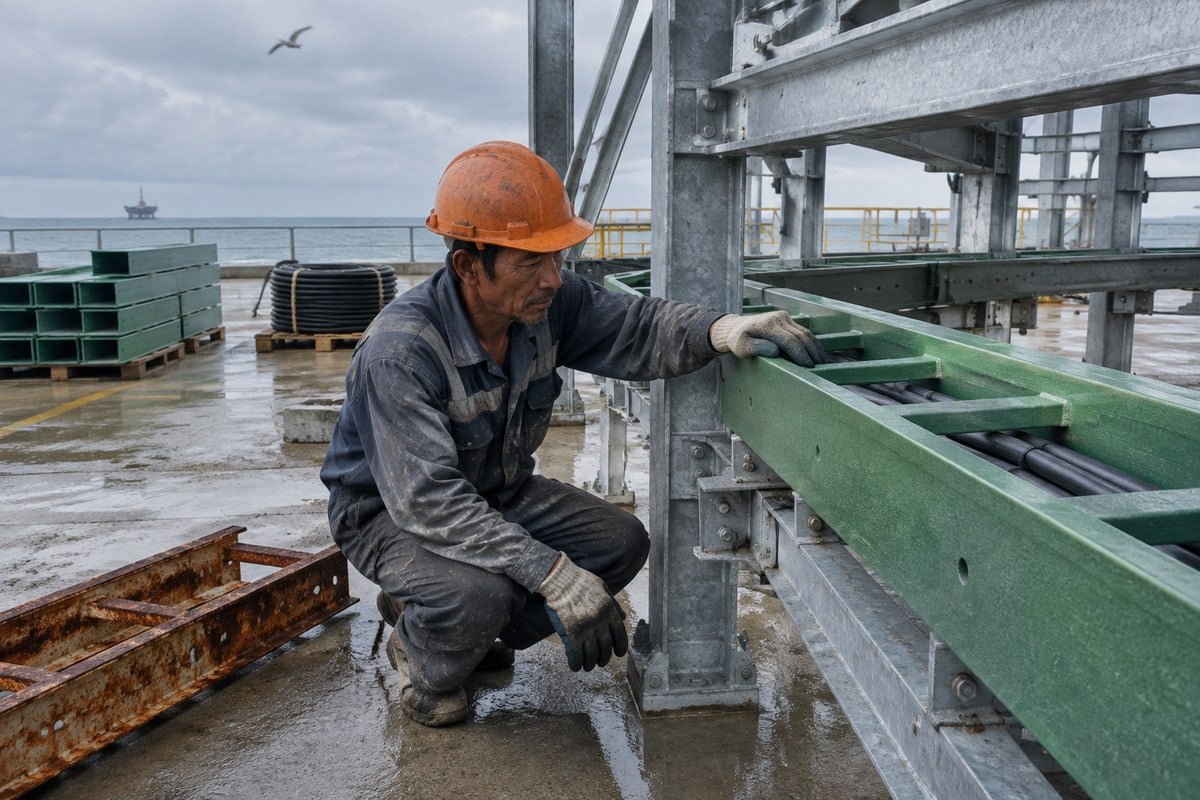
Steel trays at coastal plants rust from the inside out, and I watch our customers’ replacement budgets explode. The FRP/GRP ladder cable tray we build exists for exactly that problem.
An FRP/GRP ladder cable tray is a non-metallic cable support made from pultruded fiberglass, with two side rails joined by transverse rungs. It carries power and control cables in corrosive, humid, or electrically sensitive environments where steel trays corrode, offering light weight, insulation, and open ventilation.
FRP stands for fiber-reinforced plastic. GRP stands for glass-reinforced plastic. In cable management systems, the two names describe the same thing: glass fibers locked inside a resin matrix. The “ladder” part describes the shape. Below, I will walk through when this tray fits, what quality points to check, how to customize it, and what to expect when you source it from China.
How do I know if an FRP/GRP ladder tray fits my project’s environment?
A project director in Singapore messaged me on WhatsApp asking whether to swap hot-dip galvanized ladders for our FRP across a whole water treatment site. My answer: not everywhere.
An FRP/GRP ladder tray fits your project when three conditions meet: a strongly corrosive environment such as chemical processing plants, coastal sites, or wastewater facilities; large-section power cables that generate heat; and a need for non-conductive, low-maintenance support. If corrosion is mild, standard steel ladder tray is usually enough.
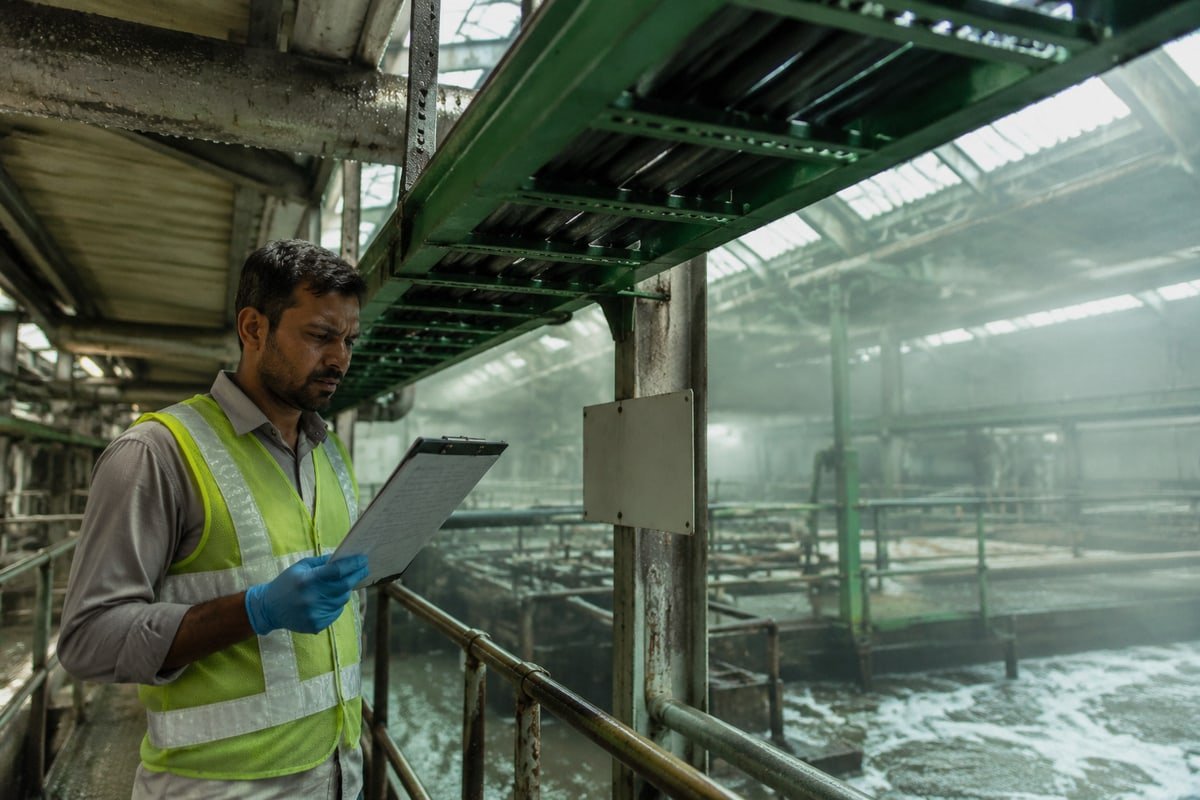
I want to be honest about this product. It is not a default option. It is a highly scene-specific option. But when the scene matches, it is almost the only reasonable choice. Its value is not that it is “better than steel.” Its value is that it survives where steel cannot survive, and it survives well.
The three-step decision chain I use with buyers
- Is the environment strongly corrosive? If no, a normal steel ladder tray is enough. Stop here and save money. If yes, go to step 2.
- Are the cables large-section power cables with high heat output? If no, an FRP trough tray or FRP perforated tray is the better fit. Those designs suit lighter control and instrumentation cables. If yes, go to step 3.
- Both answers are yes. The FRP/GRP ladder cable tray is your optimal solution. The open rungs let air move around hot cables. The resin resists the chemicals. The light weight makes installation on high platforms much easier.
Matching the environment to the tray
| Environment | Main threat to steel | My recommendation |
|---|---|---|
| Coastal or offshore platforms | Salt spray, chloride pitting | FRP/GRP ladder tray with vinylester resin 1 |
| Chemical processing plants | Acid or alkali vapor | FRP/GRP ladder tray with vinylester or epoxy resin |
| Wastewater treatment | Hydrogen sulfide, constant humidity | FRP/GRP ladder tray for power runs, FRP perforated tray for control cables |
| Dry inland solar farm | UV exposure only | Steel is fine; FRP only if UV-stabilized and the budget allows |
| Indoor commercial building | Almost none | Steel ladder tray or wire mesh tray |
Two objections I hear, and how I answer them
“Steel has more familiar load data and everyone knows how to install it.” This is true. That is exactly why steel stays the default and FRP stays the specialist. I do not argue against steel in a clean, dry plant. I only argue for FRP where the corrosion resistance pays for itself.
“FRP gives no electromagnetic shielding.” Also true. A metal tray shields sensitive data circuits a little. An FRP tray does not. So if you run data cables near power cables, you need more physical separation or shielded cable. In exchange, the non-conductive properties 2 of FRP mean the tray itself needs no grounding, and the risk of arc flash or shock during maintenance drops.
On cost, the initial price of FRP is higher than galvanized steel. But the total cost of ownership is lower in corrosive sites because painting, repair, and corrosion-related replacement disappear.
What quality standards should I check before ordering FRP/GRP ladder trays?
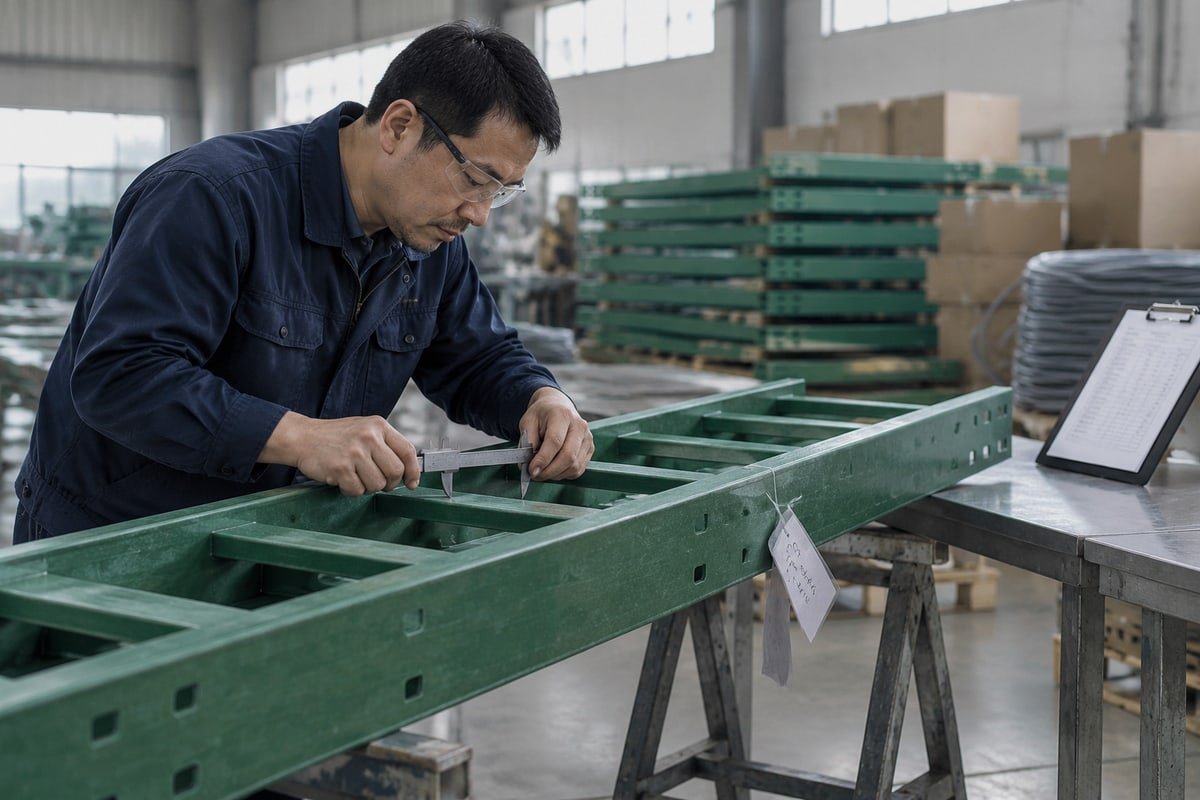
During a pre-shipment check at our Tai’an warehouse, I once ran a gloved hand along a rail and felt exposed glass fibers. That batch never left the yard.
Before ordering FRP/GRP ladder trays, check the resin type and fire rating (ASTM E84 or UL flame spread data), UV inhibitor content, NEMA load class and rated support span, glass fiber content, surface finish, and dimensional tolerances. Always request manufacturer datasheets, because load ratings differ between suppliers.
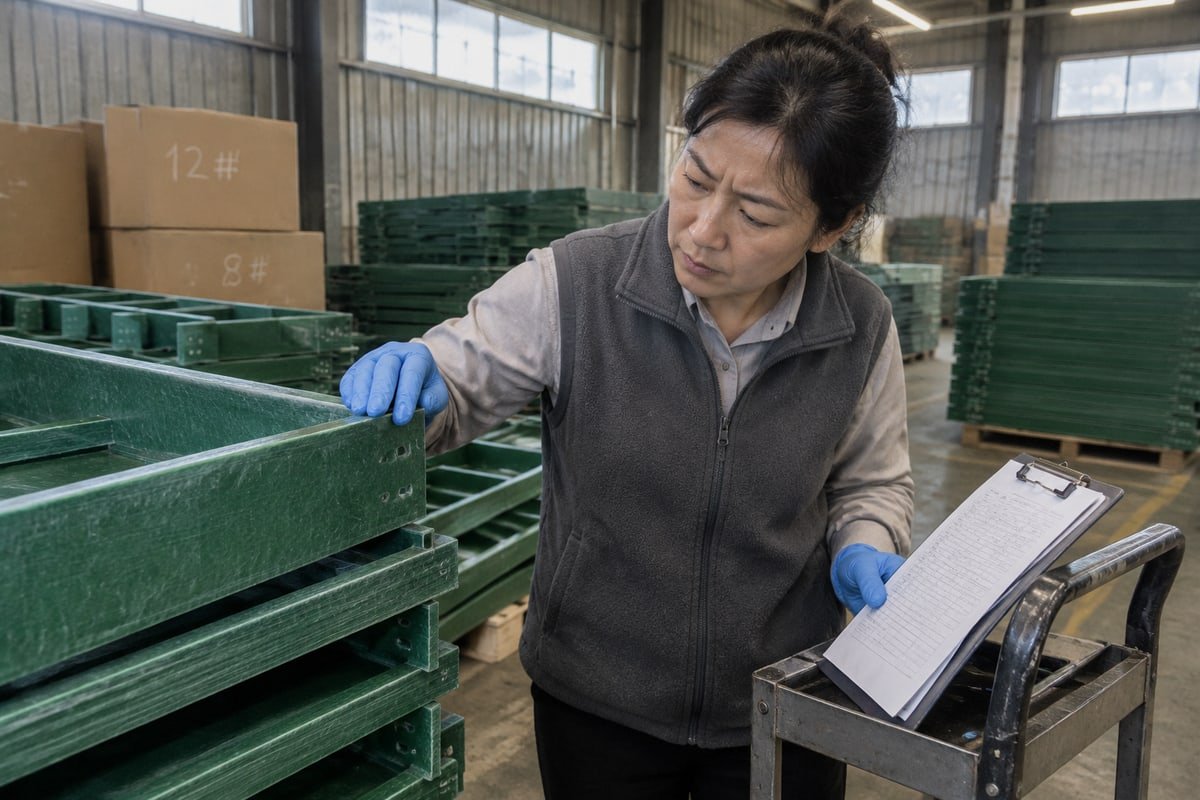
The word “FRP” covers a wide range of products. Two trays can look identical in forest green and behave very differently in acid vapor or in a fire. So I never let a buyer judge by photos alone. I push them to read the datasheet and, if the project is large, to send a third-party inspector.
The resin system decides chemical and fire behavior
| Resin system | Strengths | Where I recommend it |
|---|---|---|
| Polyester | Lowest cost, good general corrosion resistance | Outdoor plants, wastewater, mild chemical exposure |
| Vinylester resin | Strong resistance to acids and alkalis, better heat tolerance | Chemical processing plants, coastal and offshore sites |
| Epoxy | High mechanical strength | Heavy cable loads, long runs |
| Phenolic | Low smoke, zero halogen behavior in fire | Tunnels, subways, and passenger areas with LSZH rules |
Fire performance matters as much as corrosion. Industrial-grade trays use fire retardant resin formulations. Ask for flame spread and smoke data tested to ASTM E84 3 or UL methods. Do not accept “flame retardant” as a bare word on a quotation. Also ask about UV inhibitors. Pultruded fiberglass 4 without UV protection will chalk and lose surface resin in tropical sun, and Southeast Asia has plenty of that.
Load class and support span
Load rating is the second place where suppliers differ. Some catalogs quote NEMA load classes 5 and spans around 3,000 mm. These numbers are real for that specific rail profile. They are not universal. A thinner side rail with the same width can carry far less. So I always ask buyers to send me the cable schedule, the cable weight per meter, and the planned support span. Then we match a rail profile to a NEMA load class instead of guessing.
My pre-shipment inspection checklist
- Surface: no exposed fibers, no dry spots, no color variation between rails and fittings.
- Dimensions: rail height, tray width, rung spacing, and overall length within the agreed tolerance.
- Rung-to-rail joint: tight fit, fasteners or adhesive fully cured, no cracks at the joint.
- Fittings: splice plates and pre-drilled holes align with the straight sections without forcing.
- Marking: each part labeled to match the drawing so the site team does not mix profiles.
How can I customize FRP/GRP ladder trays for my specific installation needs?
Every custom request forces one trade-off in our workshop: how much does this change add to lead time versus how much installation labor it saves on site?
You can customize FRP/GRP ladder trays by width, side rail height, rung spacing, length, resin system, color, and fire-retardant grade. Add fittings such as horizontal elbows, tees, reducers, covers, splice plates, and H-shaped bridging connectors. OEM/ODM options include pre-drilled hole patterns and branded labeling for project kits.
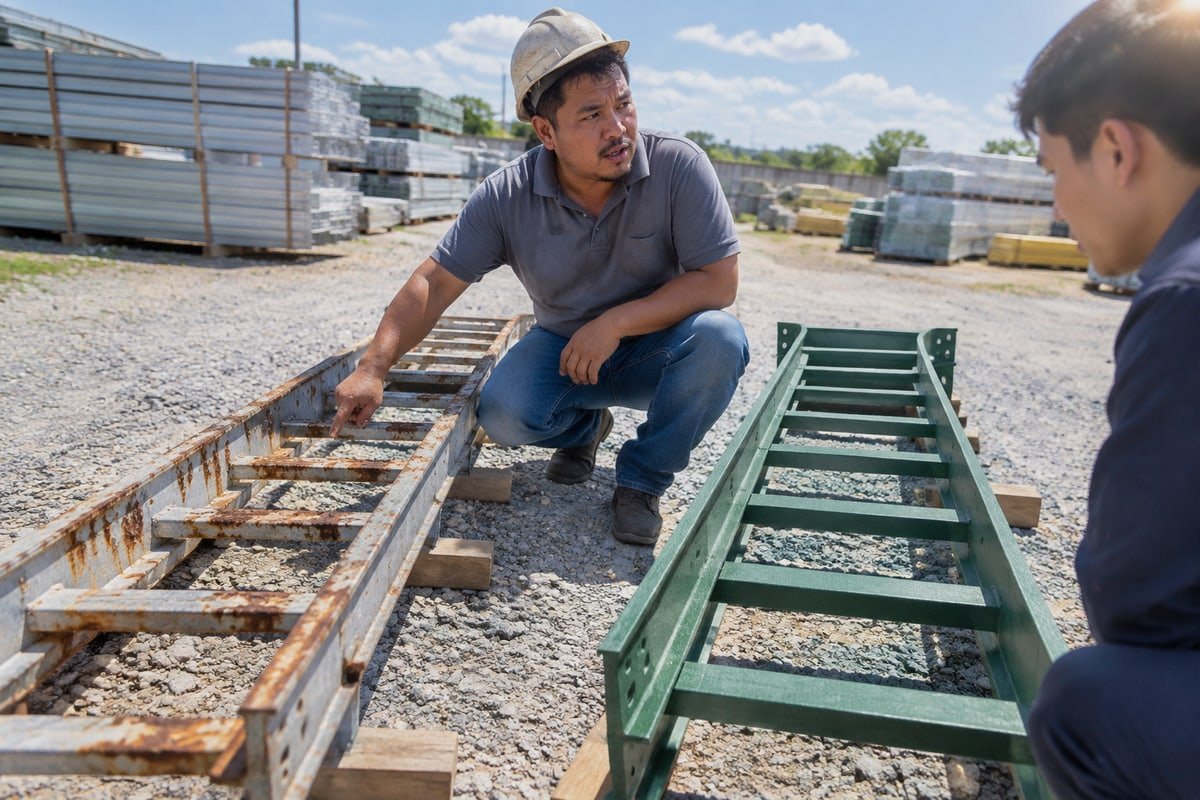
Most of our EPC and wholesale buyers do not want a single tray. They want a complete kit that fits their drawings and arrives ready to bolt together. That is where customization earns its cost. Below is how I break the options down.
Dimensions and geometry
Width and side rail height come first. Wider trays and taller rails carry more cable. Rung spacing comes next. Large-diameter power cables need closer rungs to avoid sagging between supports. Smaller spacing adds a little weight and cost, but it protects the cable jacket over years of service. Length is usually standard, but we can cut to a project length so the installer makes fewer field cuts. Pre-drilled mounting holes along the side rails let the crew hang the tray on existing structural steel without drilling fiberglass on site, which also avoids exposed fibers.
Fittings that turn a tray into a system
| Fitting | What it does | Practical note |
|---|---|---|
| Horizontal elbow | Changes direction on the same level | Match the same rail profile as the straight run |
| Tee splitter | Branches one route into two | Confirm the branch width early |
| Reducer | Steps down the tray width | Useful when cables leave the main run |
| Cover | Shields cables from UV, debris, and dripping | A peaked cover sheds water on outdoor runs |
| Splice plates | Join straight lengths end to end | Keep rail continuity and share load across the joint |
| H-shaped bridging connector | Links or braces parallel runs | Helps on multi-tier racks in plants |
Resin, color, and forward-looking options
Our standard finish is a matte forest green, which is what you see in most of our catalog photos. Buyers sometimes ask for yellow sections to mark a specific circuit or a safety zone, and that is a simple change. Resin is a bigger change. Moving from polyester to vinylester resin or to phenolic for LSZH tunnel work affects formulation and lead time, so I ask for that decision at the drawing stage, not after production starts.
Two newer ideas come up in conversations. Phenolic resin ladder trays for subways and tunnels are now a real specification item because of Low Smoke, Zero Halogen rules. Embedding RFID tags or fiber-optic sensors into the side rails during pultrusion for structural monitoring is also being discussed in the industry. I treat that second one as a joint development topic rather than a catalog item. If your project needs it, we talk about it as ODM work with clear milestones.
What lead times and logistics should I expect when sourcing FRP/GRP ladder trays from China?
Our first FRP shipment to the Philippines taught me that long pultruded rails crack at container door edges if nobody plans the loading sequence. I never skipped that step again.
Expect lead time in three parts: order confirmation and drawing approval, production of pultruded profiles and fittings, then sea freight. Standard green trays ship fastest; custom resin or color adds production time. Port-to-port sailing to Southeast Asia is short, while South America needs more buffer for transit and customs.
Delivery delays are the pain point I hear about most, followed by quality problems and returns. All three are linked. A rushed drawing approval leads to a wrong profile, which leads to a return, which leads to a delay. So I treat logistics as part of quality, not as a separate step.
The three stages of lead time
- Drawing and bill of materials confirmation. We confirm widths, rail heights, rung spacing, fittings, resin, and color. I do not release anything to production until the buyer signs off. This stage is short if the buyer has clean drawings and long if they do not.
- Production. Pultrusion of the side rails runs continuously, so standard profiles in standard green move quickly. Custom colors need a new pigment batch. Custom resin systems need formulation and cure checks. Fittings such as tees and elbows are assembled after the rails are cut, and splice plates and hardware are packed alongside.
- Inspection, packing, and shipping. Pre-shipment photos or third-party inspection happen here. Then we book the vessel and load.
Route notes for our main markets
| Destination | Route character | What I plan for |
|---|---|---|
| Singapore | Direct, frequent sailings | Short transit, strict document accuracy |
| Philippines and Thailand | Direct or one transshipment | Weather-season buffer, port congestion |
| South America | Long haul with transshipment | Extra buffer for transit and customs clearance |
| Africa | Varies by port | Confirm port handling capacity for long lengths |
Packing long pultruded profiles
Fiberglass is light, so freight is not driven by weight. It is driven by volume and by length. Long side rails need edge protection, tight strapping in bundles, and a loading order that keeps them away from container door edges. Fittings go in cartons on pallets so small parts are not lost under the rails. Each bundle carries a label that matches the drawing number. On site, the crew then finds the right profile without opening every bundle.
How I attack the three biggest buyer pain points
- Delays: I lock drawings before production and send progress photos over WhatsApp at each stage, because that is how our Singapore and Philippine buyers prefer to work.
- Quality issues: I welcome third-party inspection and send a photo report before booking the vessel.
- Returns: I offer a sample or first-article check for any new profile, so a wrong dimension is caught in Tai’an, not at your port.
Conclusion
Corroded steel trays drain budgets and stall projects. Ignoring the problem only moves the cost to the maintenance team. Where steel cannot survive, FRP/GRP ladder trays thrive.
Match the environment, check the resin and load data, customize the kit, and plan logistics early. I am happy to review your drawings at lily@datacabletray.com.
Footnotes
- Wikipedia details the chemical resistance and mechanical properties of vinyl ester resins. ↩︎
- IEEE is a leading authority on electrical safety and the properties of insulating materials. ↩︎
- ASTM International maintains the E84 standard for testing surface burning characteristics of materials. ↩︎
- Wikipedia provides a technical overview of fiber-reinforced plastic and pultrusion processes. ↩︎
- NEMA is the primary authority for electrical enclosure and cable tray load ratings. ↩︎