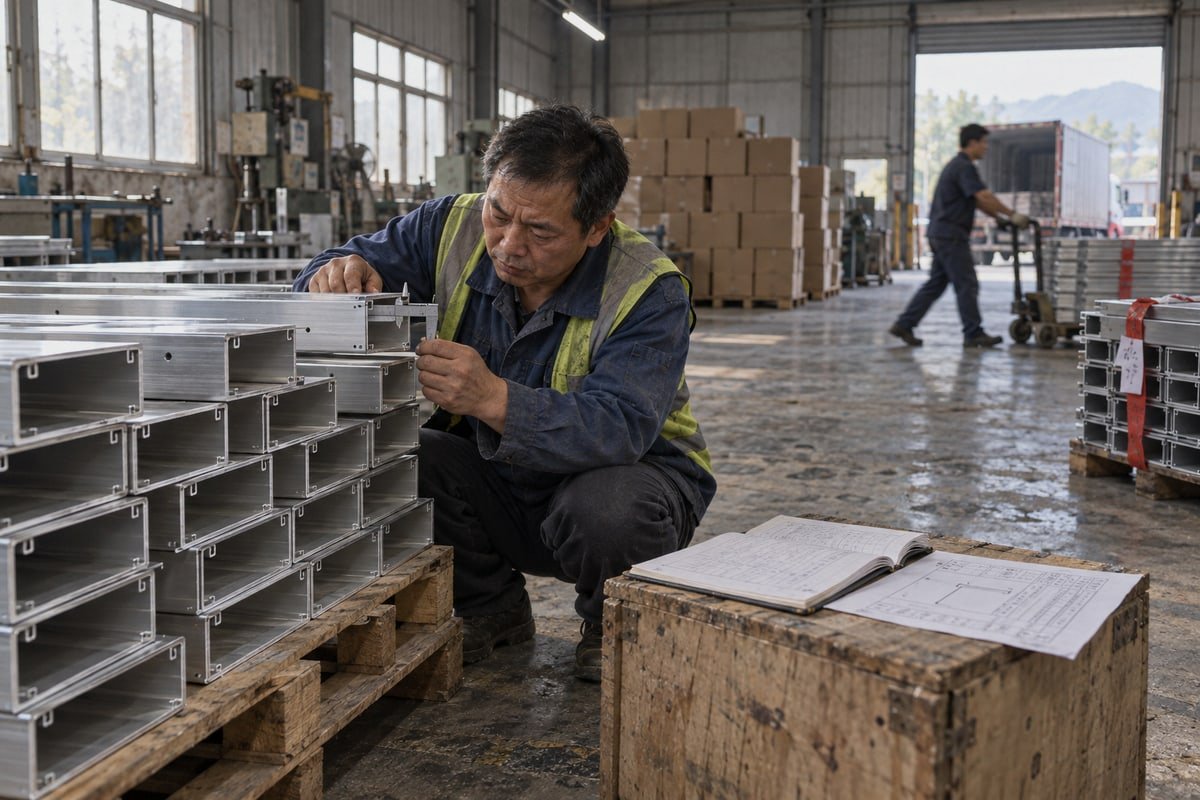
Last year a client’s rejected shipment taught me a hard lesson: picking the wrong aluminum alloy cable tray wastes months IEC 61537 certification 1. Our Tai’an production line now screens every alloy specification twice.
Choose an aluminum alloy cable tray by matching the alloy grade (6063-T6 or 6005-T5 for coastal sites) to your environment, verifying NEMA load classes against your support span, confirming salt-spray and certification documents, and selecting a supplier with proven QC and on-time delivery.
That short answer covers the framework. But each step hides real decisions. Below, I walk through the four questions I ask every buyer before we cut a single extrusion.
What aluminum alloy grade should I select for my cable tray project?
During a QC check on extruded profiles for a Philippines solar project, we caught a batch marked 6063 but tempered wrong. That near-miss shaped how I discuss alloy grades.
Select 6063-T6 aluminum for most general industrial and coastal projects. Use copper-free 5754 or 6005-T5 marine-grade alloys for offshore salt-spray zones. For fertilizer or organic-acid exposure, specify 6063-T14 over T8. Avoid aluminum entirely in high fire-rating or severe corrosive core areas.

The alloy grade is not a label. It defines how the tray behaves for the next twenty years. So the first thing I do with any new inquiry is map the environment to the alloy family.
Match the alloy to the environment
| Environment | Recommended alloy and temper | Key concern |
|---|---|---|
| Indoor, dry, controlled (data centers, clean rooms) | Mill-finish 6063-T6 aluminum | Cost efficiency, clean handling |
| Coastal or humid industrial | 6063-T6 or 6005-T5 | Salt-spray corrosion resistance 2 |
| Marine and offshore platforms | Copper-free 5754 (5XXX series) | Pitting, magnesium content limits |
| Fertilizer or organic-acid plants | 6063-T14 instead of T8 | Chemical attack on the oxide layer |
| High fire-rating or severe corrosive core zones | Do not use aluminum | Switch to a steel system |
The trade-off you are really making
Here is my honest view after years of supplying EPC projects. Choosing an aluminum alloy cable tray is a trade-off between lightweight plus corrosion resistance on one side, and fire performance plus heavy loading on the other. If your project is a coastal plant, a data center, a clean workshop, or a general industrial building with no high-grade fire requirement, aluminum gives excellent value. Once you enter a strong corrosive core area or a strict fire-protection zone, drop aluminum decisively. Never sacrifice system safety for lighter handling.
Special rules for offshore work
Marine grade applications add two extra rules. First, limit magnesium content in the alloy, because high-magnesium alloys behave badly under long salt exposure in hazardous zones. Second, watch the thermite sparking risk. When aluminum contacts rusty steel under impact, it can spark. That is why offshore specifications demand isolation material between aluminum trays and steel supports.
How do I determine the right load capacity and size for my aluminum cable tray?
Every quote I prepare involves the same trade-off: a lighter tray saves installation labor, but under-sizing the load rating risks sagging spans. Balancing both takes real calculation, not guesswork.
Calculate total cable weight plus a 20% future expansion allowance, keep the cable fill ratio around 30%, then match that load to the manufacturer’s NEMA load class table at your actual support span. Choose side rail height and width from the fill calculation, not guesswork.
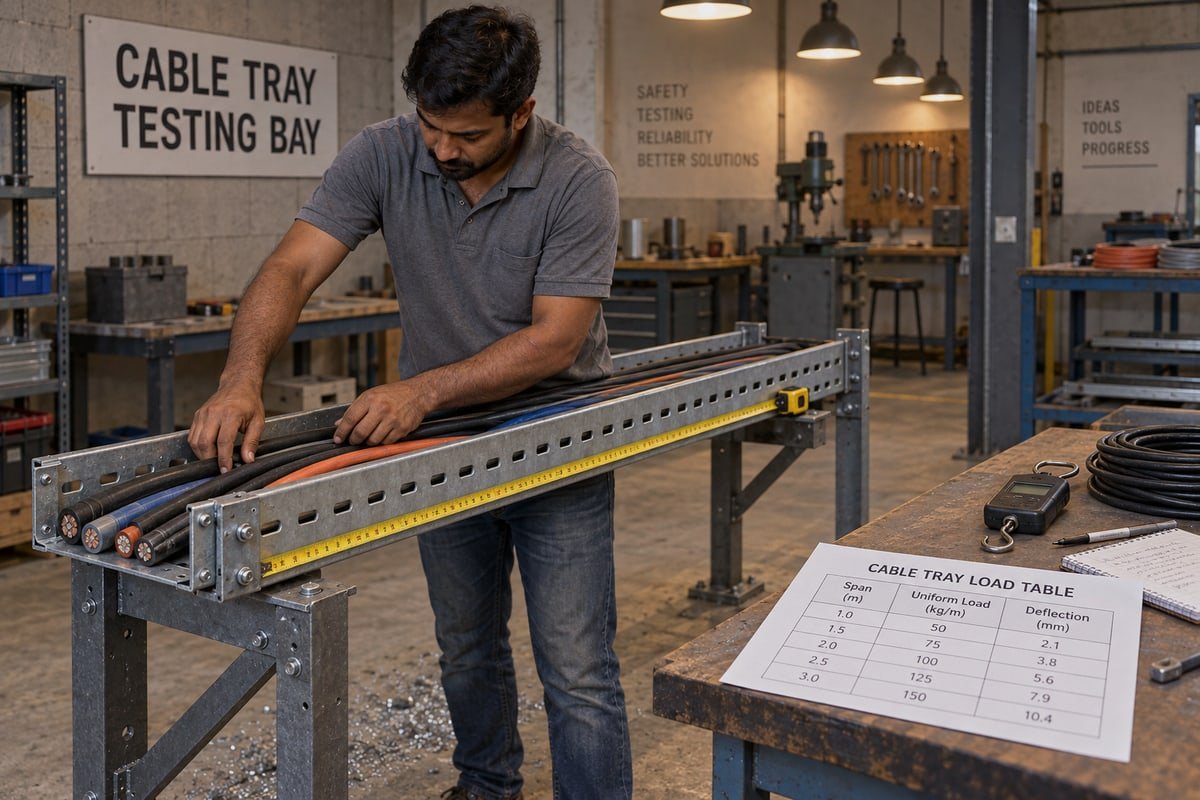
Sizing is where most buyers go wrong. They ask for a “heavy-duty 300mm tray” without knowing their span or cable mass. I always walk clients through a five-step process instead.
- Add up the cable weight. List every cable type, its weight per meter, and the run length. Then add a 20% contingency for future cable additions. Projects always grow.
- Apply the 30% fill rule. Keep the cable fill ratio 3 near 30% of the tray’s cross-section. This leaves room for airflow, keeps you within NEC fill limits, and makes future pulls easier. The fill calculation gives you your width and side rail height.
- Confirm the support span. This is the step people skip. The same tray carries very different loads at 1.5m, 2m, and 3m spans. Longer spans demand stronger side rails. Always read the load table at your real span, and check it against NEMA load classes rather than trusting generic “heavy-duty” claims.
- Pick the tray style. Style affects cooling, protection, and capacity.
- Plan for thermal expansion. Aluminum expands more than steel. Outdoor runs with wide temperature swings need expansion splice plates at calculated intervals, or the run will warp and stress the supports.
Tray style comparison
| Style | Best for | Ventilation | Mechanical protection |
|---|---|---|---|
| Ladder type tray | Heavy power cables, long runs | Excellent heat dissipation | Low |
| Perforated tray | Mixed power and control runs | Good | Medium |
| Solid-bottom tray | Sensitive data cables, dusty areas | Limited | High, better EMI shielding |
One more sizing advantage worth stating: aluminum trays run at roughly 50% the weight of comparable steel trays. That cuts labor hours and lets you use lighter support structures. Aluminum is also non-magnetic, which eliminates hysteresis and eddy current losses around high-voltage AC cables and reduces heat buildup.
How can I verify the corrosion resistance and quality of an aluminum alloy cable tray before ordering?
A Singapore project director once messaged me on WhatsApp: how do I know your tray survives our coastal air? Fair question. Here is exactly how we prove it.
Verify corrosion resistance by requesting salt-spray test reports, mill certificates confirming the alloy grade and temper, and IEC 61537 certification covering the exact tray series, load class, and environmental class. Inspect weld quality, wall thickness, and anodizing or finish samples before you place the order.

Paperwork protects you more than promises. Before our own shipments leave Tai’an, we assemble a document pack for every order, because buyers reselling into projects cannot afford a site rejection.
Documents you should demand
Ask for the mill certificate first. It confirms the actual alloy grade and temper, not just what the invoice says. Then request the salt-spray test report 4 from a named laboratory. Finally, check the IEC 61537 certificate carefully. The certificate scope must cover the specific tray series, the alloy, the load class, and the environmental class you are buying. A certificate for a different product line proves nothing. For air-handling spaces in North American projects, some installations also require UL 2043 or CSA listing, and structural performance should align with NEMA VE 1.
Physical checks that reveal quality
| Check item | What to request | Red flag |
|---|---|---|
| Alloy identity | Mill certificate with grade and temper | Vague “equivalent alloy” wording |
| Corrosion resistance | Salt-spray report with test hours | No laboratory name or date |
| Certification | IEC 61537 scope matching your series | Certificate for a different tray line |
| Surface finish | Anodized or mill-finish sample piece | Uneven or patchy oxide layer |
| Dimensions | Wall thickness and side rail measurements | Thickness below quoted specification |
Do not forget installation-side corrosion
Aluminum’s natural oxide layer handles most humidity and industrial pollutants well. But galvanic corrosion is a different threat. When an aluminum tray mounts on carbon steel supports or connects to copper grounding systems, use bi-metallic transitions or non-conductive isolation pads. Proper grounding and bonding still matters for safety, so specify compatible connectors rather than skipping the bond.
What should I look for in a supplier to avoid delivery delays and ensure proper customization?
Early in our export business, one delayed container cost a Thai contractor two weeks of site downtime. Since then, our team treats lead-time promises as contracts, not estimates.
Look for a supplier with documented lead times, in-house extrusion or verified material sourcing, pre-shipment QC reports with photos, OEM/ODM engineering support for custom widths and fittings, and experience shipping to your region. Confirm packaging standards and penalty terms for delivery delays in writing.

Delivery delays, quality control failures, and product returns are the three pains I hear most from EPC buyers and wholesalers. A good supplier attacks all three before the order is placed, not after the container ships.
Green flags versus red flags
| Area | Green flag | Red flag |
|---|---|---|
| Lead time | Written production schedule with milestones | Verbal “about 30 days” promises |
| Materials | Mill certificates traceable to each batch | No traceability on raw stock |
| Customization | Drawings reviewed by an engineer before quoting | Instant quotes for complex custom fittings |
| QC | Pre-shipment dimensional reports with photos | “Trust us, quality is good” |
| Logistics | Sea-freight packaging designed for soft aluminum | Trays loose-stacked without separators |
Why customization capability matters
Most projects need more than straight sections. Bends, tees, reducers, custom side rail heights, cover types, and hole patterns must all match the site drawings. When we run OEM and ODM development at LANYE CABLETRAY for clients in Singapore, Thailand, and South America, we start from the client’s layout drawings and confirm every fitting dimension before production. That single habit eliminates most returns, because the tray that arrives is the tray the site expected.
Test the supplier before the big order
My practical advice: place a small trial order first. Judge the supplier on three things. Did the documents arrive complete? Did the QC photos match the delivered goods? Did the container leave on the promised date? A supplier who passes a small test under no pressure usually performs under real pressure too. Also confirm packaging in writing. Aluminum dents more easily than steel, so proper edge protection and layer separation during sea freight directly reduce return claims.
Conclusion
Choosing an aluminum alloy cable tray means matching alloy, load class, and supplier discipline to your environment. Get those right and your cable management system protects the project for decades.
Footnotes
- The IEC is the international body responsible for the IEC 61537 cable tray standard. ↩︎
- Authoritative Wikipedia section explaining the protective oxide layer and corrosion resistance mechanisms of aluminum alloys. ↩︎
- NEMA provides the primary industry standards for cable tray fill and load calculations. ↩︎
- ISO 9227 is the global standard for salt spray testing to evaluate corrosion resistance. ↩︎