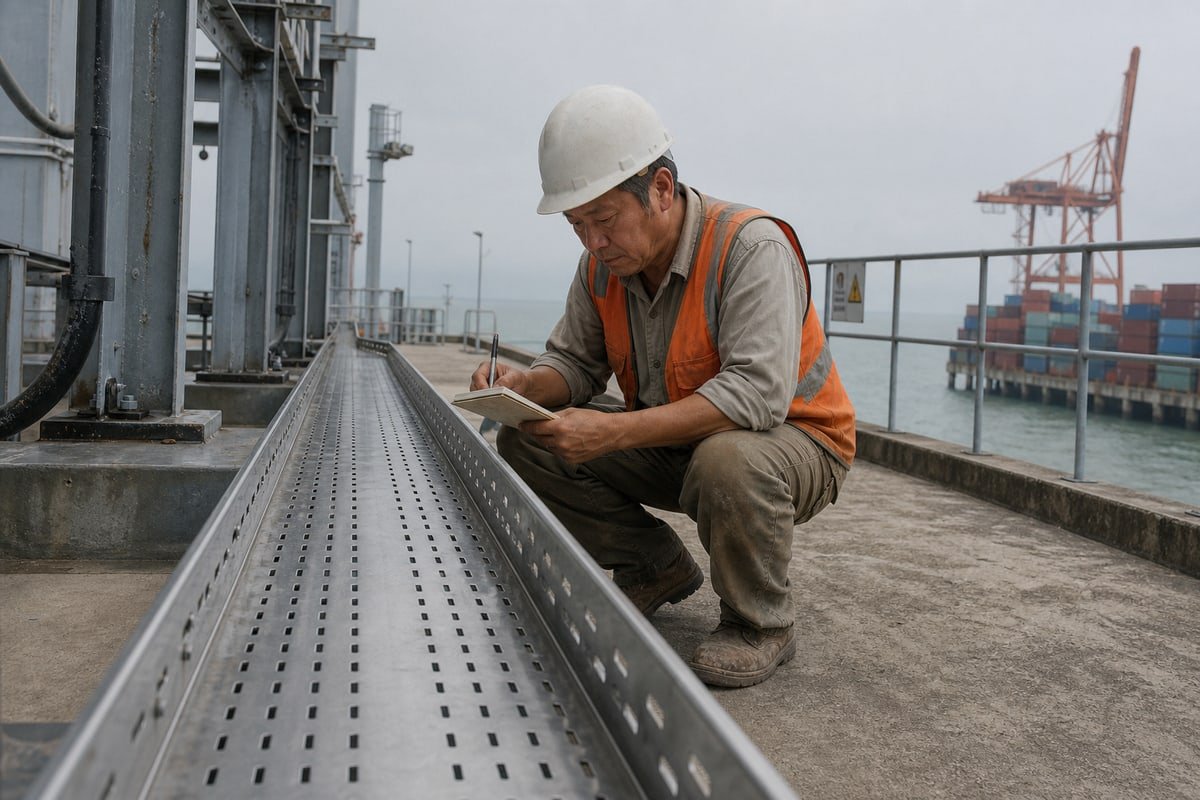
Salt spray destroys galvanized cable trays fast. I have watched coastal projects replace corroded runs in two years. So our Tai’an workshop builds the stainless steel 316 perforated cable tray.
A stainless steel 316 perforated cable tray is a U-shaped cable management system made from marine grade stainless steel containing 2–3% molybdenum. Its punched base holes provide ventilation, drainage, and tie-off points, while the 316 alloy resists chloride pitting in coastal, offshore, and chemical environments.
That short definition covers a lot of ground. Below, I break down the alloy, the perforation design, the best installation environments, and how to judge suppliers. Each section answers one practical question you will face when specifying this product.
How does 316 stainless steel differ from 304 in perforated cable tray performance?
A project director in Singapore once asked me why our 316 quote was nearly double the 304 price. We walked through his jetty drawings together, and the answer became obvious.
Grade 316 adds 2–3% molybdenum, raising its pitting resistance equivalent number (PREN) to 24–26, well above 304. In perforated trays, this protects punched hole edges and cut ends from chloride pitting caused by seawater splash, salt fog, and de-icing salts, where 304 corrodes first.

The SS304 vs SS316 debate comes up in almost every quotation I prepare. So let me lay out the real differences in plain terms.
The Chemistry Behind the Gap
Grade 304 contains chromium and nickel but no deliberate molybdenum. Grade 316 adds that 2–3% molybdenum content 1 on purpose. Molybdenum stabilizes the passive oxide layer against chloride attack. That is why 316 reaches a PREN of 24–26, while 304 sits noticeably lower. In practice, this means 316 shrugs off seawater splash, high salt fog, and de-icing salt exposure for years.
| Factor | SS304 | SS316 |
|---|---|---|
| Molybdenum content | None added | 2–3% |
| PREN value | Lower, chloride-sensitive | 24–26 |
| Seawater splash tolerance | Pits over time | Long-term resistance |
| Chlorine sanitizer washdown | Risk of stress-corrosion cracking | Compatible |
| Relative cost | Lower | Highest among common grades |
| Best fit | Dry indoor, inland plants | Coastal, offshore, chemical zones |
Why Perforated Geometry Magnifies the Difference
Here is the detail many buyers miss. Punching hundreds of holes exposes fresh, bare metal at every slot edge. Those edges and cut ends are exactly where pitting and crevice corrosion 2 start first. A perforated tray in 304 gives corrosion hundreds of starting points. A 316 tray blocks pitting at the source, right where the geometry is weakest.
When 304 Still Makes Sense
I will be honest with buyers here. For dry indoor commercial buildings far from the coast, 304 is often sufficient and saves money. But if your facility uses chlorine or bromine-based cleaning agents, 304 can suffer rapid stress-corrosion cracking. In those cases, 316 is not a luxury. It is the minimum safe specification.
What perforation patterns and sizes should I choose for my cable tray project?
Our punching dies get inspected before every 316 production run, because a worn die leaves rough slot edges. Rough edges collect chlorides and scratch cable jackets during pulls.
Choose standardized oblong slot patterns for most projects; they accept cable ties, support drainage, and keep airflow steady. Match tray width (50–1200 mm), rail height (25–300 mm), and thickness (0.5–3.0 mm) to your cable fill, load bearing capacity, and span requirements.
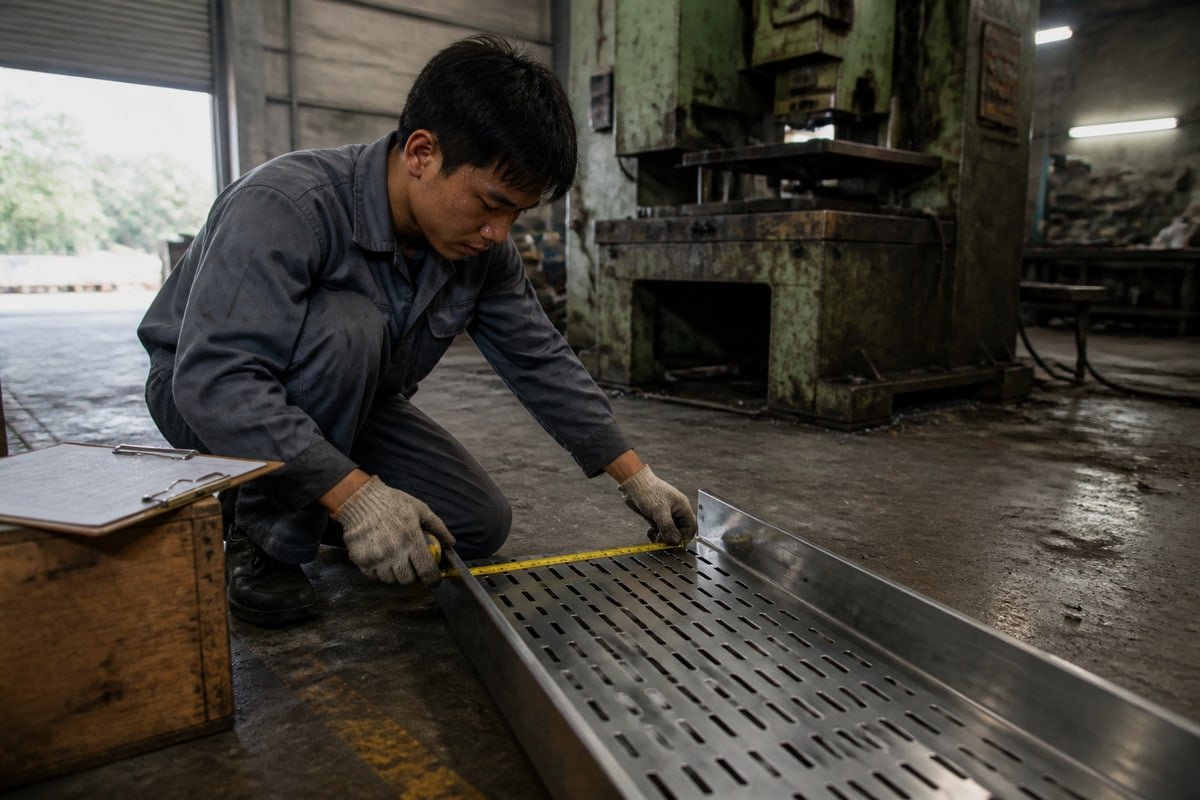
Pattern choice sounds cosmetic. It is not. The perforation layout controls airflow, drainage speed, tie-off flexibility, and residual strength of the base plate. Let me break down the main options.
Common Perforation Patterns
| Pattern | Strengths | Watch Out For |
|---|---|---|
| Oblong slots in parallel rows | Easy cable-tie fixing, fast drainage, industry standard | Slot direction should run along the tray length |
| Round holes | Slightly stronger base retention | Harder to thread wide cable ties |
| Louvered or embossed openings | Directs airflow, hides cables from view below | More complex tooling, higher cost |
Oblong slots win most projects. The standardized hole pattern simplifies installation because ties, clamps, and cable tray accessories drop into place without drilling. That is one reason a ventilated cable tray with slotted perforations remains the default in industrial cable routing worldwide.
Sizing the Tray Correctly
| Dimension | Common Range | Selection Driver |
|---|---|---|
| Width | 50–1200 mm | Cable quantity and fill ratio |
| Side rail height | 25–300 mm | Cable stacking depth and containment |
| Sheet thickness | 0.5–3.0 mm | Load bearing capacity and support span |
| Standard length | 2000–6000 mm, custom available | Support spacing and shipping limits |
There is no single universal size. Exact dimensions depend on cable load, support span, and installation constraints. My rule of thumb: size the width for your planned cables plus growth room, then pick thickness to match the span between supports. A thicker sheet lets you widen support spacing, which often saves more money than a thinner tray does. Also remember the open base helps dissipate heat, which maintains cable ampacity better than an enclosed trunking design ever could.
Where are stainless steel 316 perforated cable trays best suited for installation?
Every quotation forces a choice between protection, airflow, and budget. When chloride exposure enters the picture, I stop debating and point buyers toward environments where this tray earns its cost.
Stainless steel 316 perforated cable trays suit offshore platforms, FPSO vessels, ships, coastal chemical and electroplating plants, and washdown clean rooms using chlorine-based sanitizers. They fit anywhere combining high chloride exposure with cables that need moderate heat dissipation, drainage, and solid support.
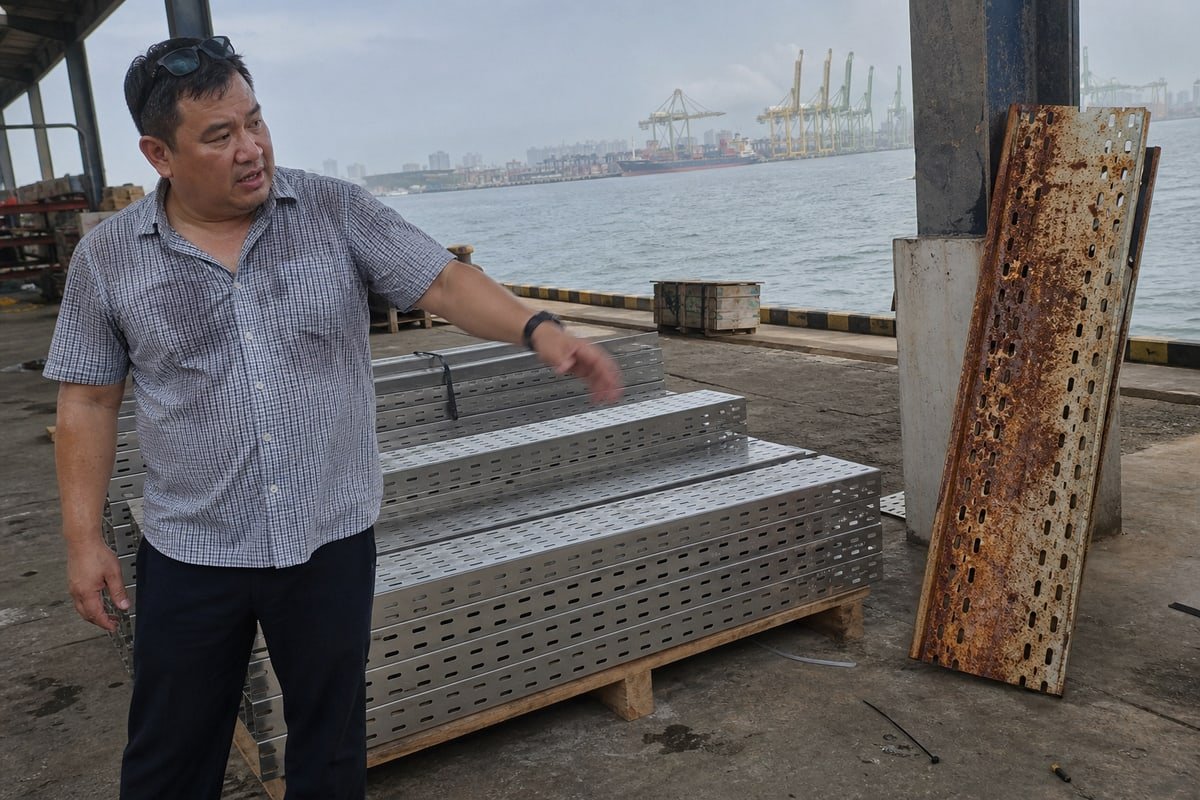
The application map for this product is very precise. It almost always points to one combination: extreme chloride environments plus cables that need balanced heat dissipation, load support, and drainage.
Environment-by-Environment Breakdown
| Environment | Typical Circuits | Why 316 Perforated Fits |
|---|---|---|
| Offshore platforms, FPSO units, ships | Auxiliary power, lighting, control cables | Resists seawater splash; slots drain washdown water fast |
| Coastal chemical and electroplating plants | Small power and control lines | Handles salt fog plus chemical vapor together |
| Coastal pharma and food clean rooms | Equipment supply and control wiring | Survives frequent chlorine sanitizer washdowns; smooth surface resists biofilm adhesion |
| Water treatment facilities | Dosing and instrumentation circuits | Constant humidity and chlorine exposure |
Drainage deserves special emphasis. In washdown areas, the slots let rinse water escape immediately. Standing water concentrates chloride ions as it evaporates, and that concentration is what triggers pitting. Fast drainage removes the risk before it starts. The alloy also stays stable across extreme temperatures, from cold storage to hot refinery zones, though in fluctuating high-heat areas I always recommend expansion joints 3, since 316 expands slightly more with heat than carbon steel. In seismic regions, the ductile austenitic structure of 316 bends rather than snaps, which protects cable containment during earthquake cycles.
Where It Is Not the Best Fit
This tray cannot seal out dust and water completely. Precision signal cables demanding full enclosure belong in trunking. And cables needing maximum cooling do better on ladder or wire mesh trays. That said, the continuous base gives useful physical support, blocks small animals from below, and offers modest EMI screening that open designs lack.
How do I evaluate quality and customization options when sourcing these trays from a supplier?
Years of shipping container loads to Singapore and the Philippines taught me one hard lesson: a mill certificate means little without verification at the finished tray.
Verify the alloy with PMI or spectrometer testing, inspect slot edges for burrs, check weld and bend quality, and confirm load ratings against NEMA standards. Then review customization scope—widths, heights, thickness, fittings—plus documented QC steps, packing methods, and realistic delivery lead times.
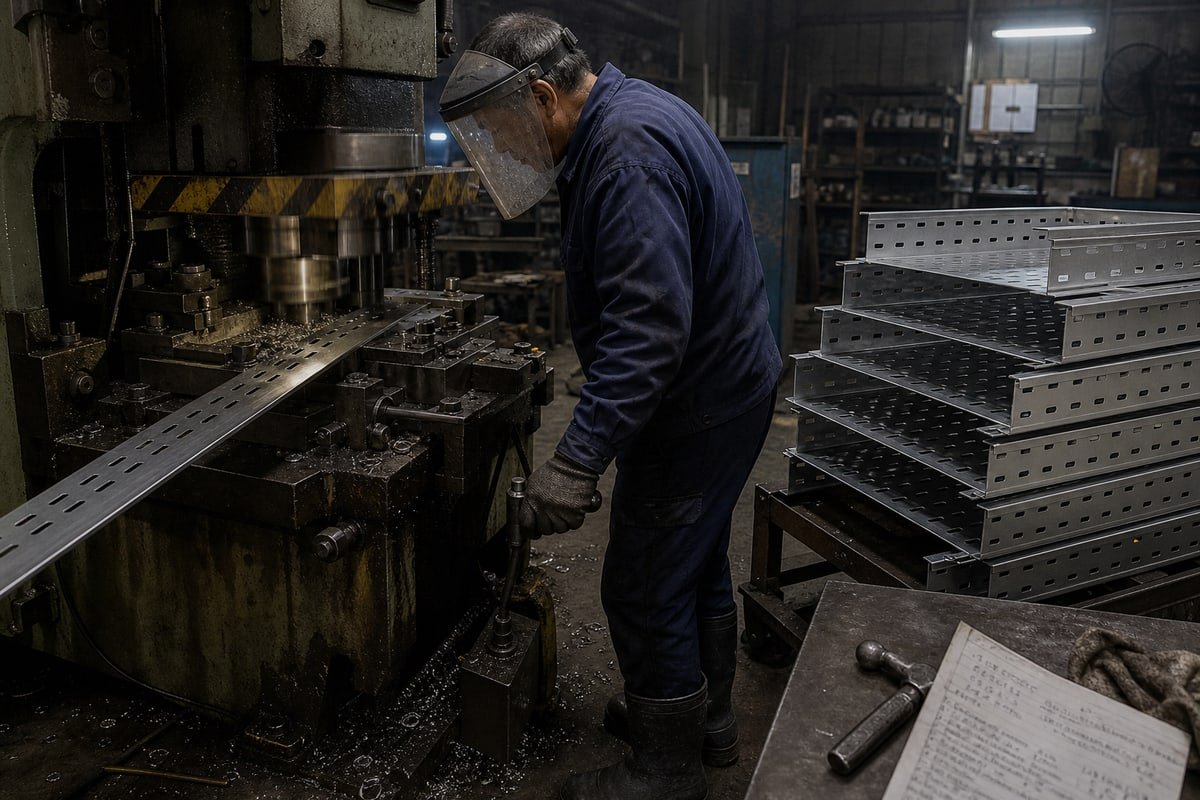
Sourcing 316 trays carries higher stakes than sourcing galvanized product. The material premium is large, so a substitution or a fabrication defect costs you real money. Here is the evaluation sequence I recommend to every EPC buyer, based on how we run our own checks at LANYE CABLETRAY.
A Six-Step Evaluation Checklist
- Confirm the alloy first. Ask for PMI or spectrometer test results on finished trays, not just raw sheet certificates. A mixed batch with 304 sections will fail on site, and you will not see it until corrosion appears.
- Inspect the slot edges. Run a finger along the perforations on a sample. Burrs signal worn tooling. Rough edges damage cable jackets and become corrosion initiation points.
- Check welds and bends. Weld zones on stainless need post-weld cleaning or passivation. Discolored, untreated welds corrode first, even on genuine 316.
- Verify structural claims. Marketing pages love words like strong and dustproof. Ask instead for load-span data referenced to NEMA standards 4 classes, so load bearing capacity is a number, not an adjective.
- Map the customization scope. A capable partner should offer widths from 50 to 1200 mm, rail heights to 300 mm, and matched cable tray accessories: bends, tees, reducers, covers, and hold-down clamps. Our team develops OEM drawings with clients before tooling starts, which prevents fit problems later.
- Lock down QC evidence and logistics. We photograph every batch before sea-freight packing and interleave trays with film to prevent scratching. Insist on the same. Then agree on a realistic lead time in writing, because a cheap quote with a missed delivery date costs a project far more than the price difference.
Follow this sequence and the common pain points—delays, quality surprises, and returns—largely disappear.
Conclusion
Chlorides never rest, and neither should your specification. A stainless steel 316 perforated cable tray balances corrosion resistance, drainage, and support. Contact me at LANYE CABLETRAY to discuss your project.
Footnotes
- Authoritative global resource for stainless steel grades and their chemical compositions. ↩︎
- Technical guide explaining the mechanisms of pitting and crevice corrosion in stainless steel. ↩︎
- Overview of mechanical components used to manage thermal expansion in industrial structures. ↩︎
- Official organization establishing technical standards for electrical equipment and cable management systems. ↩︎